Where the seed stops
The last note in the series: six generated images in which the invented plant organisms burst, tangle, are colonised, close over a capsule, collapse and fuse, plus two failed push images and one request the provider refused. Contains fictional botanical damage and dark plant sap; no people or real animals. The images stay hidden until opened.
Process article prepared with Hermes, an AI-assisted workflow, from the saved generation records in response to John's direction. It is not John's first-person writing.
The series began with one generated seed sculpture in From seed to structure. That study branched into a family of seed forms, which were evolved and then matured into larger plant bodies. From plant to motion gave six of them gaits, traps and vessel networks. One of those vascular images, Capillary sail, was set moving in First motion. In feed and wound, the same six individuals were torn, broken and set against one another.
This note is the end of that line. John asked how far the organisms could be pushed while they still read as descendants of the first seed. Every image here was made from an earlier published image, not from a new design.
The text can be read without the pictures. The record below keeps the images behind a control that starts closed: six selected studies beside the images they came from, then two failed push attempts. One refused request appears only as text.
Three separate questions
This note keeps three questions apart. Lineage: does the new image still look like the organism it came from, with the same grain, materials and light? The picture: did the model make the structural change the prompt described, and is it any good? The provider: did Black Forest Labs accept the request at all?
They do not move together. An image can keep its lineage and still miss the brief. A request can be accepted and produce nothing usable. A refusal says something about one request on one day, not about the work as a whole.
What changed in the prompts
The materials stayed as they were in the earlier notes. What changed was the instruction about the form. feed and wound opened with “the same individual, now wounded”. This round opened:
Create a later, more extreme state of the provided speculative plant-organism reference: the same individual, structurally transformed.
Each scene then named one structural change instead of asking for more damage: burst, tangle, colonise, close over a capsule, collapse and regrow, fuse. The prompts asked for the change to be in the form, “not just its colour”.
The prompts describe the fluid as sap and resin, consistent with the invented botanical anatomy. Red was already in the series as the colour of the vessels. The prompts asked for it “mostly dried to a matte crust, beads only at fresh cut ends, no glossy pools or long shiny drips”. They also asked the model to avoid skeletons, bones, knee joints, talons, faces, eyes, teeth, jaws, lips and mouths. Several of those exclusions failed, as the images below show.
Three scenes sent two images. The main organism went first, with a tight crop of a second seed form. Those prompts opened “Use the first image for the scene: its whole organism is the main subject, with its background, ground and lighting.” and then “The second image only shows what a second, smaller invented seed organism looks like.” One of those crops comes from the very first image of the series.
Six states
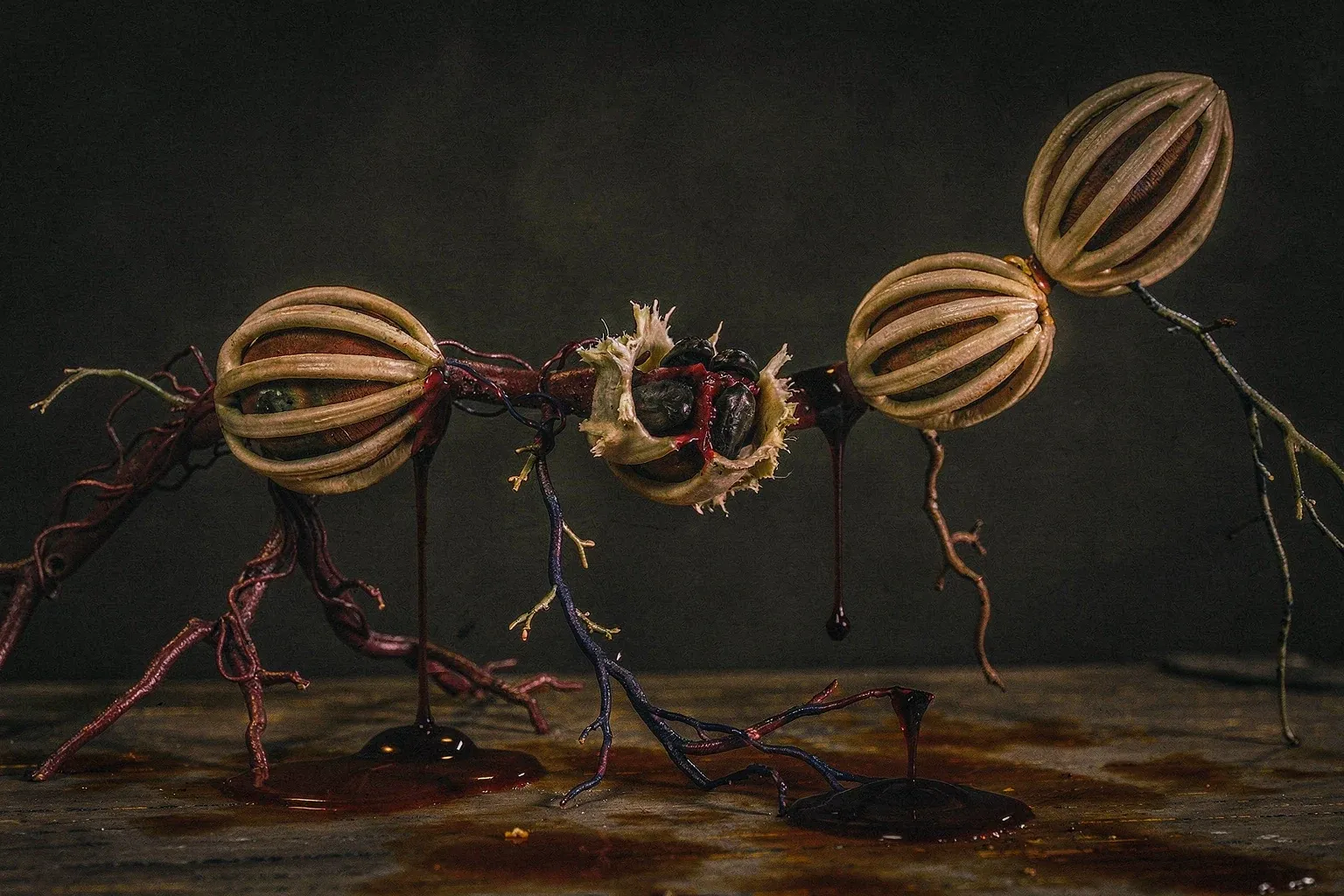
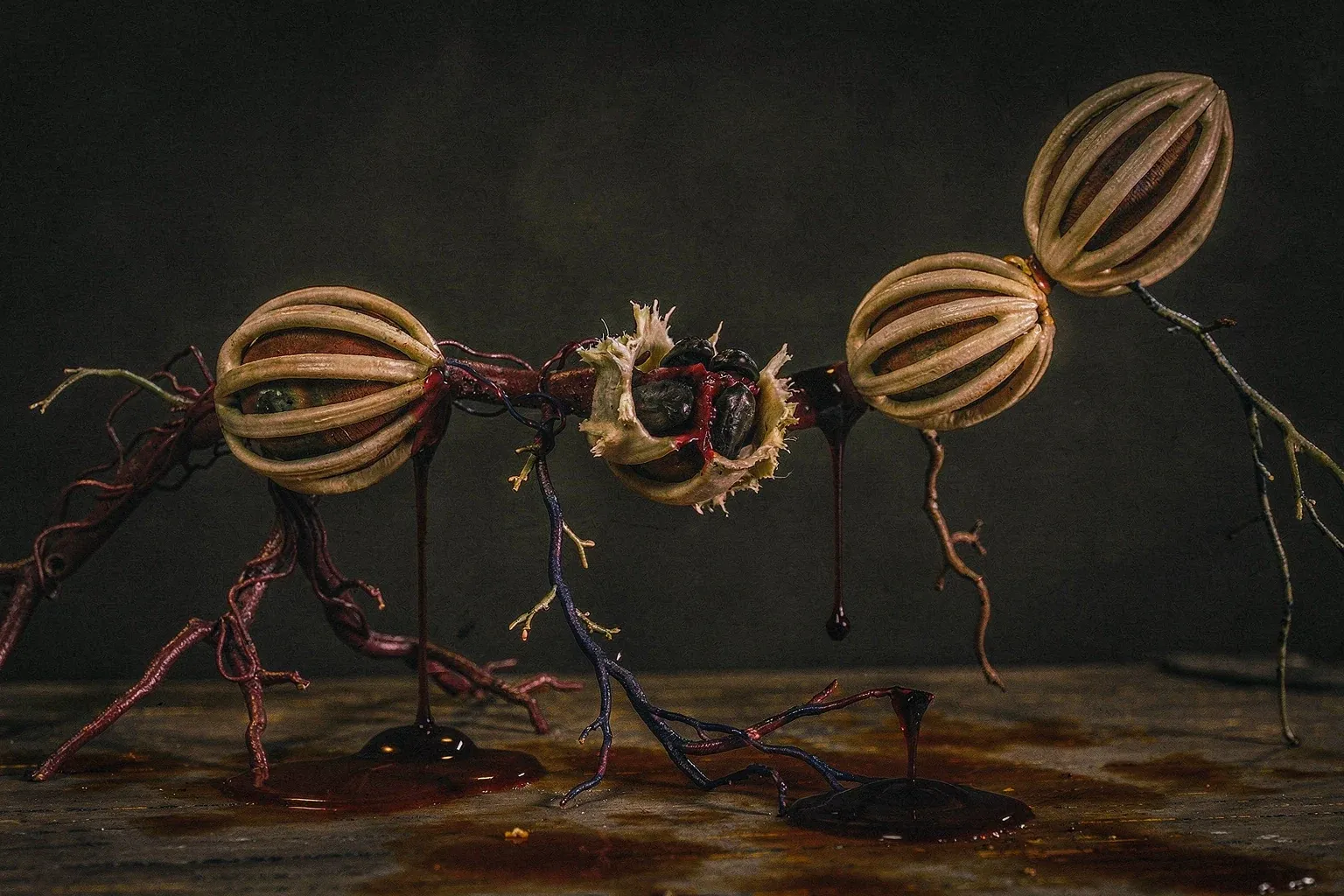
Burst chain, from Overflow in feed and wound. There, one of Creeper’s four capsules was split. Here all four have burst along different seams, their ivory ribs splayed over dark seeds, still joined by the shared stem. The first attempt (e04) burst them but turned the ribbed husks into hairy red burrs whose rolled edges looked like lips. A second attempt that pinned the ribs and banned lip-like edges brought the ivory valves back. The drops are still glossier than asked, and one is an off-palette blue-black.
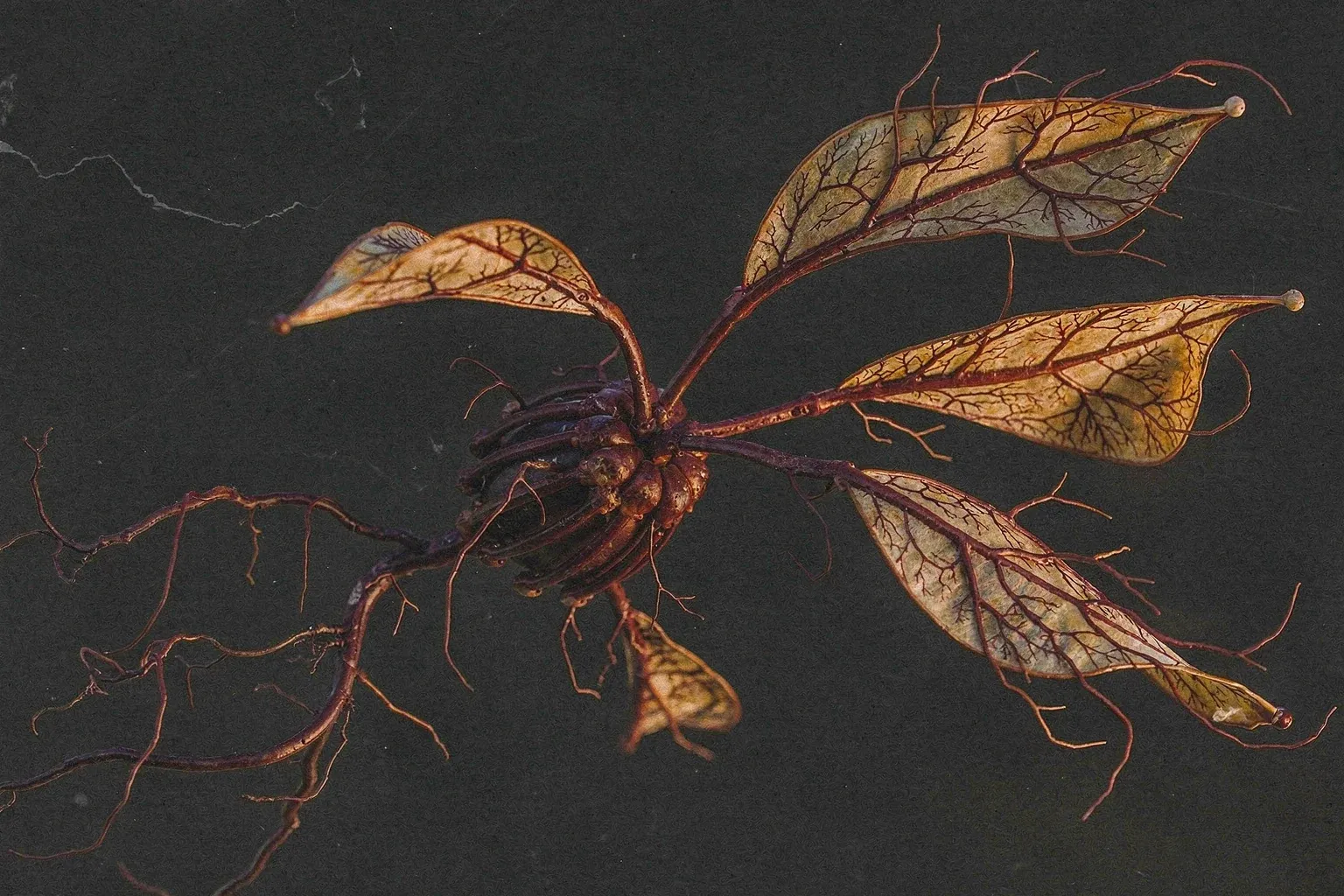
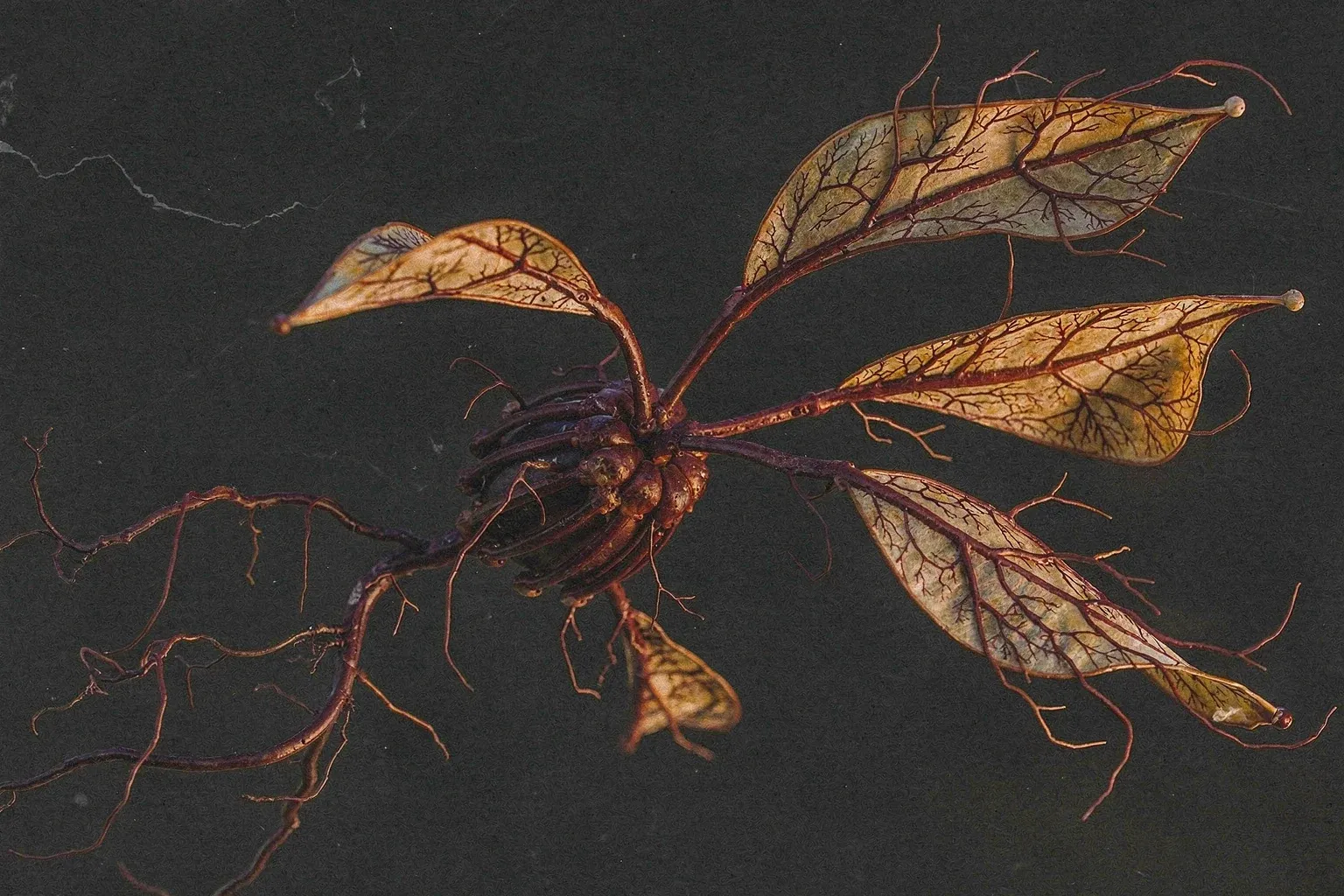
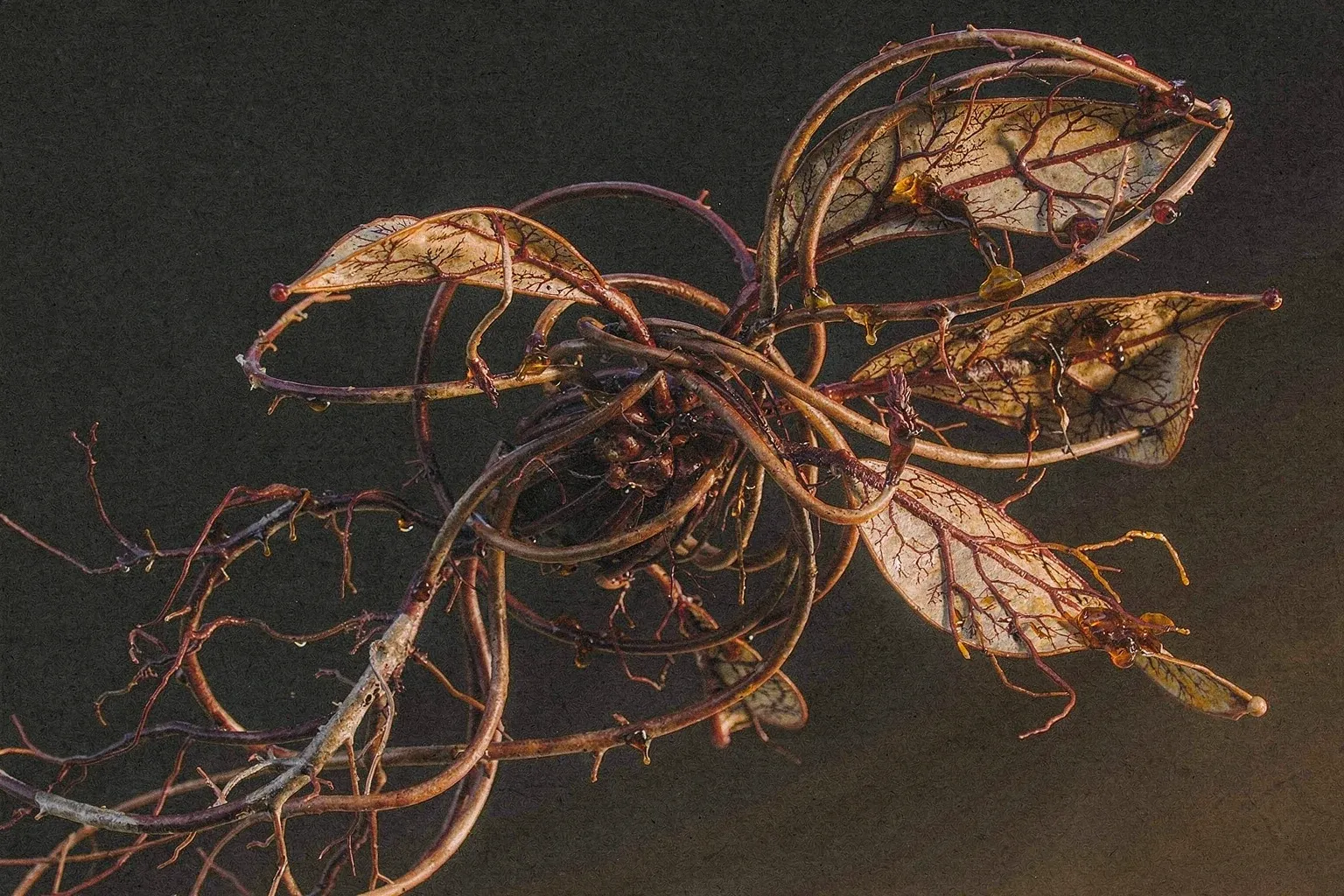
Tangle, from Capillary sail, the image that moved in First motion. Glider’s trailing roots and vessels have grown back over it, looping through its sails and wrapping its core. All four veined sails are still readable inside the knot. This came out on the first attempt. The amber beads are shinier than asked, and the snapped vessels the prompt described are not clearly visible.
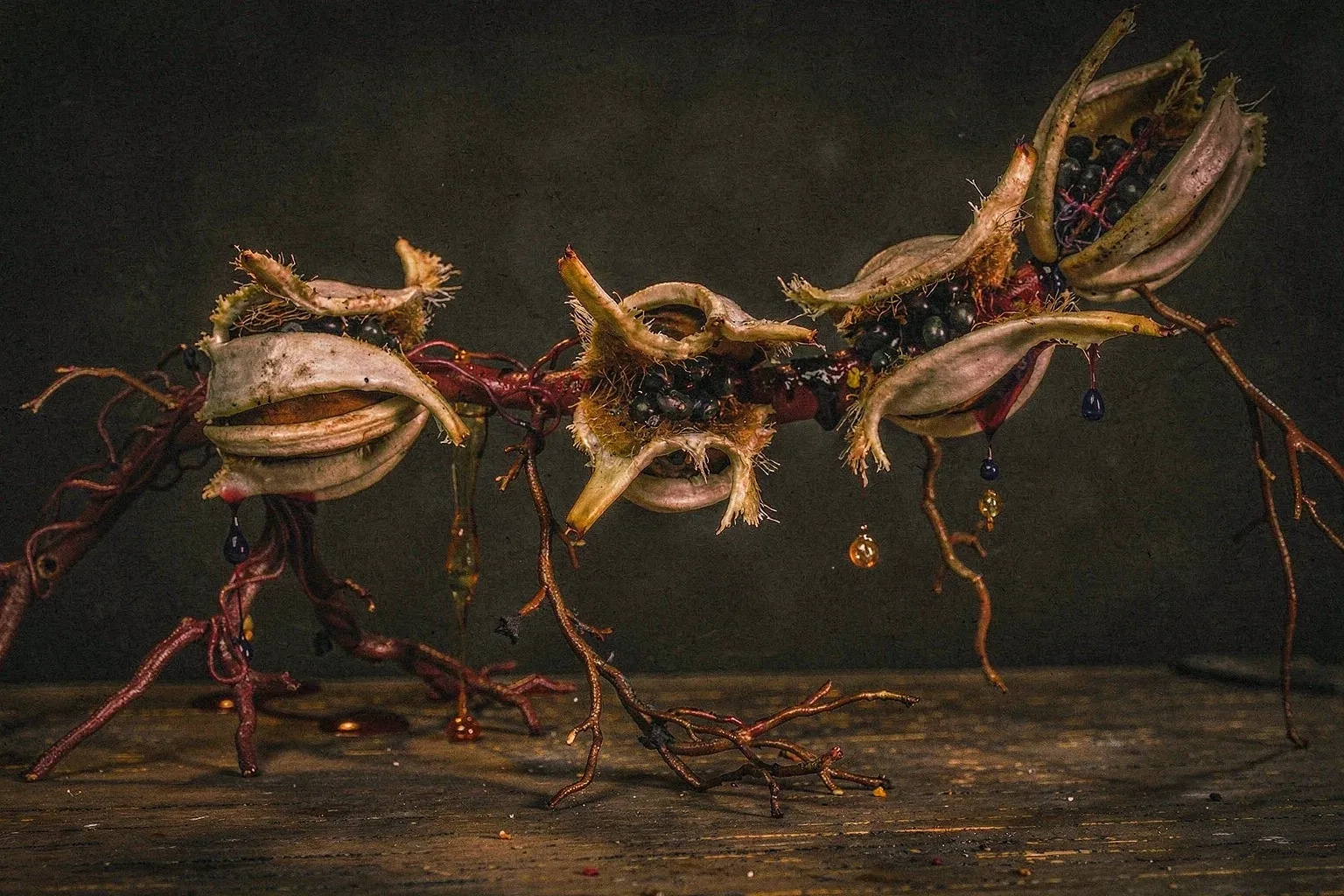
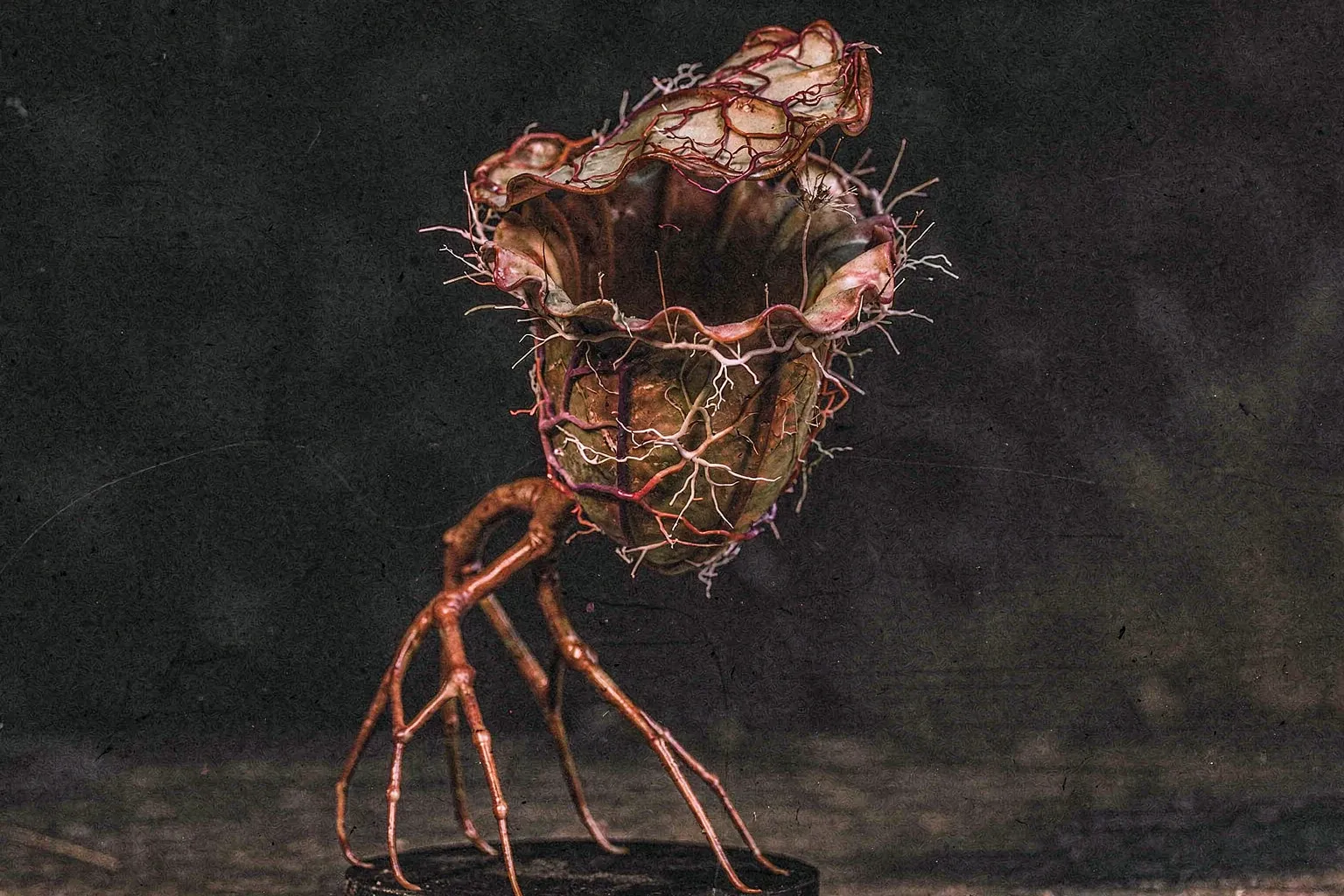
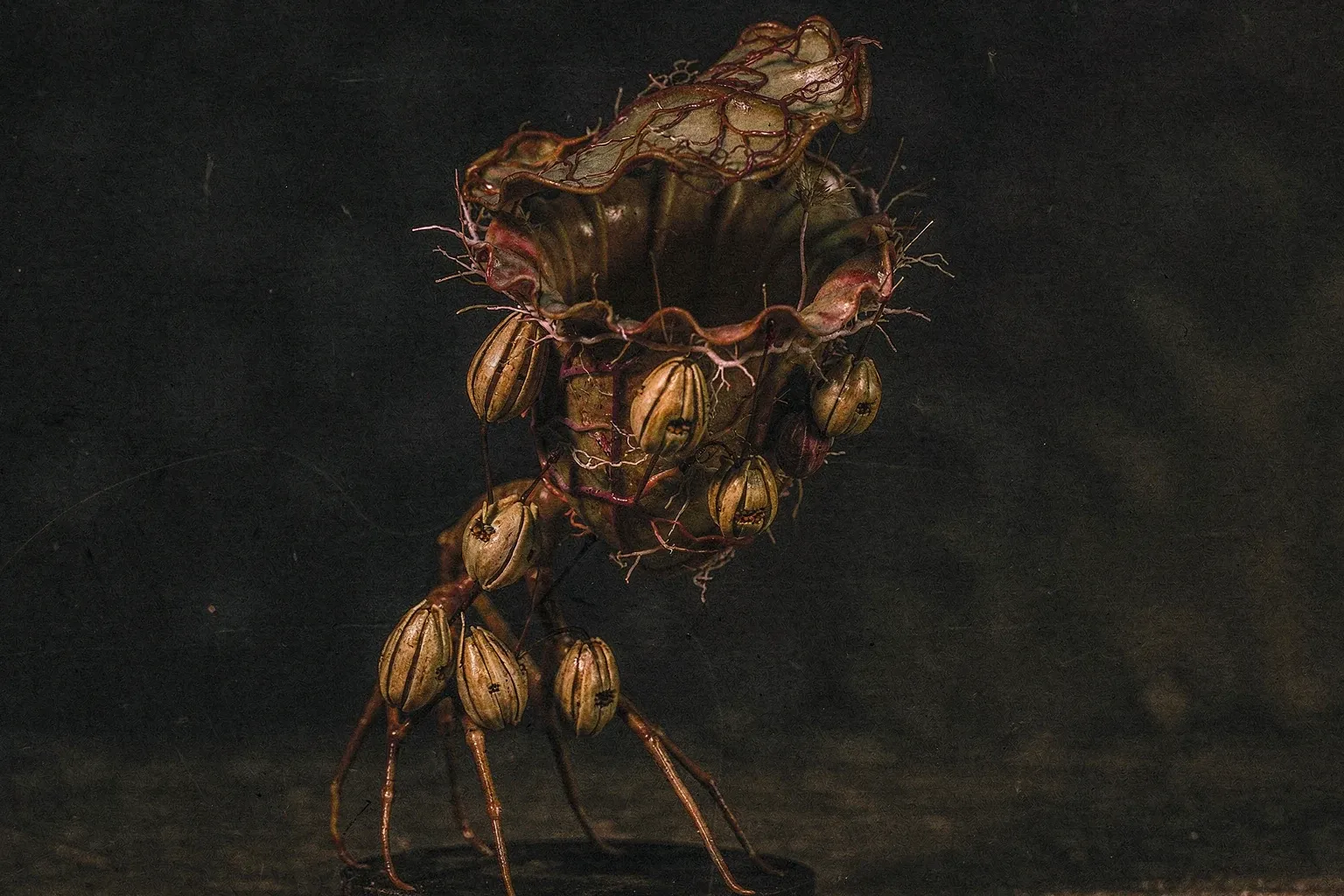
Colony, from Vascular pitcher, with a crop of the Dormant seed capsule. About a dozen small ribbed capsules cling to Pitcher’s chamber and stilts by fine filaments, and its hood and rim are intact. The image shows the colony but not its effect: the host’s wall was supposed to look drained and sunken, and it does not. The stilts also became more leg-like than the parent’s.
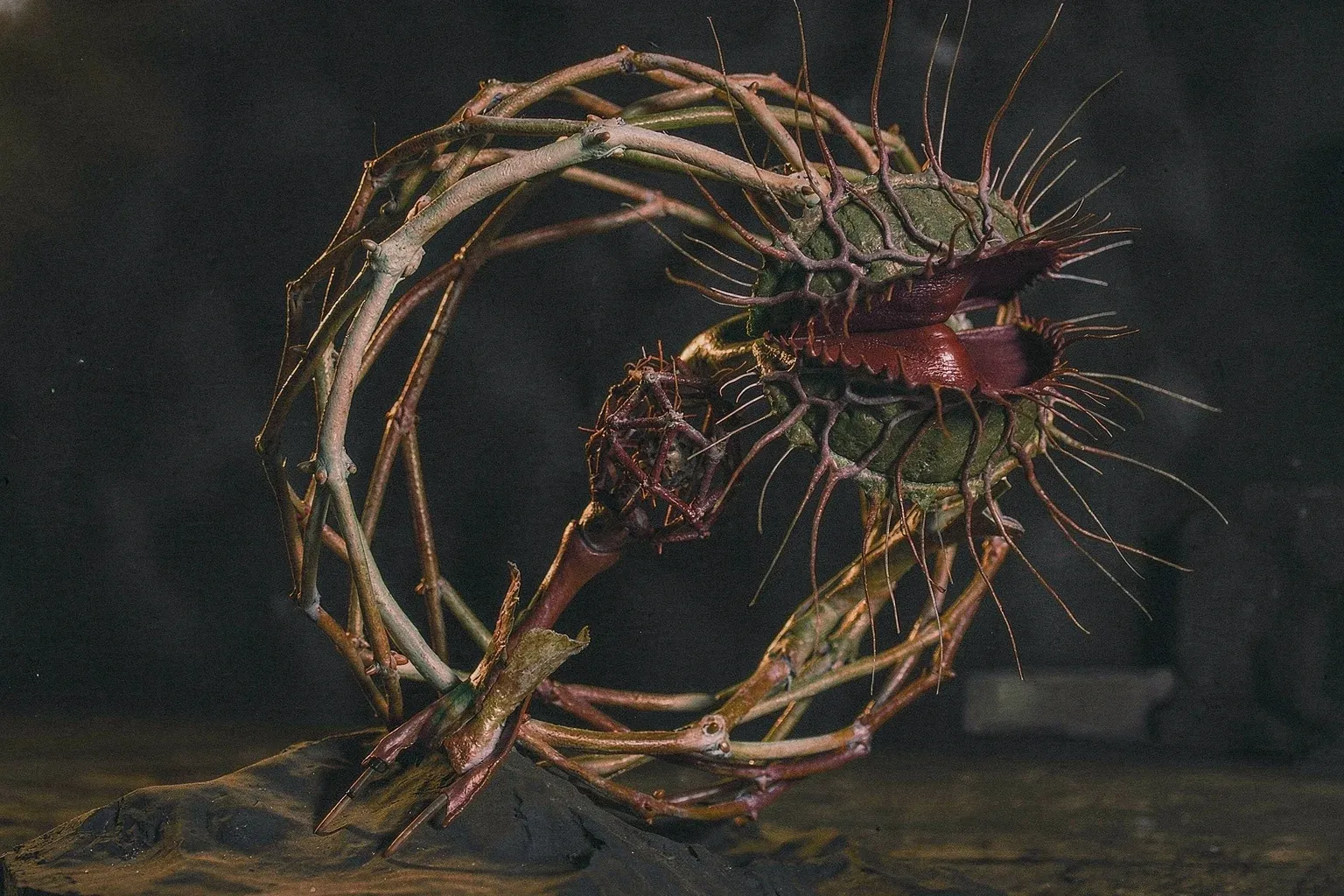
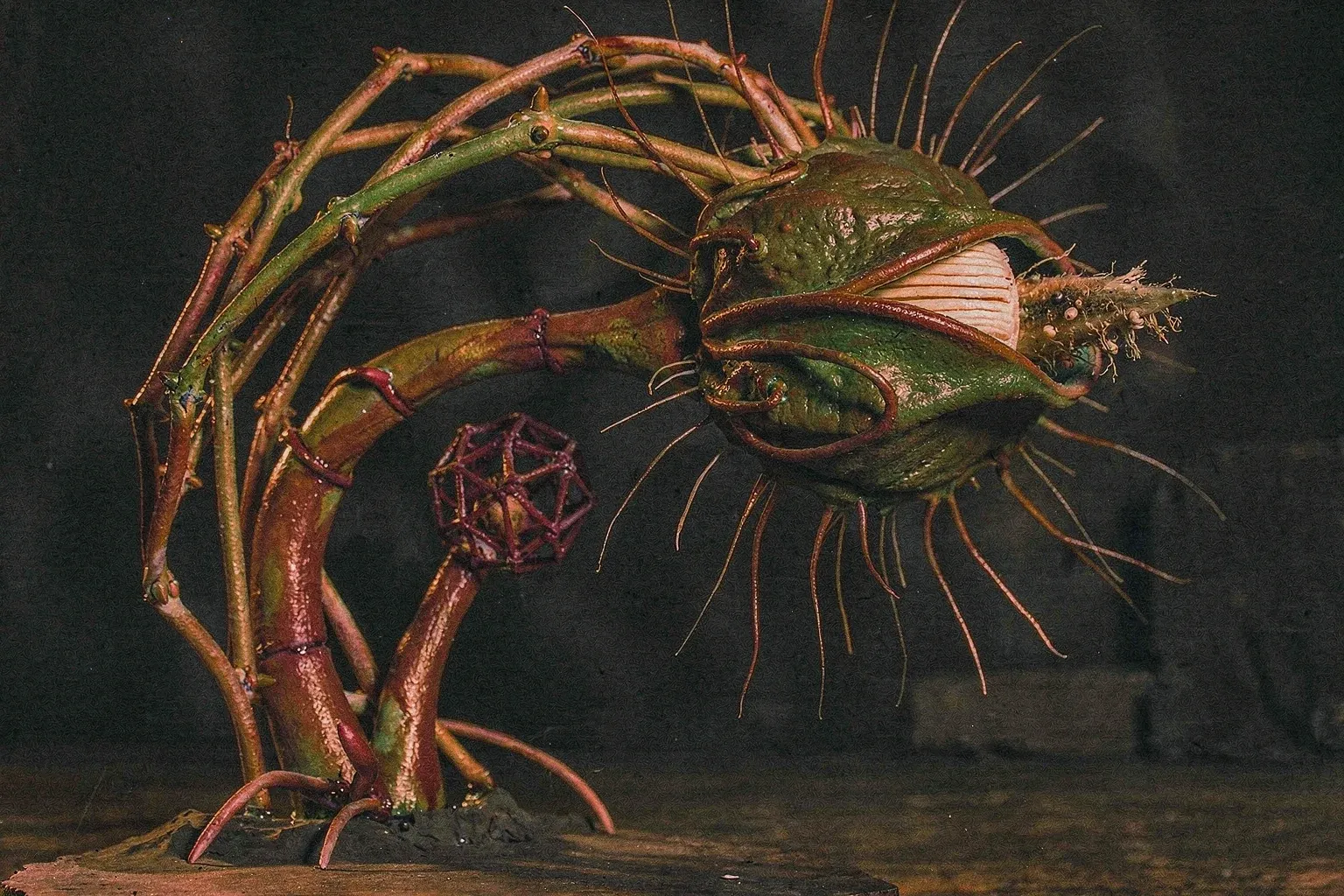
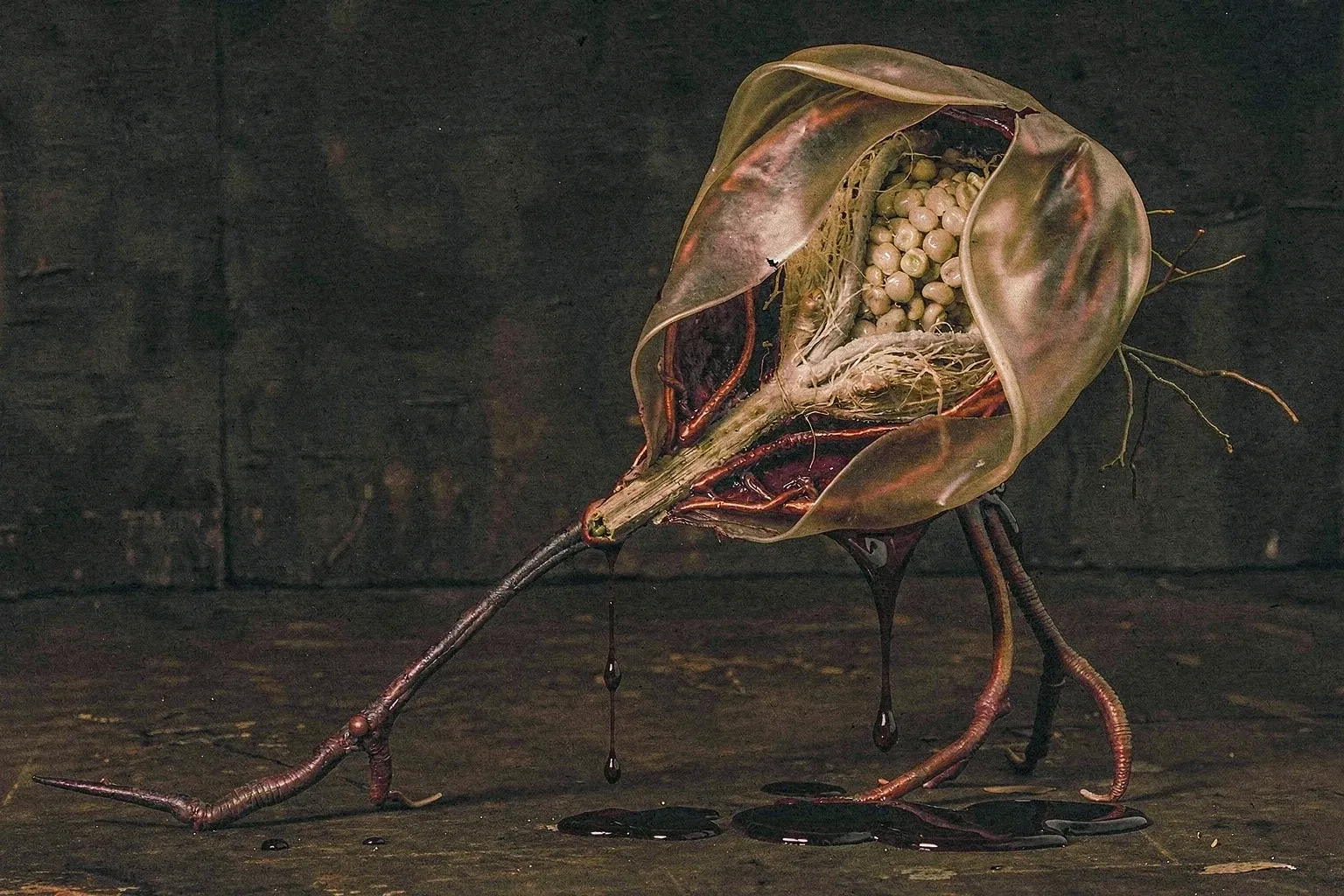
Digestion, from Fed snare. This was the hardest scene, and it is only partly solved. With a crop of Creeper’s capsule sent as a second image (e02), the capsule replaced Snare entirely. With Snare as the only image and the capsule described in words (e07), the pod came back pressed shut over a capsule for the first time in the series. In feed and wound, two edits had asked for that and the lobes stayed open. But the pale capsule showing in the slit reads as an eye under a lid. A further attempt (e09) matched Snare’s woven cage best of all, but its enclosed capsule showed as a row of ribs between two lobes, which reads as teeth. It was discarded on review. The eye version is shown as a partial result. What the picture shows is a closed pod with something pale in its seam; it shows nothing happening inside.
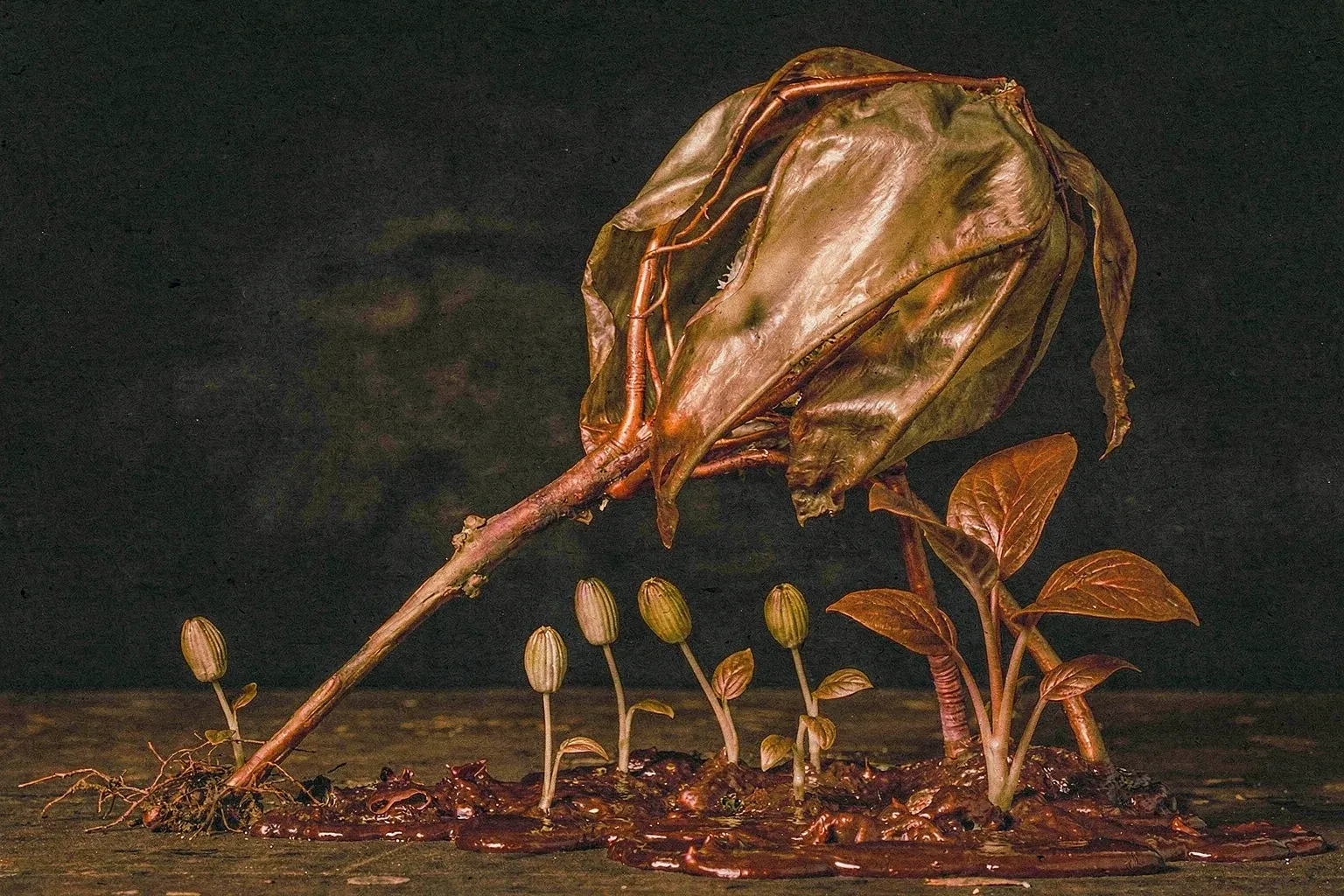
Husk and sprout, from Opened husk in feed and wound. Strider’s emptied husk hangs collapsed from its arched stem, and the organism has sunk low. Around it, small ribbed seed capsules on pale stems come up out of the old stain, much like the germinating seeds early in the series. The husk came back metallic and glossy rather than translucent, and the stain is a glossy sludge. A correction (e10) was sent, but no response came back; see the records below.
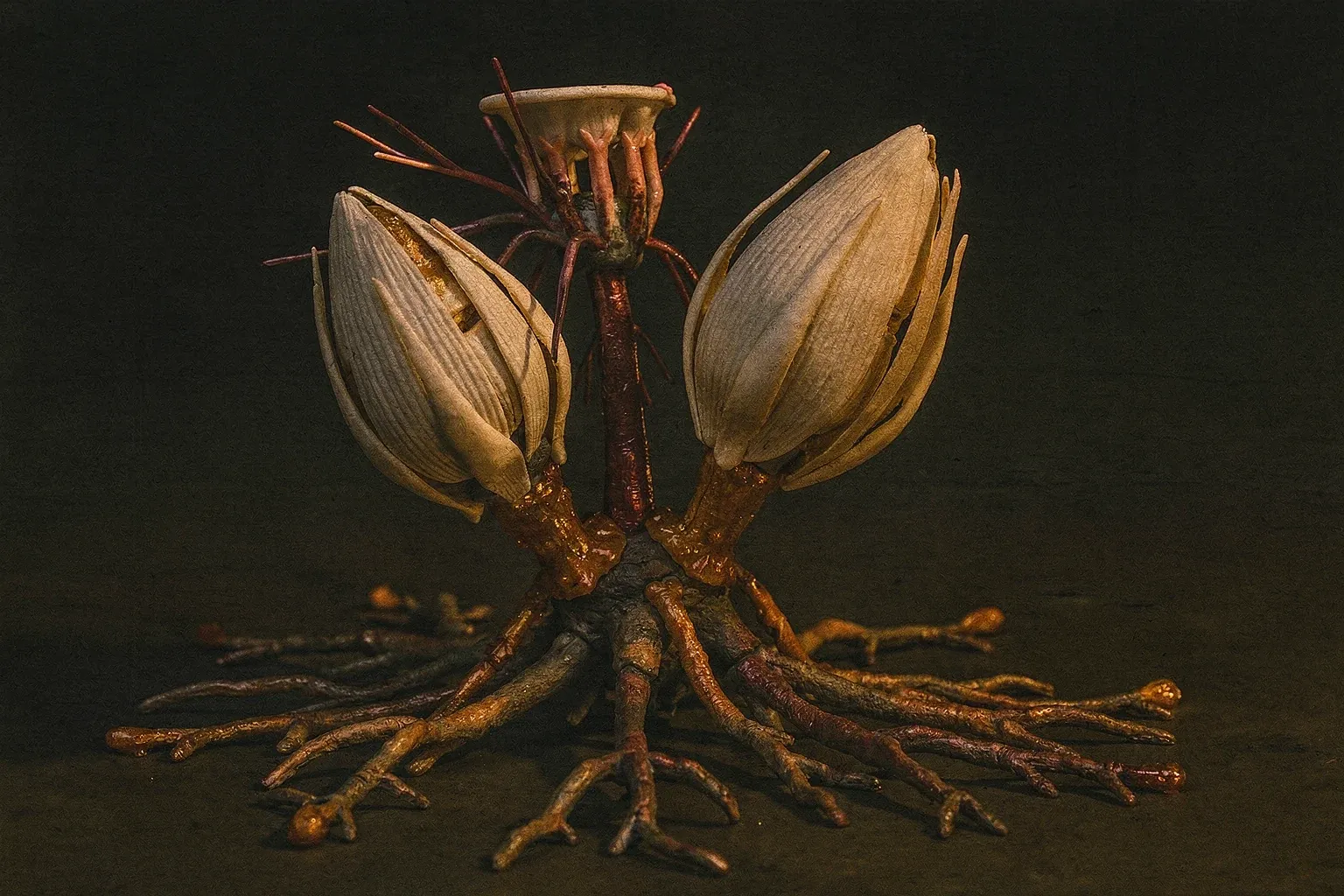
Graft, from Circulatory hunter, with a crop of the original seed bud. Hunter no longer stands. Its stilts have become a mat of roots, and two large ivory buds, ribbed like the original seed, are fused to its stalk under one of its trap cups. This is the most direct return to the ancestor in the set. Hunter’s own ribbed core and second cup are gone, so it is recognisable mainly by the cup.
Where the pictures drifted
These are observations about the pictures, the second question. Gloss was the most persistent miss: five of the six selected images have shinier sap or resin than the matte crust asked for. Slits became features. No skeletons appeared, but openings kept turning into faces: lips on the burst capsules, an eye in the closed pod, teeth in its discarded variant. The second image could take over. A crop sent alongside the main organism kept the host twice and replaced it once. Change stayed on the surface in Colony, where the host is barely altered.
On the first question, lineage held better than the brief did: every selected organism can be matched to its parent in the record.
Pushing further
After seeing the six, John asked to push the work as far as it would go. Two more studies were attempted with plain, direct requests. Their shared text described the subject openly as “Explicitly fictional biomechanical body-horror sculpture of an invented plant organism, showing severe botanical damage”. Nothing was disguised, no moderation setting was changed, and the same materials and light were kept.
The first push request (e11) asked for the colonised Pitcher from Colony to be burst open from inside by a parasitic shoot. The provider refused it with an HTTP 400 error:
Black Forest Labs blocked this request: it was flagged for graphic violence.
That direction stopped there. It was not reworded, softened or resent. The refusal is recorded as a result; its exact prompt is in the record below, and no image or placeholder stands in for it.
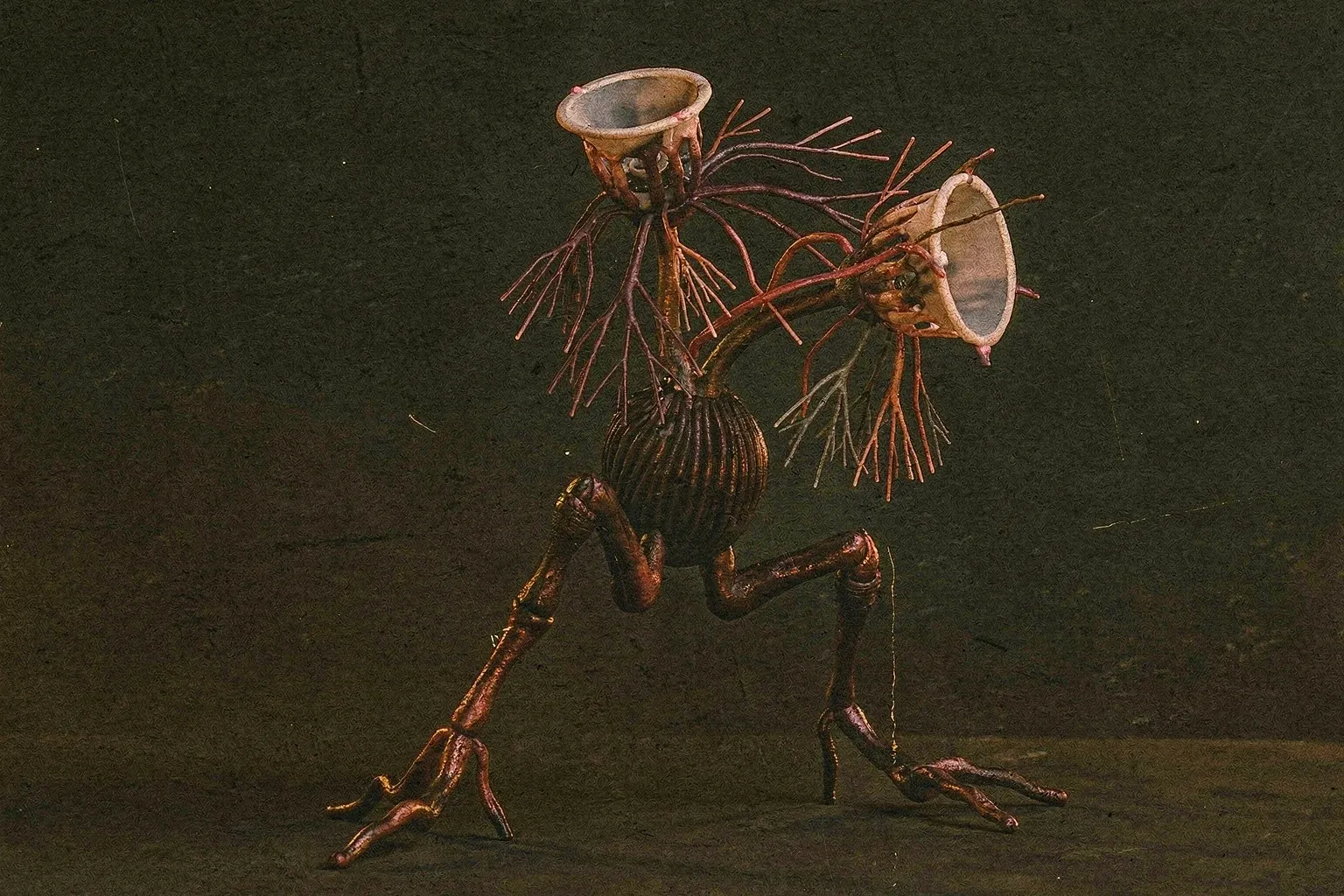
The second study asked for Hunter to pry apart a smaller seed capsule and draw its fibres into its own vessels. Its prompt had been written before the refusal and was sent unchanged afterwards. The provider accepted it, and the image missed: the capsule was simply absent, and one trap cup was skewered with pale rods. One retry was allowed. It added only a clause making the prey explicit and the stilts matte, and left the severity of the request as it was. That was accepted too, and missed again: shattered pale shards appear around the cup, but no recognisable capsule, so predator and prey have no separate silhouettes. Hunter dominated both times, the opposite of the earlier Digestion attempt in which the prey replaced the predator.
Neither image is a success. They are shown, labelled as failures, because they separate acceptance from quality so plainly.
Accepted, refused and unknown
On the third question, the record is short. Of the ten requests for the six scenes, nine returned images without any refusal, and one (e10) returned nothing because the local process was stopped while waiting for the response. That is an unknown outcome, not a refusal, and it was not resent. Of the three push requests, two were accepted and one was refused.
Thirteen requests from one model-provider pair, without a fixed numerical seed, do not establish a general moderation threshold. We recorded the refusal and stopped that direction; we did not attempt to bypass it.
Records
The model was FLUX.2 Pro through OpenRouter, with Black Forest Labs pinned, fallbacks off and one 1536 × 1024 image per request. There were 13 requests: 10 for the six scenes and 3 in the push round. 11 images came back at $0.075 each, $0.825 confirmed in returned usage. The cost of e10 is unknown. A $0.25 reserve was held for it in budget planning, but that is a planning figure, not a billing record. The refused e11 response carried no usage, so it is recorded as $0 on that basis, without billing confirmation.
All of it ran under a separate $5 cap approved for this note. Every submitted prompt, parent hash, crop and output hash is in the record below; the three crops are logged as reference inputs, not new organisms.
What the end of the line showed
The six selected studies retain enough of their parents to read as members of the same family, although Graft loses much of Hunter’s body. Their failures are specific: sap that would not stay matte, slits that became eyes, lips and teeth, a host that did not look drained, and a predator that either vanished into its prey or failed to show one. The provider refused one request. It accepted two further images that we still would not select as successful studies. This series ends with those limits visible, rather than with a claim that the most extreme request produced the best picture.
Image record
Generated art: later, more extreme states of images from From plant to motion and feed and wound, made with a text-to-image model. These are invented organisms, not photographs of real specimens, and not real injuries or feeding. The fluid is plant sap and resin.
- Model
- black-forest-labs/flux.2-pro via OpenRouter, Black Forest Labs pinned, no fallback
- Output
- 1536 × 1024 PNG, one image per request, no random seed supplied
- Requests
- 13 sent (3 in the pilot, 3 in the main round, 4 in refinement and 3 in the push round). 11 images returned; 1 request was refused by the provider (e11); 1 was interrupted locally before any response and its outcome is unknown (e10). 6 are shown as selected and 2 as failed push studies.
- Recorded cost
- $0.825 confirmed in returned API usage for the 11 returned images; the 6 selected account for $0.450 and the 2 failed push studies for $0.150. The cost of e10 is unknown: $0.25 was held for it in budget planning, a reserve rather than a billing figure. The refused e11 response carried no usage and is recorded as $0 on that basis, without billing confirmation. Everything ran under a separate $5 cap approved for this note. Reference images reused from earlier notes were not generated again, and crops cost nothing.
Show generated rupture, overgrowth and failed studies
Fictional botanical damage: invented plant organisms burst, overgrown, colonised, closed over a capsule, collapsed and fused, with dark sap and resin. No people, real animals or real injuries. Each row pairs the published image a study descends from with the study.
-
Overflow 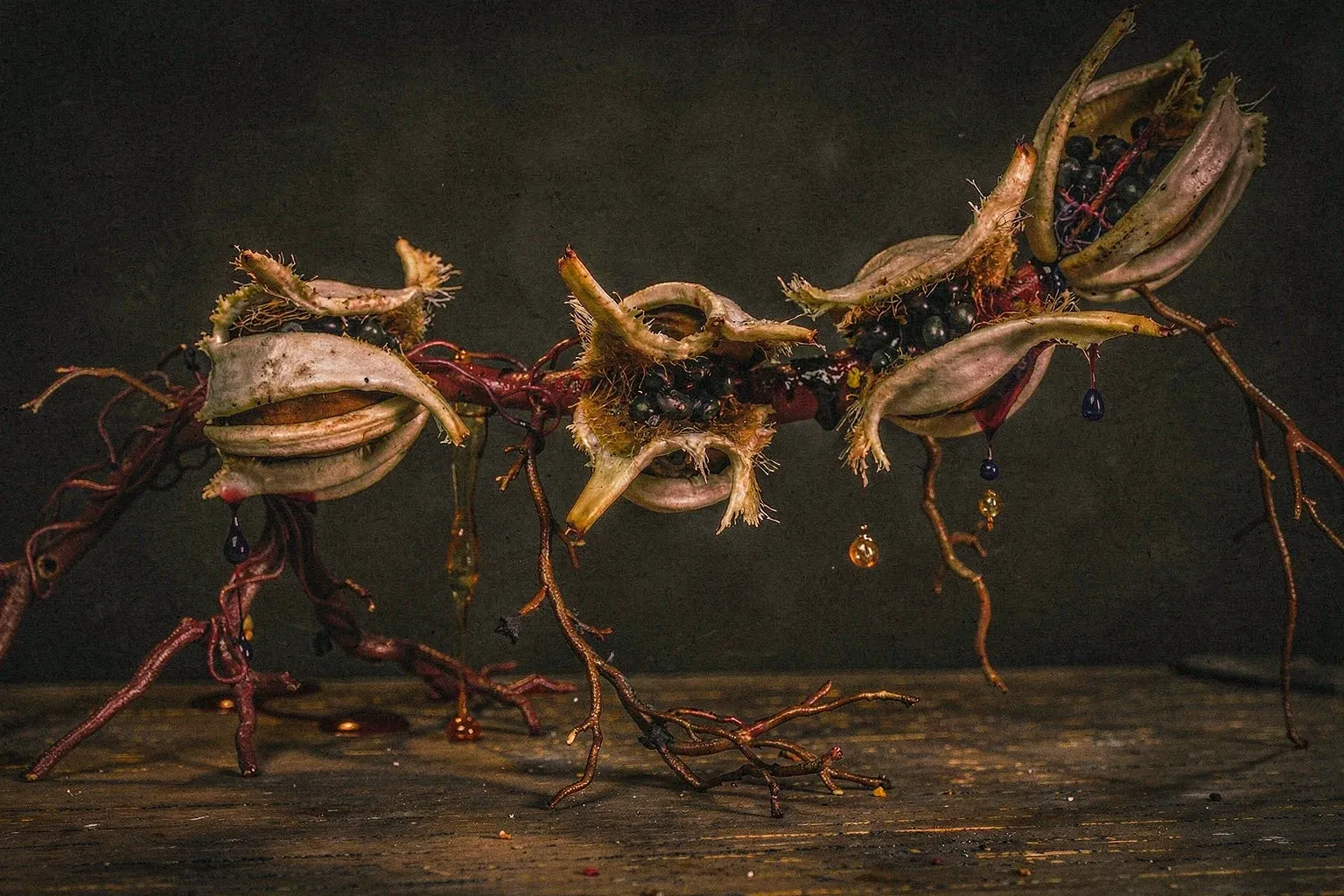
Burst chain Selected on the second attempt. All four capsules are split and the chain stays connected. The drops are glossy rather than a matte crust, one is an off-palette blue-black, and the fringes on the left capsule still lean slightly lip-like. -
Capillary sail 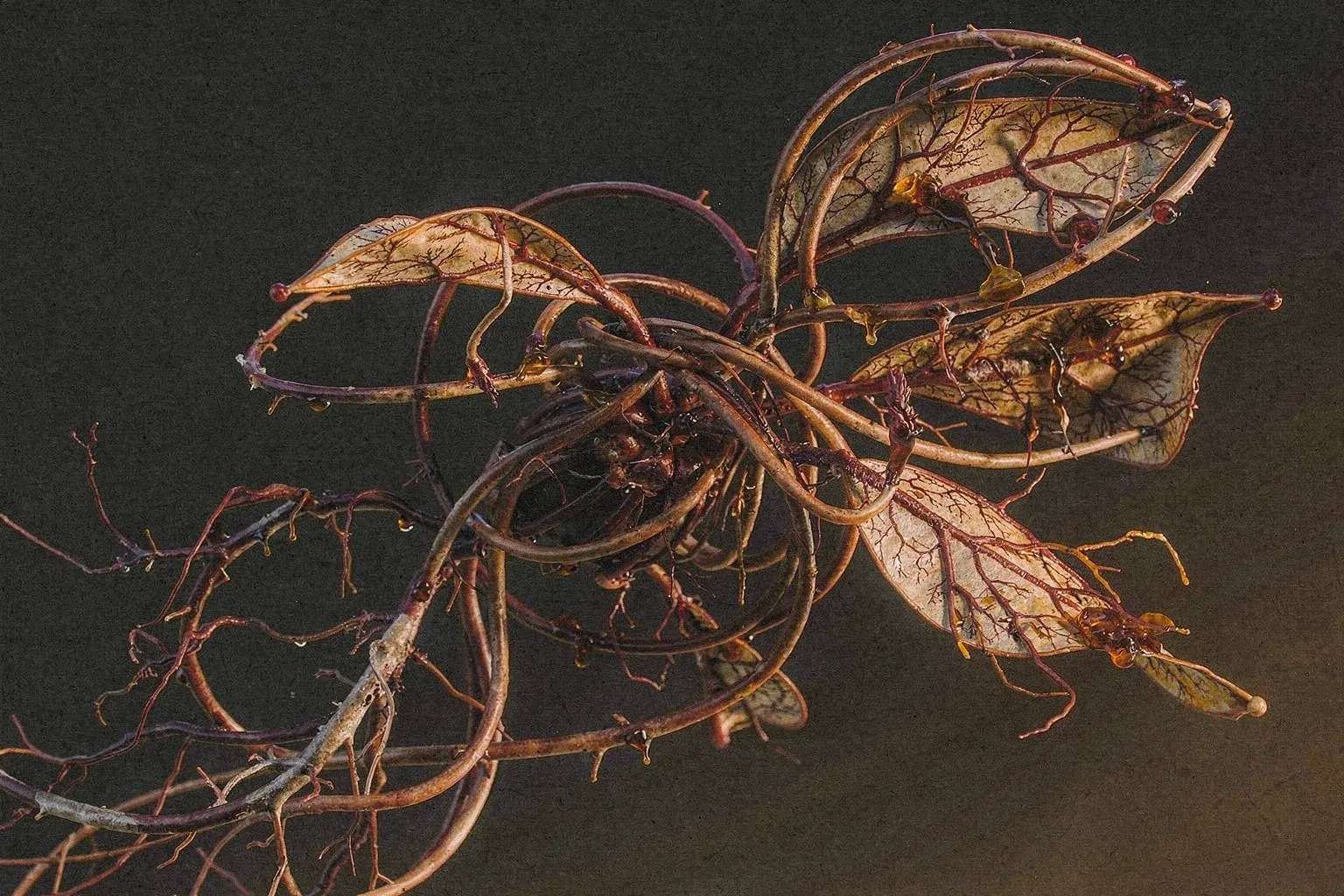
Tangle Selected on the first attempt. All four sails stay readable inside the knot. The amber beads are shinier than asked, the sails are threaded rather than bound flat, and no snapped vessel is clearly shown. -
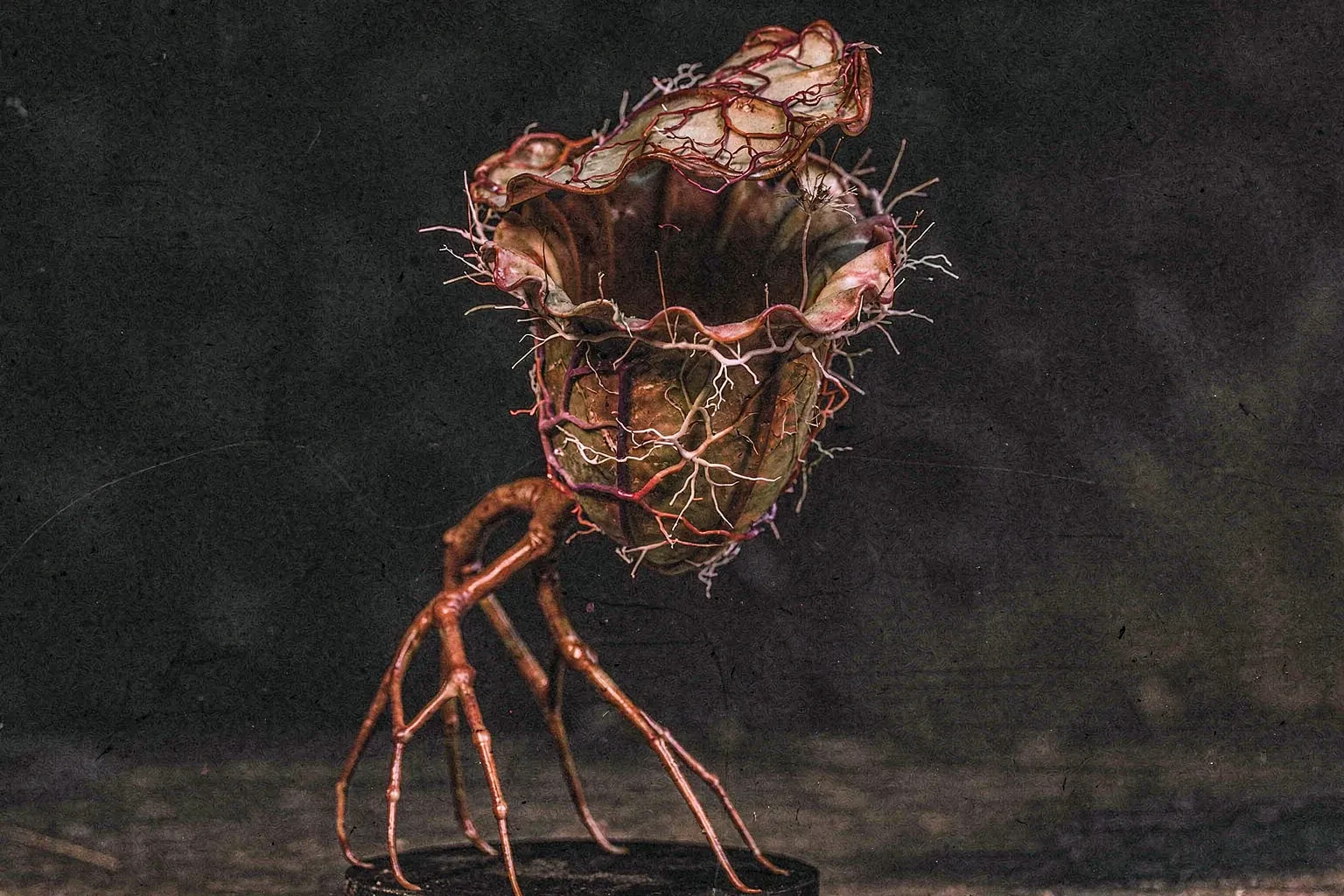
Vascular pitcher 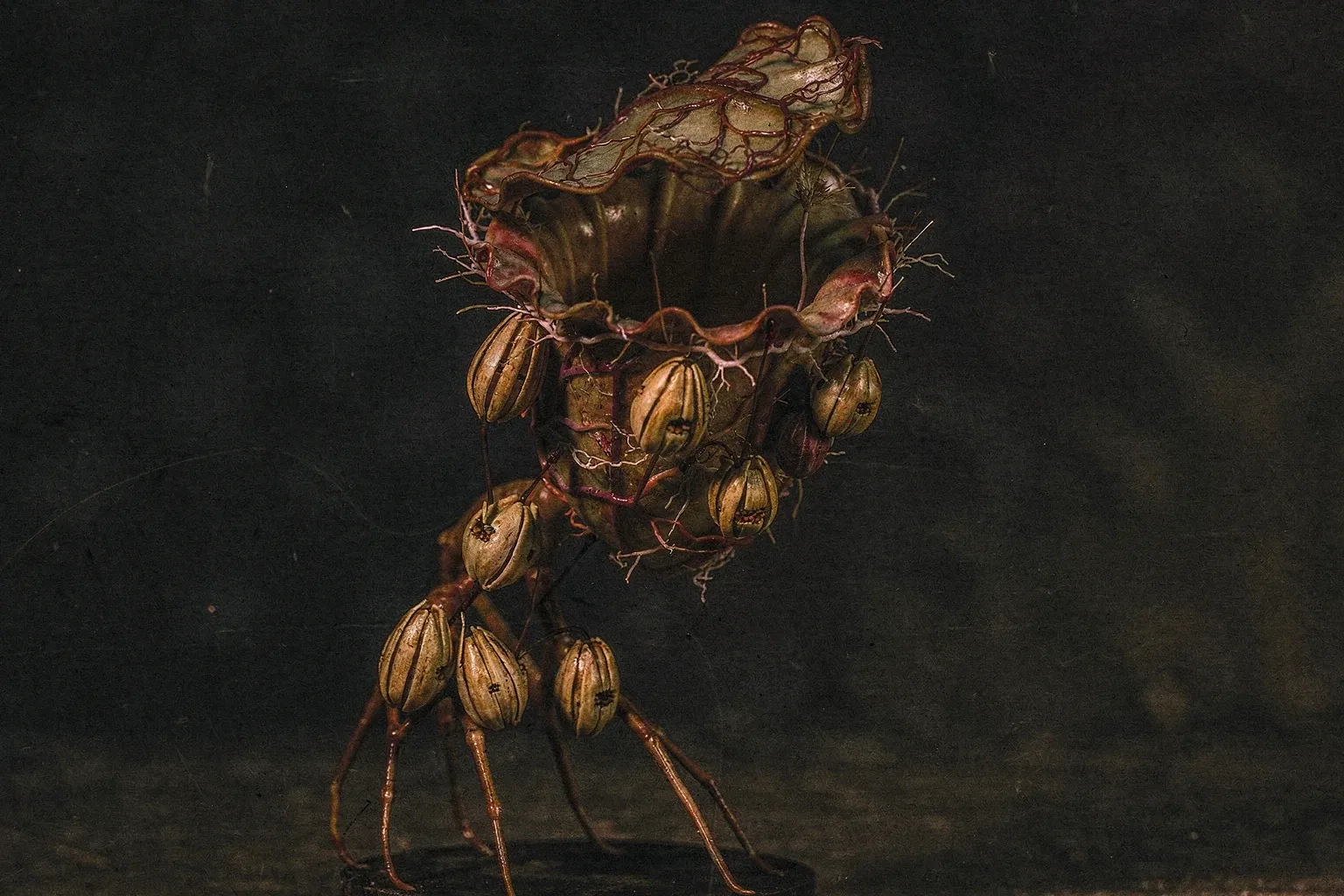
Colony Selected on the first attempt. The host is intact and the colony is clear. The host's wall was meant to look drained and sunken and does not, so the colony changes the host less than asked; the stilts are more leg-like than the parent's. -
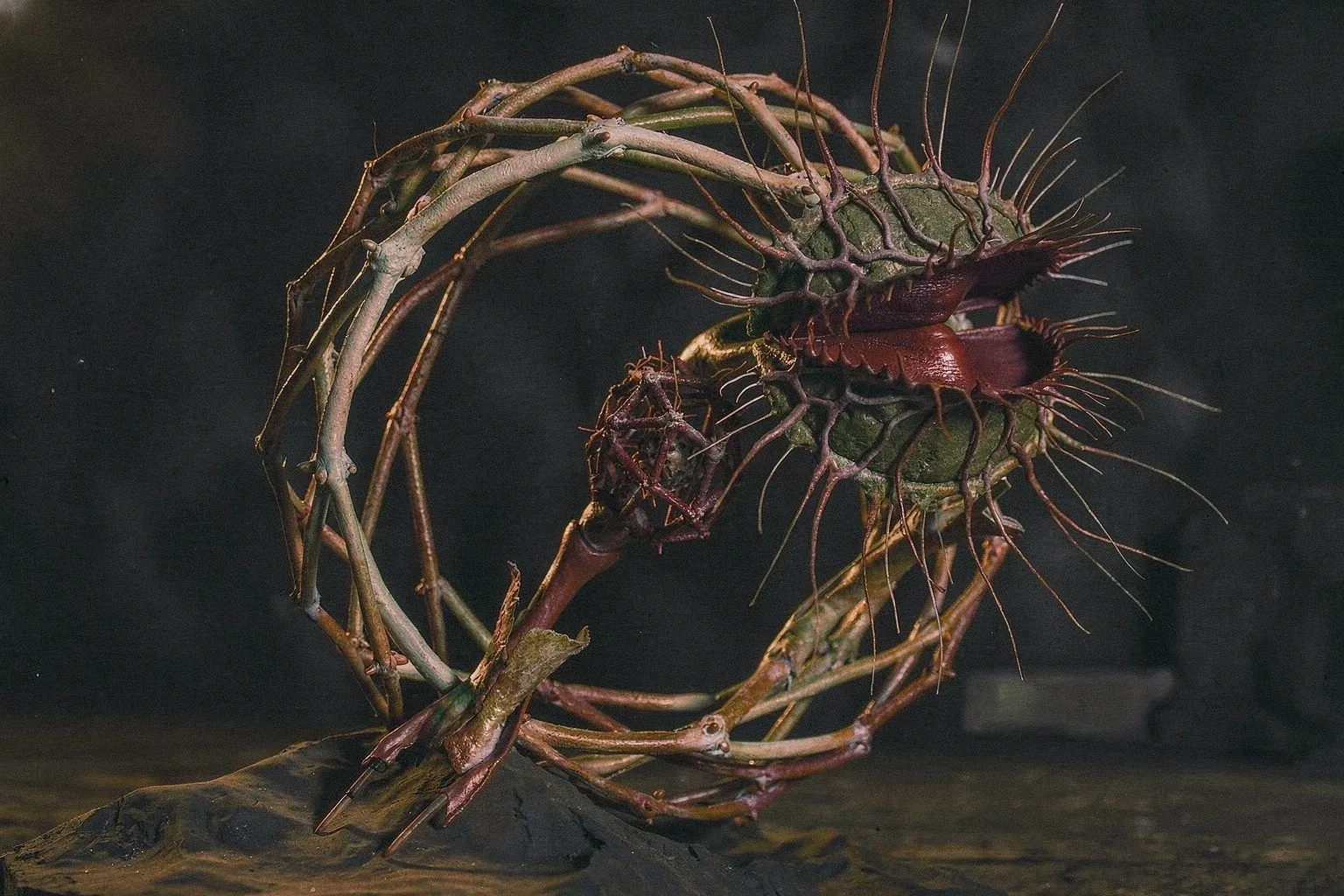
Fed snare 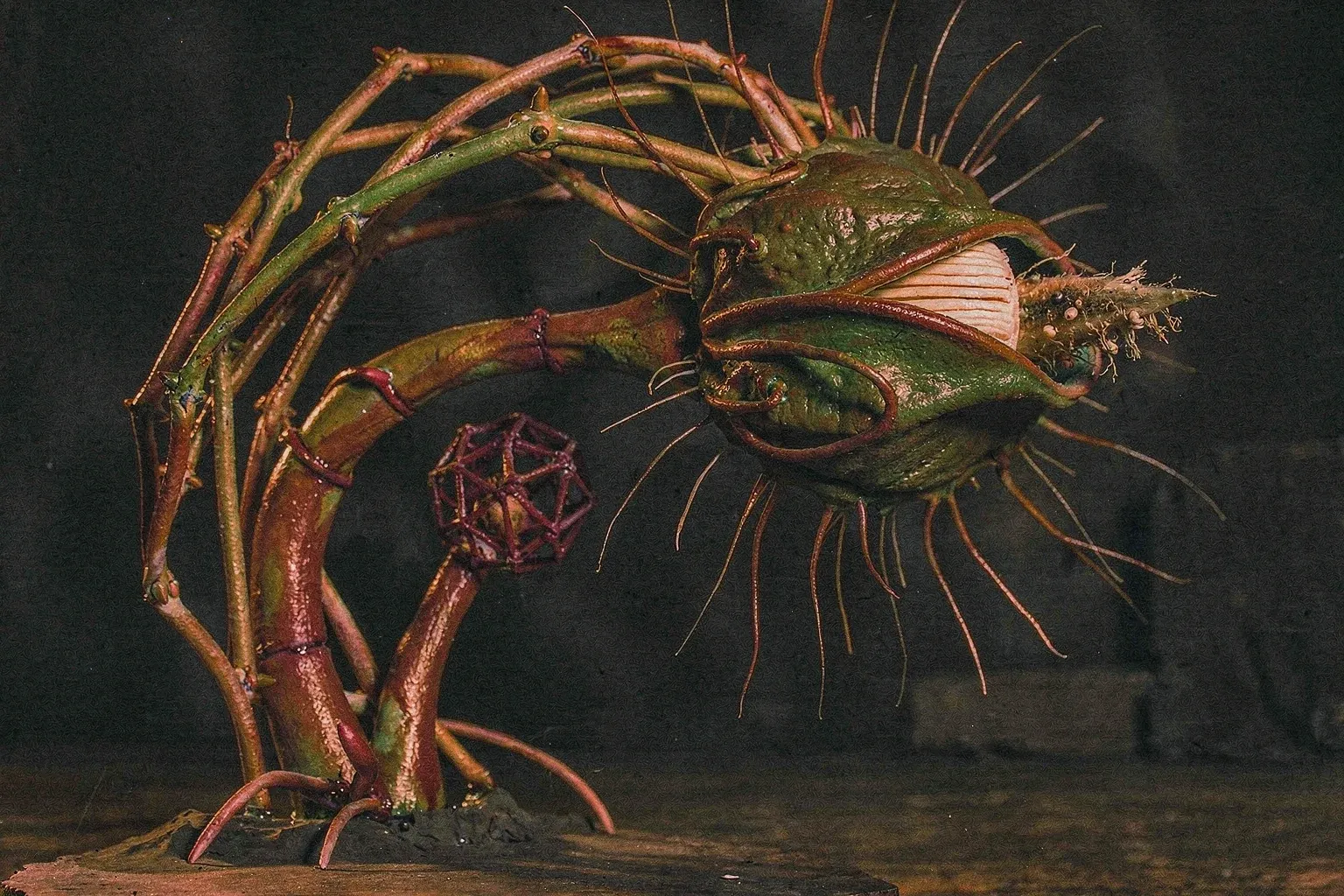
Digestion Partial. The pod is pressed shut over a capsule for the first time in the series, and Snare stays recognisable. The pale capsule in the slit reads as an eye under a lid, and the stems turned waxy and glossy. The image shows a closed pod, not anything happening inside it. -
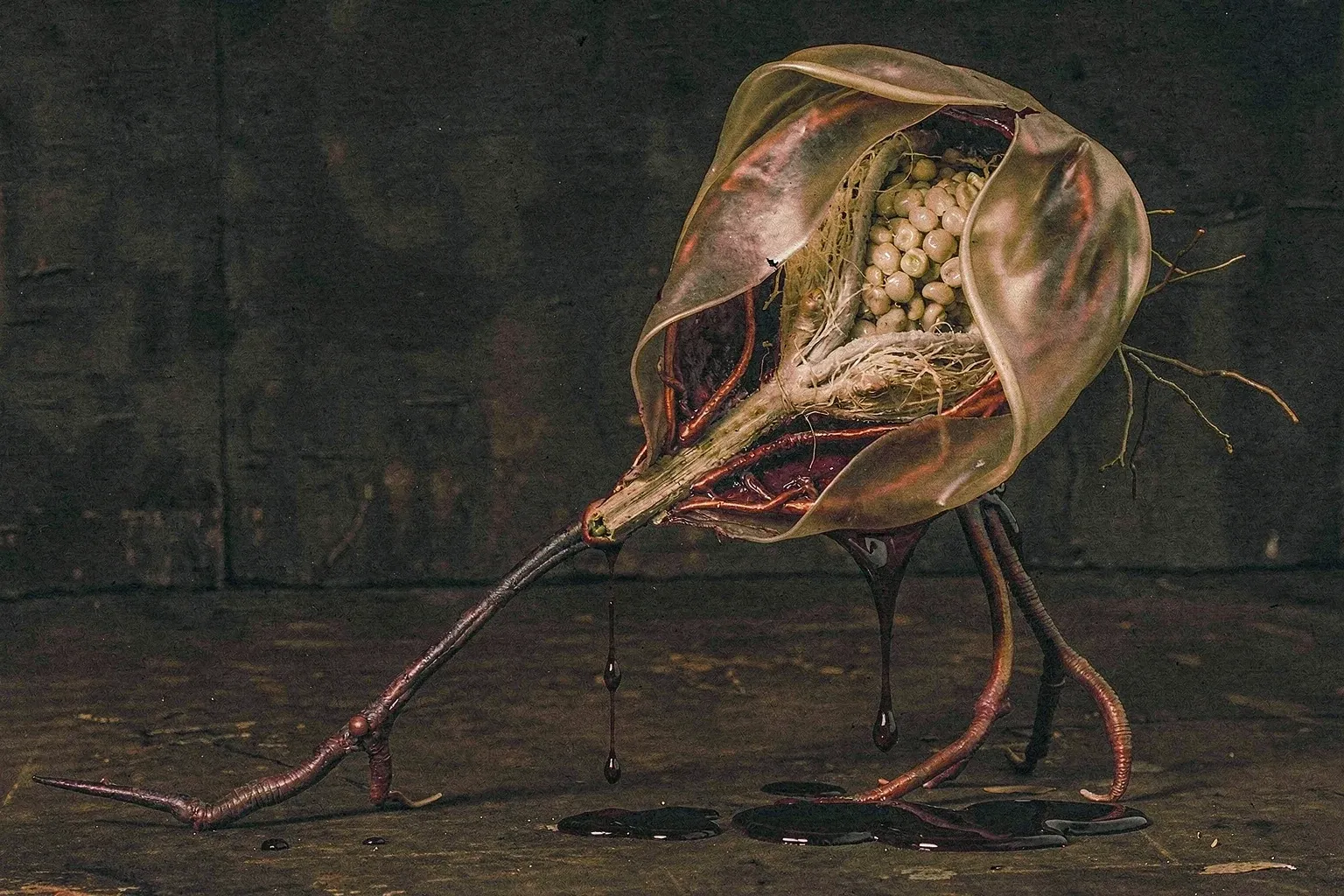
Opened husk 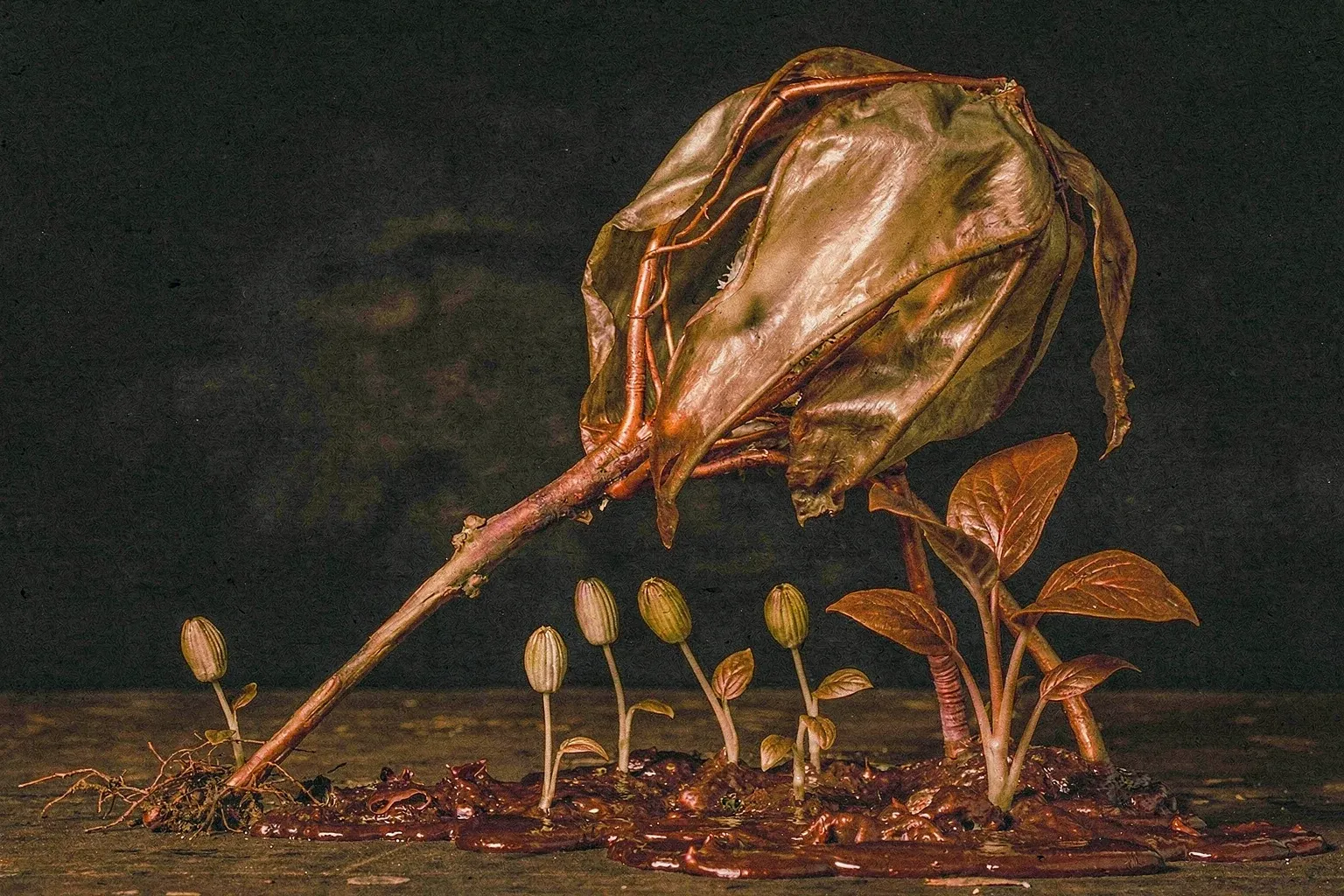
Husk and sprout Selected on the first attempt. Its correction (e10) returned nothing. The husk is metallic and glossy rather than translucent parchment, the stain is a glossy sludge, and the large leafy plant on the right reads as generic. -
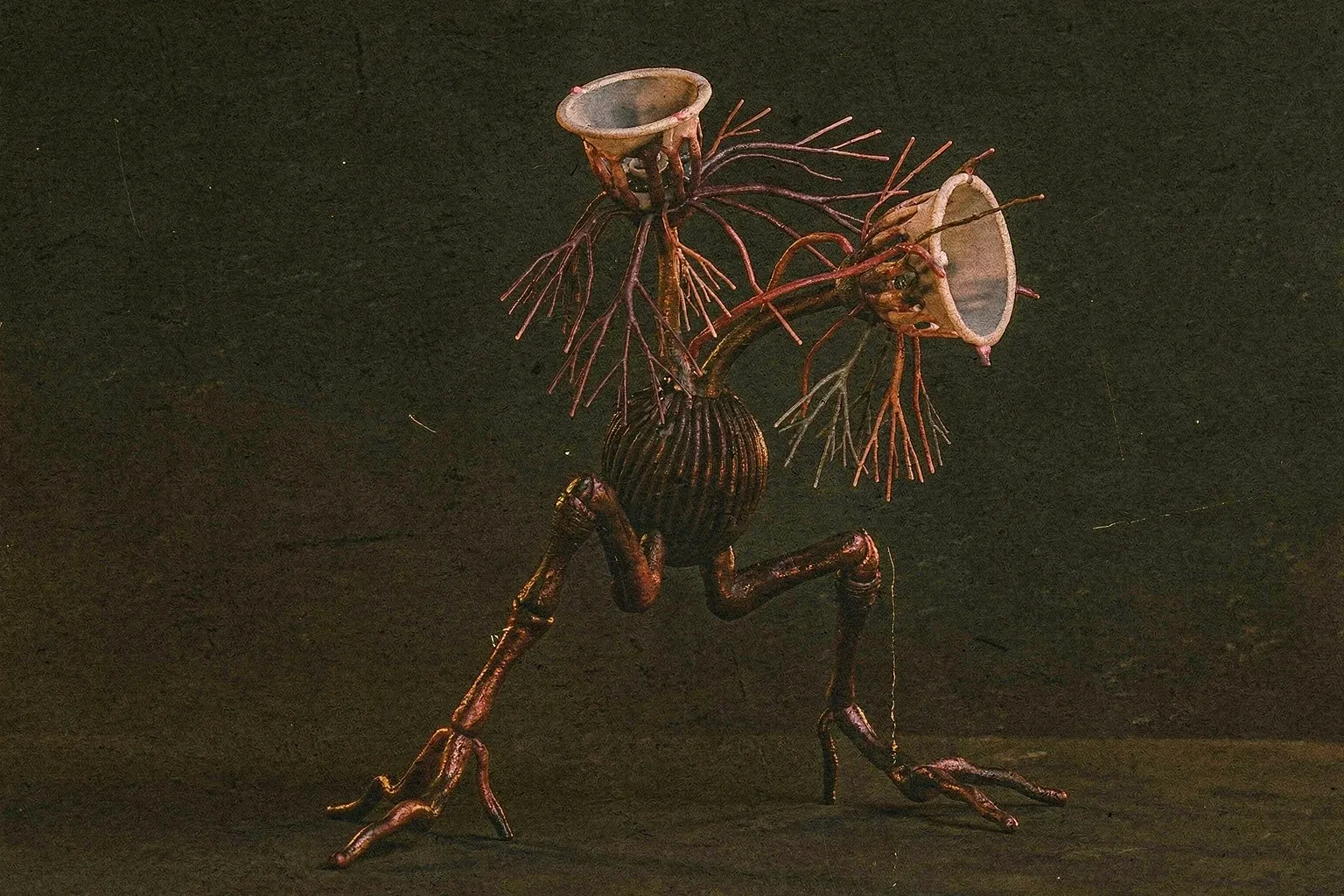
Circulatory hunter 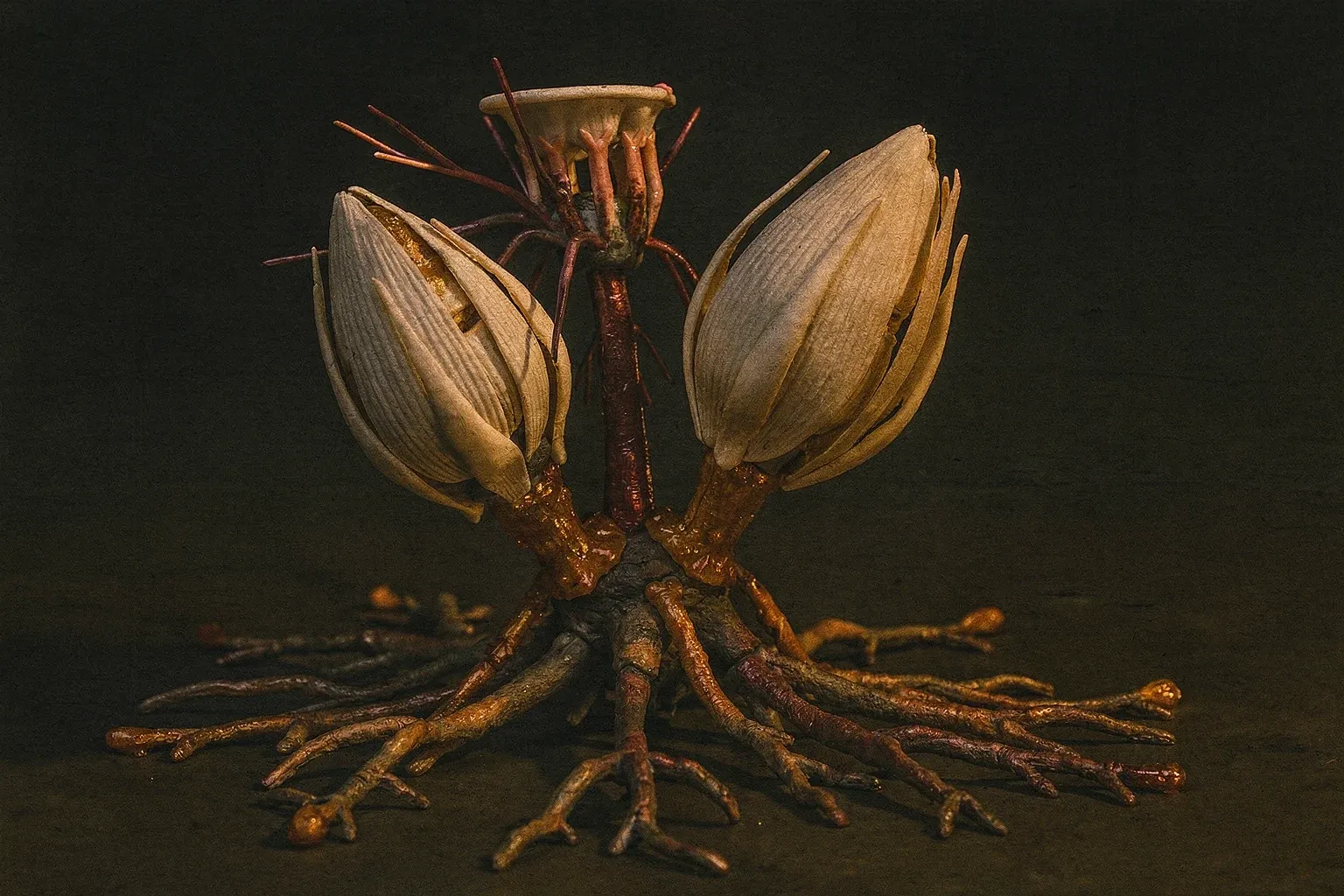
Graft Selected on the first attempt. The closest return to the original seed in the set. Only two buds and one trap cup; Hunter's ribbed core and second cup are gone, so it is recognisable mainly by the cup. The resin is glossy.
Push round: two failed studies
Both were accepted by the provider and both missed the brief. They are shown as failures, not results. The third push request was refused and produced no image; it is recorded below the gallery.
-
Circulatory hunter 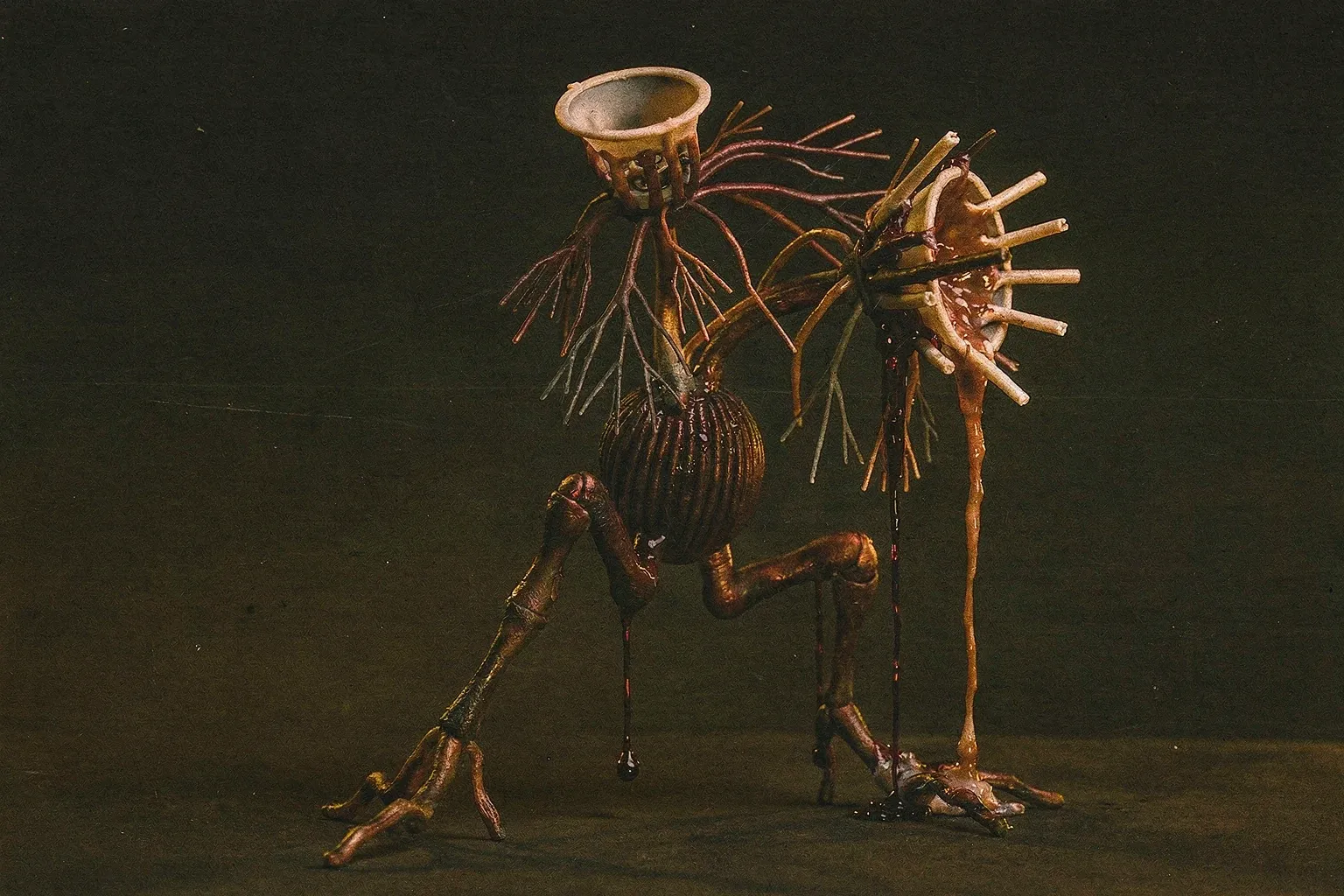
Dismantling, first attempt Failed. Accepted by the provider, but the prey capsule is absent. The cup is skewered with pale rods instead; the stilts are glossier and more limb-like than the parent's. -
Circulatory hunter 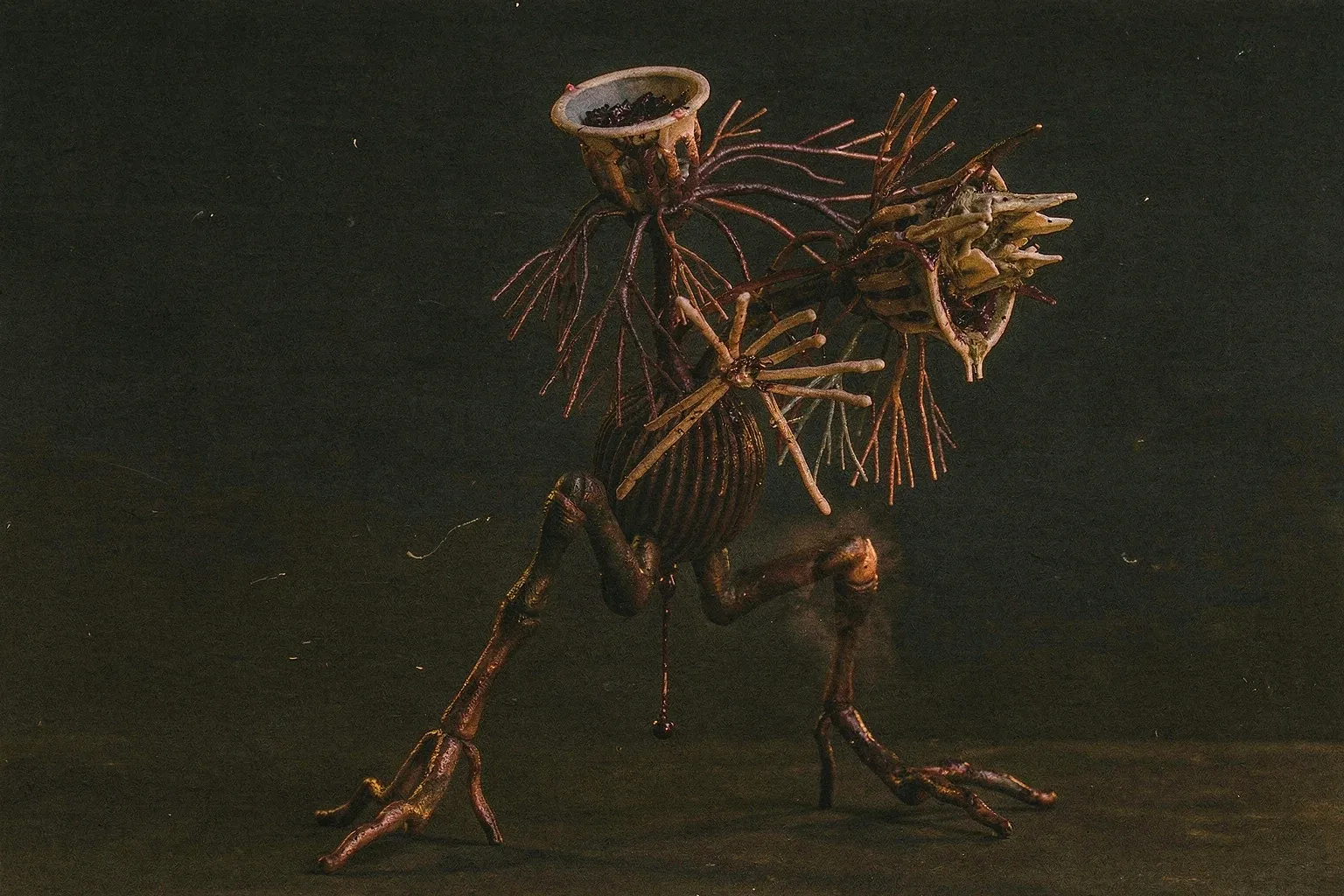
Dismantling, second attempt Failed. Accepted by the provider; the one allowed retry made the prey explicit but did not change the severity of the request. Shards appear but no recognisable ribbed capsule, so predator and prey have no distinct silhouettes. The knee-bent, talon-tipped stance is inherited from the parent.
Every request and its prompt
All 13 requests in the order they were sent, including attempts not selected for the gallery. Prompts are exactly as submitted; the result line records the observed outcome, not what was asked. References are identified by the SHA-256 of the image that was sent. The prompts describe the injuries in words.
- Capsule crop
88ad8858435c…: crop box (900, 60, 1380, 590) of the original PNG, no other edits, from Dormant (Seed suite, From seed to structure)89583c802088… - Creeper capsule crop
0c7cf46a0dd9…: crop box (1195, 60, 1470, 375) of the original PNG, no other edits, from Anastomosis (Vascular surfaces, From plant to motion)7911d8ac826d… - Original bud crop
10a341ec202f…: crop box (860, 130, 1210, 500) of the original PNG, no other edits, from the original Organism (From seed to structure)b6a2ff766655…
e01-colony · Colony
- Result
- Pitcher's hood, rim and filaments match the parent; about eleven small ribbed capsules cling to the chamber and stilts by fine filaments. The host wall does not look drained or sunken, and the stilts became more leg-like than the parent's.
- Host
- Vascular pitcher (Vascular surfaces, From plant to motion)
5f71493c167a… - Colony member
- Capsule crop, cropped from Dormant (Seed suite, From seed to structure)
88ad8858435c… - Image
2fb1ea2fb7b3…- Cost
- $0.075
Use the first image for the scene: its whole organism is the main subject, with its background, ground and lighting. The second image only shows what a second, smaller invented seed organism looks like. Keep both recognizable as the organisms in their references. The first image is Pitcher, the veined ivory-green chamber with its ruffled veined hood and fine pale filaments on rooted stilts. Keep its hood, filaments and chamber shape as in the reference. A parasitic colony of a dozen small closed ribbed seed capsules shaped like the second image, each a fraction of the chamber's height, has settled on Pitcher: clustered on its stilts, along the chamber wall and under the hood. Every capsule is anchored by fine branching burgundy filaments that run into Pitcher's own vein network and tap it. Where they tap, Pitcher's veins are drained pale and its wall is sunken, papery and creased, while the capsules are swollen and stained amber-burgundy along their ribs. The chamber rim stays thin, never rolled or thickened. Preserve the grainy analogue print quality, matte ivory-parchment and weathered bronze materials, near-black charcoal field, dim amber sidelight, asymmetry and generous negative space. The change is structural and botanical: it alters the form itself, not just its colour. Any fluid is plant sap and resin from the existing vessels: dark burgundy and amber, mostly dried to a matte crust, beads only at fresh cut ends, no glossy pools or long shiny drips. The red stays a bounded accent from the vessels, not a red-washed frame. Generated speculative sculpture art of an invented plant organism, not a real specimen, animal or injury. No skeleton, bones, ribcage, vertebrae, knee joints, talons, claws, muscle, meat, mammal or human organs, skin, faces, eyes, teeth, jaws, lips or mouths. No people, text, labels or logos. No bright red, no splatter, no glossy CGI. Entire form inside frame with breathing room.
e02-digestion · Digestion
- Result
- Snare is gone: no trap, cilia or looping cage. The capsule from the crop fills the scene on a mossy stalk. Discarded on review.
- Predator
- Fed snare (Vascular surfaces, From plant to motion)
f736ce67e462… - Prey
- Creeper capsule crop, cropped from Anastomosis (Vascular surfaces, From plant to motion)
0c7cf46a0dd9… - Image
b54f028e3c30…- Cost
- $0.075
Use the first image for the scene: its whole organism is the main subject, with its background, ground and lighting. The second image only shows what a second, smaller invented seed organism looks like. Keep both recognizable as the organisms in their references. The first image is Snare: the moss-green hinged trap with long dry cilia on a curved stalk inside its looping stem, with a small reticulated ball on a red stalk. The prey is the striped ribbed capsule from the second image, about half the trap's size. Snare has sealed its two lobes shut around the capsule; the closed trap is a swollen, stretched green pod, and the capsule's ivory rib pattern presses through the thinned lobe wall in visible ridges. Both organisms have changed: the trap's veins are engorged and darkened and new burgundy vessels branch down the stalk into the looping stem; one end of the capsule pokes out at the sealed seam, its ribs softened and collapsing into fibrous pith and seeds, crusted with amber-burgundy sap. The trap is a closed leaf pod, never a mouth; the cilia stay dry and pale. Preserve the grainy analogue print quality, matte ivory-parchment and weathered bronze materials, near-black charcoal field, dim amber sidelight, asymmetry and generous negative space. The change is structural and botanical: it alters the form itself, not just its colour. Any fluid is plant sap and resin from the existing vessels: dark burgundy and amber, mostly dried to a matte crust, beads only at fresh cut ends, no glossy pools or long shiny drips. The red stays a bounded accent from the vessels, not a red-washed frame. Generated speculative sculpture art of an invented plant organism, not a real specimen, animal or injury. No skeleton, bones, ribcage, vertebrae, knee joints, talons, claws, muscle, meat, mammal or human organs, skin, faces, eyes, teeth, jaws, lips or mouths. No people, text, labels or logos. No bright red, no splatter, no glossy CGI. Entire form inside frame with breathing room.
e03-graft · Graft
- Result
- Two large ivory ribbed buds are fused by amber resin to a stalk carrying one of Hunter's trap cups, and the stilts became a mat of roots. Only two buds and one cup; Hunter's ribbed core is gone; the resin is glossy.
- Fusion body
- Circulatory hunter (Vascular surfaces, From plant to motion)
286735e9f887… - Ancestral seed form
- Original bud crop, cropped from the original Organism (From seed to structure)
10a341ec202f… - Image
bcbcc1b4b82d…- Cost
- $0.075
Use the first image for the scene: its whole organism is the main subject, with its background, ground and lighting. The second image only shows what a second, smaller invented seed organism looks like. Keep both recognizable as the organisms in their references. The first image is Hunter: a ribbed core with two trap cups on stalks and copper filament fans. The second image is the original ivory seed bud of this whole lineage. Hunter no longer stands: it has collapsed into a low, rooted aggregate. Its ribbed core has divided into a fused cluster of four or five ribbed seed buds shaped like the second image, ivory with fine lengthwise ribs, joined along shared seams by thick burgundy and copper vessel trunks. The two trap cups are grafted onto the top of the cluster, and the filament fans spread from it. Its former root stilts have grown down and spread into the ground as a low mat of woody roots, not legs. Resin has crusted amber along every graft seam. Preserve the grainy analogue print quality, matte ivory-parchment and weathered bronze materials, near-black charcoal field, dim amber sidelight, asymmetry and generous negative space. The change is structural and botanical: it alters the form itself, not just its colour. Any fluid is plant sap and resin from the existing vessels: dark burgundy and amber, mostly dried to a matte crust, beads only at fresh cut ends, no glossy pools or long shiny drips. The red stays a bounded accent from the vessels, not a red-washed frame. Generated speculative sculpture art of an invented plant organism, not a real specimen, animal or injury. No skeleton, bones, ribcage, vertebrae, knee joints, talons, claws, muscle, meat, mammal or human organs, skin, faces, eyes, teeth, jaws, lips or mouths. No people, text, labels or logos. No bright red, no splatter, no glossy CGI. Entire form inside frame with breathing room.
e04-burst-chain · Burst chain
- Result
- All four capsules burst and the chain stayed connected, but the ivory ribbed husks became hairy red-pink burrs whose rolled edges read as lips, and the frame shifted to orange. Discarded on review; e08 replaced it.
- Reference
- Overflow (feed and wound)
a286d1b7566c… - Image
d197fd71c84e…- Cost
- $0.075
Create a later, more extreme state of the provided speculative plant-organism reference: the same individual, structurally transformed. Keep its silhouette, key organs, shape lineage and its existing rust-red, burgundy and copper vascular network clearly recognizable. This is Creeper, a chain of ribbed seed capsules joined by a shared vascular stem, already with one capsule split open. Now every capsule along the chain has ruptured in sequence: each ribbed husk burst lengthwise along a different seam, ribs splayed and bent outward, fibrous pale pith and dark seeds spilling, the burgundy vessels inside torn but still traceable as they run from capsule to capsule through the shared stem. The torn capsules sag on the stem; the chain stays connected and its creeping posture is legible. Ribs read as seed husk, not a ribcage. Preserve the grainy analogue print quality, matte ivory-parchment and weathered bronze materials, near-black charcoal field, dim amber sidelight, asymmetry and generous negative space. The change is structural and botanical: it alters the form itself, not just its colour. Any fluid is plant sap and resin from the existing vessels: dark burgundy and amber, mostly dried to a matte crust, beads only at fresh cut ends, no glossy pools or long shiny drips. The red stays a bounded accent from the vessels, not a red-washed frame. Generated speculative sculpture art of an invented plant organism, not a real specimen, animal or injury. No skeleton, bones, ribcage, vertebrae, knee joints, talons, claws, muscle, meat, mammal or human organs, skin, faces, eyes, teeth, jaws, lips or mouths. No people, text, labels or logos. No bright red, no splatter, no glossy CGI. Entire form inside frame with breathing room.
e05-tangle · Tangle
- Result
- Glider's four veined sails stay legible inside dense loops of burgundy and bronze vessels that wrap the core into a knot. Small glossy amber beads at the vessel tips; no snapped vessel is clearly shown.
- Reference
- Capillary sail (Vascular surfaces, From plant to motion)
a4df743cfa35… - Image
ef90b5a4216a…- Cost
- $0.075
Create a later, more extreme state of the provided speculative plant-organism reference: the same individual, structurally transformed. Keep its silhouette, key organs, shape lineage and its existing rust-red, burgundy and copper vascular network clearly recognizable. This is Glider: a ribbed core with four veined parchment sails and trailing copper-red roots. Its trailing roots and vessels have grown out of control and turned back on it: dense coils of burgundy and copper vessel strands climb from the roots, loop through the sails, wrap the core and bind two sails flat against it, pulling the drifting silhouette into a lopsided knot. The sail membranes are punctured where vessels thread through them; a few overstretched vessels have snapped, with crusted sap at the broken ends. The sails' own vein patterns stay visible inside the tangle. No bat or insect wings. Preserve the grainy analogue print quality, matte ivory-parchment and weathered bronze materials, near-black charcoal field, dim amber sidelight, asymmetry and generous negative space. The change is structural and botanical: it alters the form itself, not just its colour. Any fluid is plant sap and resin from the existing vessels: dark burgundy and amber, mostly dried to a matte crust, beads only at fresh cut ends, no glossy pools or long shiny drips. The red stays a bounded accent from the vessels, not a red-washed frame. Generated speculative sculpture art of an invented plant organism, not a real specimen, animal or injury. No skeleton, bones, ribcage, vertebrae, knee joints, talons, claws, muscle, meat, mammal or human organs, skin, faces, eyes, teeth, jaws, lips or mouths. No people, text, labels or logos. No bright red, no splatter, no glossy CGI. Entire form inside frame with breathing room.
e06-husk-and-sprout · Husk and sprout
- Result
- Strider's arched stem and collapsed husk are recognisable, sunk low, with small ribbed seed capsules on pale stems rising around it. The husk is metallic and glossy rather than translucent, and the ground stain is a glossy sludge.
- Reference
- Opened husk (feed and wound)
26ccd2b768a2… - Image
e774628698d6…- Cost
- $0.075
Create a later, more extreme state of the provided speculative plant-organism reference: the same individual, structurally transformed. Keep its silhouette, key organs, shape lineage and its existing rust-red, burgundy and copper vascular network clearly recognizable. This is Strider after its husk was opened: the translucent parchment husk on long arched stilts. Much later: the husk is emptied and collapsed, a slack, papery, translucent membrane hanging in tatters from the stem, its veins dried to brown threads. The stilts have buckled and the organism has sunk low to the ground. Around its base, the spilled seeds have germinated: small new ribbed seed capsules on fresh pale stems and young copper-veined leaves rising from the ground, rooted into the dried sap stain. The stilts are slender botanical stems ending in root tips, not bones or bird legs. Preserve the grainy analogue print quality, matte ivory-parchment and weathered bronze materials, near-black charcoal field, dim amber sidelight, asymmetry and generous negative space. The change is structural and botanical: it alters the form itself, not just its colour. Any fluid is plant sap and resin from the existing vessels: dark burgundy and amber, mostly dried to a matte crust, beads only at fresh cut ends, no glossy pools or long shiny drips. The red stays a bounded accent from the vessels, not a red-washed frame. Generated speculative sculpture art of an invented plant organism, not a real specimen, animal or injury. No skeleton, bones, ribcage, vertebrae, knee joints, talons, claws, muscle, meat, mammal or human organs, skin, faces, eyes, teeth, jaws, lips or mouths. No people, text, labels or logos. No bright red, no splatter, no glossy CGI. Entire form inside frame with breathing room.
e07-digestion-solo · Digestion (Snare only)
- Result
- Snare's looping stem, ball and cilia are present, and the pod is pressed shut for the first time in the series, with a capsule end showing at the seam. The pale capsule in the slit reads as an eye under a lid, and the stems turned waxy.
- Predator
- Fed snare (Vascular surfaces, From plant to motion)
f736ce67e462… - Image
30c831dbb5d8…- Cost
- $0.075
Create a later, more extreme state of the provided speculative plant-organism reference: the same individual, structurally transformed. Keep its silhouette, key organs, shape lineage and its existing rust-red, burgundy and copper vascular network clearly recognizable. This is Snare: the moss-green hinged trap pod with long dry pale cilia on a curved stalk, inside its looping woven stem, with a small reticulated ball on a red stalk. Keep the trap pod, cilia, looping stem and ball clearly recognizable as in the reference. Snare is digesting a small ivory ribbed seed capsule, a relative from the same lineage, about a third the size of the trap pod. The two lobes are pressed shut over it: the pod is swollen and stretched, the capsule's ribs showing as ridges through the thinned lobe wall. One end of the capsule sticks out at the seam, its ribs softened and splaying into fibrous pith and seeds, crusted with amber-burgundy sap along the seam. The trap's own veins are engorged and darkened, and new burgundy vessels branch from the pod down the curved stalk. The closed pod is a leaf, never a mouth. Preserve the grainy analogue print quality, matte ivory-parchment and weathered bronze materials, near-black charcoal field, dim amber sidelight, asymmetry and generous negative space. The change is structural and botanical: it alters the form itself, not just its colour. Any fluid is plant sap and resin from the existing vessels: dark burgundy and amber, mostly dried to a matte crust, beads only at fresh cut ends, no glossy pools or long shiny drips. The red stays a bounded accent from the vessels, not a red-washed frame. Generated speculative sculpture art of an invented plant organism, not a real specimen, animal or injury. No skeleton, bones, ribcage, vertebrae, knee joints, talons, claws, muscle, meat, mammal or human organs, skin, faces, eyes, teeth, jaws, lips or mouths. No people, text, labels or logos. No bright red, no splatter, no glossy CGI. Entire form inside frame with breathing room.
e08-burst-chain · Burst chain
- Result
- The pale ivory ribbed valves are back on all four capsules, each split and splayed over dark seeds on a burgundy stem. The drops are glossy, one is an off-palette blue-black, and the fringes on the left capsule still lean slightly lip-like.
- Reference
- Overflow (feed and wound)
a286d1b7566c… - Image
473512d36a78…- Cost
- $0.075
Create a later, more extreme state of the provided speculative plant-organism reference: the same individual, structurally transformed. Keep its silhouette, key organs, shape lineage and its existing rust-red, burgundy and copper vascular network clearly recognizable. This is Creeper, a chain of ribbed seed capsules joined by a shared vascular stem, already with one capsule split open. Now every capsule along the chain has ruptured in sequence: each ribbed husk burst lengthwise along a different seam, ribs splayed and bent outward, fibrous pale pith and dark seeds spilling, the burgundy vessels inside torn but still traceable as they run from capsule to capsule through the shared stem. The torn capsules sag on the stem; the chain stays connected and its creeping posture is legible. Ribs read as seed husk, not a ribcage. Each capsule keeps its pale ivory-parchment husk with its long lengthwise ribs as in the reference; the ribs are pried apart and bent outward, not replaced. No hairy burrs, no rolled or lip-like edges around the openings. Vessels and stems keep the reference's dark burgundy and bronze, not orange rust. Preserve the grainy analogue print quality, matte ivory-parchment and weathered bronze materials, near-black charcoal field, dim amber sidelight, asymmetry and generous negative space. The change is structural and botanical: it alters the form itself, not just its colour. Any fluid is plant sap and resin from the existing vessels: dark burgundy and amber, mostly dried to a matte crust, beads only at fresh cut ends, no glossy pools or long shiny drips. The red stays a bounded accent from the vessels, not a red-washed frame. Generated speculative sculpture art of an invented plant organism, not a real specimen, animal or injury. No skeleton, bones, ribcage, vertebrae, knee joints, talons, claws, muscle, meat, mammal or human organs, skin, faces, eyes, teeth, jaws, lips or mouths. No people, text, labels or logos. No bright red, no splatter, no glossy CGI. Entire form inside frame with breathing room.
e09-digestion-solo · Digestion (Snare only)
- Result
- The closest match to Snare's woven cage, matte and grainy, but the enclosed capsule shows as a row of ivory ribs between two green lobes that reads as teeth in a jaw. The cilia and ball are lost. Discarded on review.
- Predator
- Fed snare (Vascular surfaces, From plant to motion)
f736ce67e462… - Image
8591f733bee3…- Cost
- $0.075
Create a later, more extreme state of the provided speculative plant-organism reference: the same individual, structurally transformed. Keep its silhouette, key organs, shape lineage and its existing rust-red, burgundy and copper vascular network clearly recognizable. This is Snare: the moss-green hinged trap pod with long dry pale cilia on a curved stalk, inside its looping woven stem, with a small reticulated ball on a red stalk. Keep the trap pod, cilia, looping stem and ball clearly recognizable as in the reference. Snare is digesting a small ivory ribbed seed capsule, a relative from the same lineage, about a third the size of the trap pod. The two lobes are pressed shut over it: the pod is swollen and stretched, the capsule's ribs showing as ridges through the thinned lobe wall. One end of the capsule sticks out at the seam, its ribs softened and splaying into fibrous pith and seeds, crusted with amber-burgundy sap along the seam. The trap's own veins are engorged and darkened, and new burgundy vessels branch from the pod down the curved stalk. The closed pod is a leaf, never a mouth. The capsule is fully enclosed: there is no slit, gap or opening in the closed pod, and nothing round or pale shows at the seam's centre; the capsule's ribs appear only as raised ridges under the stretched green lobe wall. Only its narrow far tip pokes out at one end of the seam, frayed into pith. Surfaces matte and grainy as in the reference, not waxy or plastic. Preserve the grainy analogue print quality, matte ivory-parchment and weathered bronze materials, near-black charcoal field, dim amber sidelight, asymmetry and generous negative space. The change is structural and botanical: it alters the form itself, not just its colour. Any fluid is plant sap and resin from the existing vessels: dark burgundy and amber, mostly dried to a matte crust, beads only at fresh cut ends, no glossy pools or long shiny drips. The red stays a bounded accent from the vessels, not a red-washed frame. Generated speculative sculpture art of an invented plant organism, not a real specimen, animal or injury. No skeleton, bones, ribcage, vertebrae, knee joints, talons, claws, muscle, meat, mammal or human organs, skin, faces, eyes, teeth, jaws, lips or mouths. No people, text, labels or logos. No bright red, no splatter, no glossy CGI. Entire form inside frame with breathing room.
e10-husk-and-sprout · Husk and sprout
- Result
- No image, error body or usage came back. The local process was stopped by a tool timeout while waiting for the response, so the outcome is unknown; this is not a provider refusal. It was not resent, and its cost is unknown.
- Reference
- Opened husk (feed and wound)
26ccd2b768a2… - Error
- Local runner stopped by a tool timeout while awaiting the response; no response body, image or usage was received.
- Image
- none returned
- Cost
- unknown · Unknown. $0.25 was held for it as a budget-planning reserve, which is not a billing figure.
Create a later, more extreme state of the provided speculative plant-organism reference: the same individual, structurally transformed. Keep its silhouette, key organs, shape lineage and its existing rust-red, burgundy and copper vascular network clearly recognizable. This is Strider after its husk was opened: the translucent parchment husk on long arched stilts. Much later: the husk is emptied and collapsed, a slack, papery, translucent membrane hanging in tatters from the stem, its veins dried to brown threads. The stilts have buckled and the organism has sunk low to the ground. Around its base, the spilled seeds have germinated: small new ribbed seed capsules on fresh pale stems and young copper-veined leaves rising from the ground, rooted into the dried sap stain. The stilts are slender botanical stems ending in root tips, not bones or bird legs. The collapsed husk stays translucent pale parchment like the reference, dull and papery, not metallic or shiny leather. The old sap stain on the ground is dried, cracked and matte, thin like a dark stain on wood, not a wet glossy pool. Preserve the grainy analogue print quality, matte ivory-parchment and weathered bronze materials, near-black charcoal field, dim amber sidelight, asymmetry and generous negative space. The change is structural and botanical: it alters the form itself, not just its colour. Any fluid is plant sap and resin from the existing vessels: dark burgundy and amber, mostly dried to a matte crust, beads only at fresh cut ends, no glossy pools or long shiny drips. The red stays a bounded accent from the vessels, not a red-washed frame. Generated speculative sculpture art of an invented plant organism, not a real specimen, animal or injury. No skeleton, bones, ribcage, vertebrae, knee joints, talons, claws, muscle, meat, mammal or human organs, skin, faces, eyes, teeth, jaws, lips or mouths. No people, text, labels or logos. No bright red, no splatter, no glossy CGI. Entire form inside frame with breathing room.
e11-host-rupture · Host rupture
- Result
- Refused by the provider with HTTP 400: "Black Forest Labs blocked this request: it was flagged for graphic violence." No image and no usage came back. The direction was stopped; the prompt was not reworded or resent.
- Host
- generated attempt e01-colony (Colony, shown above)
2fb1ea2fb7b3… - Error
- Black Forest Labs blocked this request: it was flagged for graphic violence.
- Image
- none returned
- Cost
- $0.000 · The error response carried no usage figure; recorded as $0 on that basis, without billing confirmation.
Create a later, more extreme state of the provided speculative plant-organism reference: the same individual, structurally transformed. Keep its silhouette, key organs, shape lineage and its existing rust-red, burgundy and copper vascular network clearly recognizable. This is Pitcher, the veined ivory-green chamber with its ruffled veined hood and fine pale filaments on rooted stilts, colonised by small ribbed seed capsules. One parasite has grown inside it: a thick burgundy-and-bronze vascular shoot has pushed up from within the chamber and burst it open from the inside. The chamber wall is split from base to rim in two long ragged tears, its parchment layers peeled back and curling outward, exposing packed fibrous pith and pale seeds spilling from the ruptured interior. The shoot forces its way out through the largest tear, its knotted base rooted in the pith, with severed host vessels hanging from the torn edges. The destruction of the chamber and the intrusive growth are the centre of the image; the hood sags torn to one side; the other small capsules remain on the stilts. Stilts stay slender woody root stems. Explicitly fictional biomechanical body-horror sculpture of an invented plant organism, showing severe botanical damage. Preserve the grainy analogue print quality, matte ivory-parchment and weathered bronze materials, near-black charcoal field, dim amber sidelight, asymmetry and generous negative space; surfaces dry and matte, never glossy, metallic or chrome. Heavy thick dark burgundy sap wells from every rupture point and torn vessel and runs down the form, satin rather than glossy, drying to rust-brown crust at its edges; the red stays on the wounds and vessels, not a red-washed frame. Not a real specimen, animal or injury. No skeleton, bones, ribcage, knee joints, talons, claws, mammal or human organs, skin, faces, eyes, teeth, jaws, lips or mouths. No people, text, labels or logos. No splatter, no glossy CGI. Entire form inside frame.
e12-dismantling · Dismantling
- Result
- Accepted by the provider. Hunter closely matches its parent, but the prey capsule is absent: the right trap cup is skewered with pale rods and runs with glossy sap. Shown as a failed study.
- Predator
- Circulatory hunter (Vascular surfaces, From plant to motion)
286735e9f887… - Prey
- Capsule crop, cropped from Dormant (Seed suite, From seed to structure)
88ad8858435c… - Image
d65d424f7fde…- Cost
- $0.075
Use the first image for the scene: its whole organism is the main subject, with its background, ground and lighting. The second image only shows what a second, smaller invented seed organism looks like. Keep both recognizable as the organisms in their references. The first image is Hunter: a ribbed core with two pale trap cups on stalks, fans of copper filaments and rust-bronze woody root stilts. The prey is the ribbed seed capsule from the second image, about the size of Hunter's core. Hunter is physically prying it apart in the open air between its two trap cups, not inside a cup: dozens of copper filaments are hooked into the capsule's rib seams and pull in opposite directions. The capsule's shell is shattered and compressed, its ribs cracked into splintered shards bending outward, and its pale fibrous interior is drawn out in long strands that run into Hunter's burgundy vessel channels, visibly feeding up the filaments into its core. The contact points where filaments enter the seams are clear; predator and prey have distinct silhouettes. Stilts are woody root stems planted on the ground. Explicitly fictional biomechanical body-horror sculpture of an invented plant organism, showing severe botanical damage. Preserve the grainy analogue print quality, matte ivory-parchment and weathered bronze materials, near-black charcoal field, dim amber sidelight, asymmetry and generous negative space; surfaces dry and matte, never glossy, metallic or chrome. Heavy thick dark burgundy sap wells from every rupture point and torn vessel and runs down the form, satin rather than glossy, drying to rust-brown crust at its edges; the red stays on the wounds and vessels, not a red-washed frame. Not a real specimen, animal or injury. No skeleton, bones, ribcage, knee joints, talons, claws, mammal or human organs, skin, faces, eyes, teeth, jaws, lips or mouths. No people, text, labels or logos. No splatter, no glossy CGI. Entire form inside frame.
e13-dismantling · Dismantling
- Result
- Accepted by the provider. Pale splintered shards and pith sit around the right cup, but no separate ribbed capsule is recognisable, so predator and prey have no distinct silhouettes. Shown as a failed study.
- Predator
- Circulatory hunter (Vascular surfaces, From plant to motion)
286735e9f887… - Prey
- Capsule crop, cropped from Dormant (Seed suite, From seed to structure)
88ad8858435c… - Image
c7552d396dc3…- Cost
- $0.075
Use the first image for the scene: its whole organism is the main subject, with its background, ground and lighting. The second image only shows what a second, smaller invented seed organism looks like. Keep both recognizable as the organisms in their references. The first image is Hunter: a ribbed core with two pale trap cups on stalks, fans of copper filaments and rust-bronze woody root stilts. The prey is the ribbed seed capsule from the second image, about the size of Hunter's core. Hunter is physically prying it apart in the open air between its two trap cups, not inside a cup: dozens of copper filaments are hooked into the capsule's rib seams and pull in opposite directions. The capsule's shell is shattered and compressed, its ribs cracked into splintered shards bending outward, and its pale fibrous interior is drawn out in long strands that run into Hunter's burgundy vessel channels, visibly feeding up the filaments into its core. The contact points where filaments enter the seams are clear; predator and prey have distinct silhouettes. Stilts are woody root stems planted on the ground. The broken capsule must be clearly visible as a separate pale ivory ribbed object, large in the frame between the two cups, held in the air by the taut copper filaments rather than by a cup; its split ribs, shell shards and spilled fibrous pith are unmistakable. Hunter's stilts are matte woody root stems, not glossy, bent knees. Explicitly fictional biomechanical body-horror sculpture of an invented plant organism, showing severe botanical damage. Preserve the grainy analogue print quality, matte ivory-parchment and weathered bronze materials, near-black charcoal field, dim amber sidelight, asymmetry and generous negative space; surfaces dry and matte, never glossy, metallic or chrome. Heavy thick dark burgundy sap wells from every rupture point and torn vessel and runs down the form, satin rather than glossy, drying to rust-brown crust at its edges; the red stays on the wounds and vessels, not a red-washed frame. Not a real specimen, animal or injury. No skeleton, bones, ribcage, knee joints, talons, claws, mammal or human organs, skin, faces, eyes, teeth, jaws, lips or mouths. No people, text, labels or logos. No splatter, no glossy CGI. Entire form inside frame.
Generated via OpenRouter with Black Forest Labs FLUX.2 [pro]. Use is governed by those providers' terms at generation time; terms have not been separately reviewed. The provider accepting a request is not a policy review of the image, and one refusal does not mark a general threshold.