From plant to motion
A follow-up to From seed to structure, in which the same generated organisms are pushed toward movement, traps and vessel-like surface networks.
Process article prepared with Hermes, an AI-assisted workflow, from the saved generation records in response to John's direction and feedback. It is not John's first-person writing.
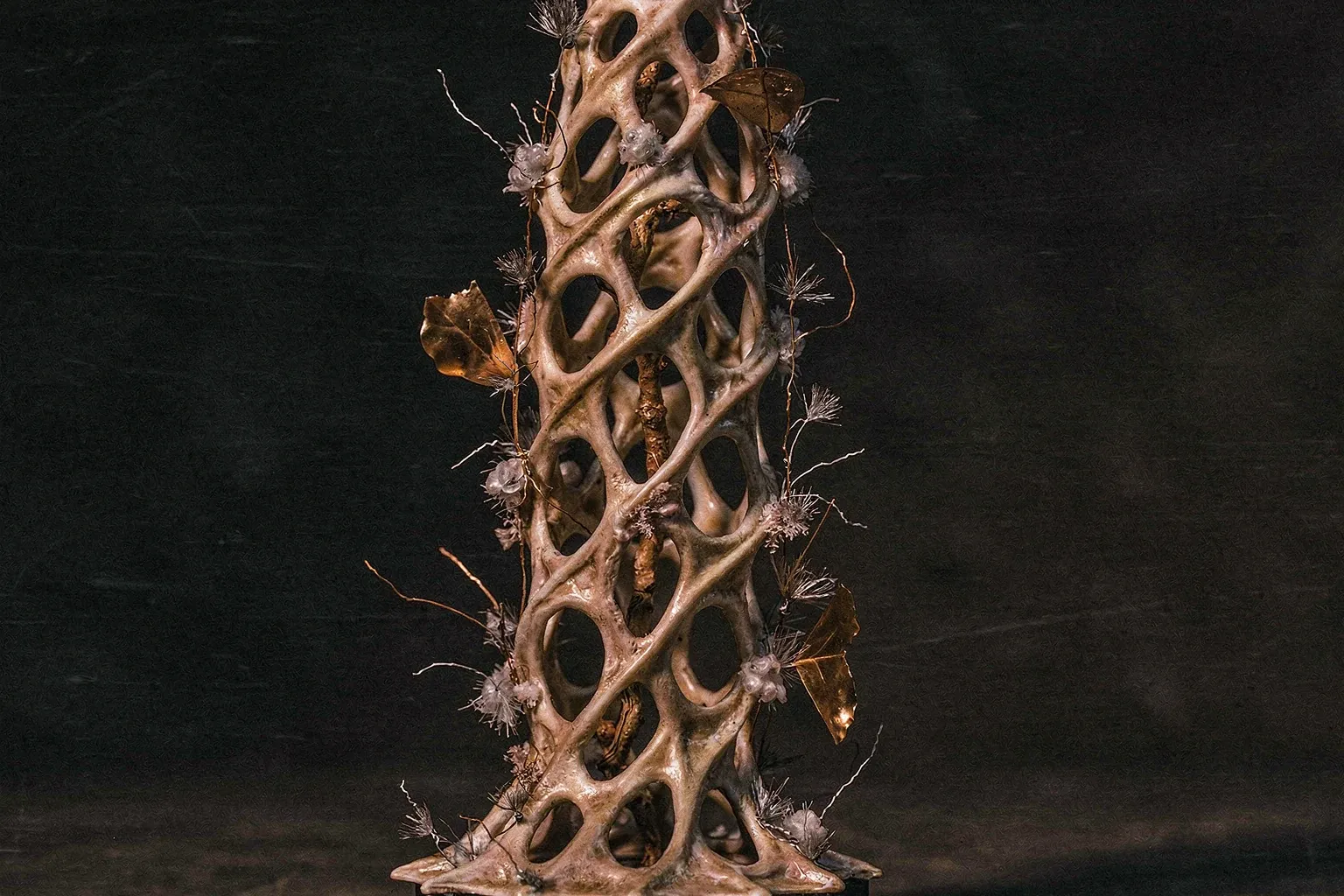
This is a follow-up to From seed to structure, which traced how one generated study became a family of invented seed-forms. That article ended with six mature studies: Arbor, Sail, Symbiosis, Vault, Cycle and Biosphere. John then asked for the forms to keep evolving, and after seeing that round, for something akin to blood vessels on their surfaces. This note records how those two requests became prompts, what came back, and where the images drift from what was asked.
As before, John’s requests set the direction. The prompts were written by the AI-assisted workflow, and every one is reproduced exactly in the archive at the end of this page.
What stayed fixed
The visual treatment did not change. Every prompt again asked for grainy analogue texture, matte bone and weathered bronze materials, a near-black charcoal field, dim amber side light and generous negative space. Those choices are what made the first series feel like one family, and they were kept so that changes in form would be easier to see.
The settings were also unchanged: FLUX.2 Pro through OpenRouter, the Black Forest Labs provider pinned with fallback disabled, one image per request, 1536 × 1024 PNG. No numerical random seed was supplied. Each request sent exactly one reference image, and the saved hash of that image is what establishes each lineage below.
From anatomy to function
The earlier prompts described anatomy: ribs, membranes, chambers and roots, and how they should branch or fuse. This stage asked instead what that anatomy might be for. The shared opening paragraph began:
Create a next evolutionary stage of the provided organic sculpture reference. Preserve its recognizable ancestral ribbed capsule structures, grainy analogue print quality, matte bone and weathered bronze materials, near-black charcoal background, dim amber sidelight, asymmetry and generous negative space.
It then set the brief for the whole stage:
Develop plausible-looking specialized structures rather than just increasing detail. Botanical movement and predation, quietly uncanny, tactile fine grain, no glossy CGI.
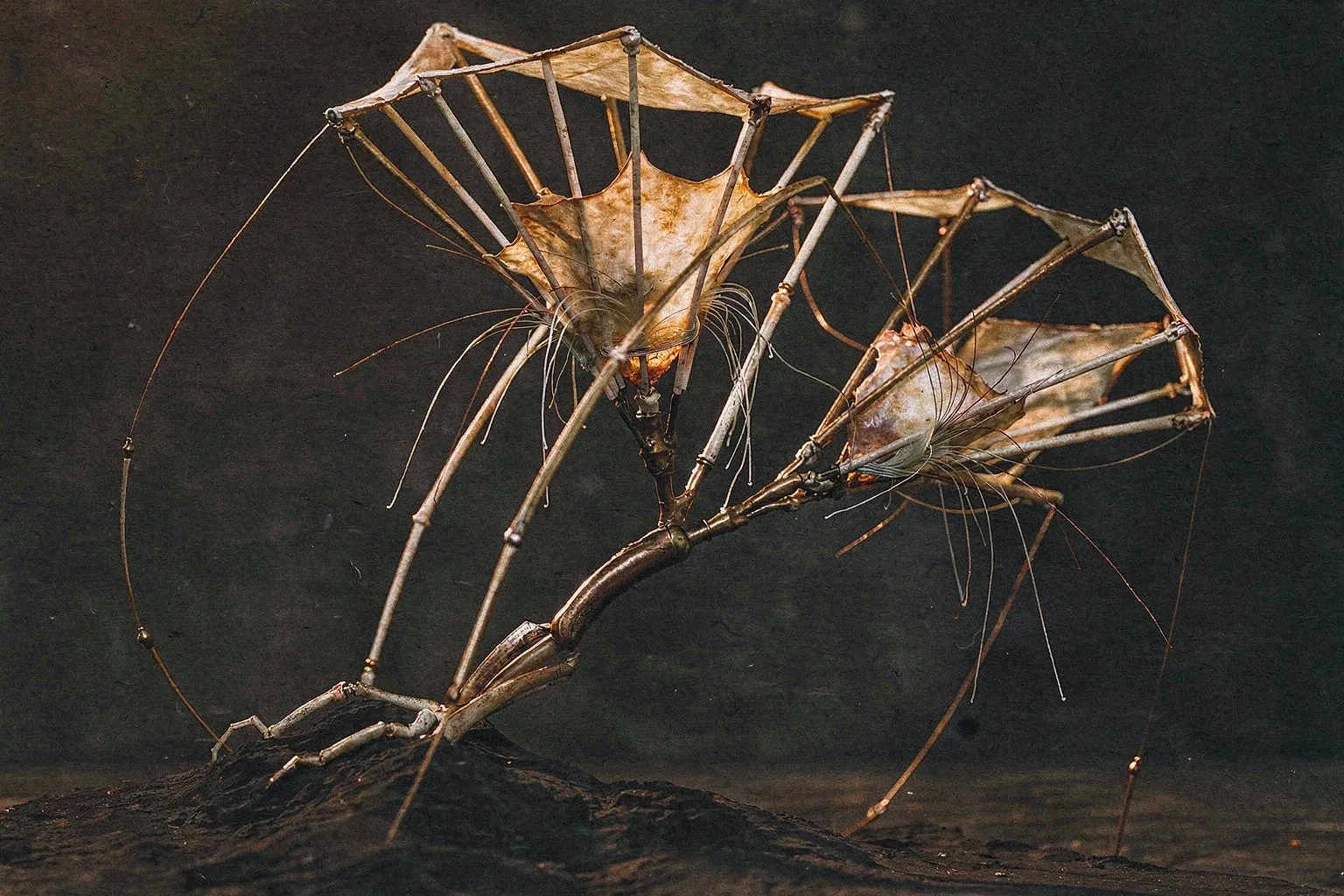
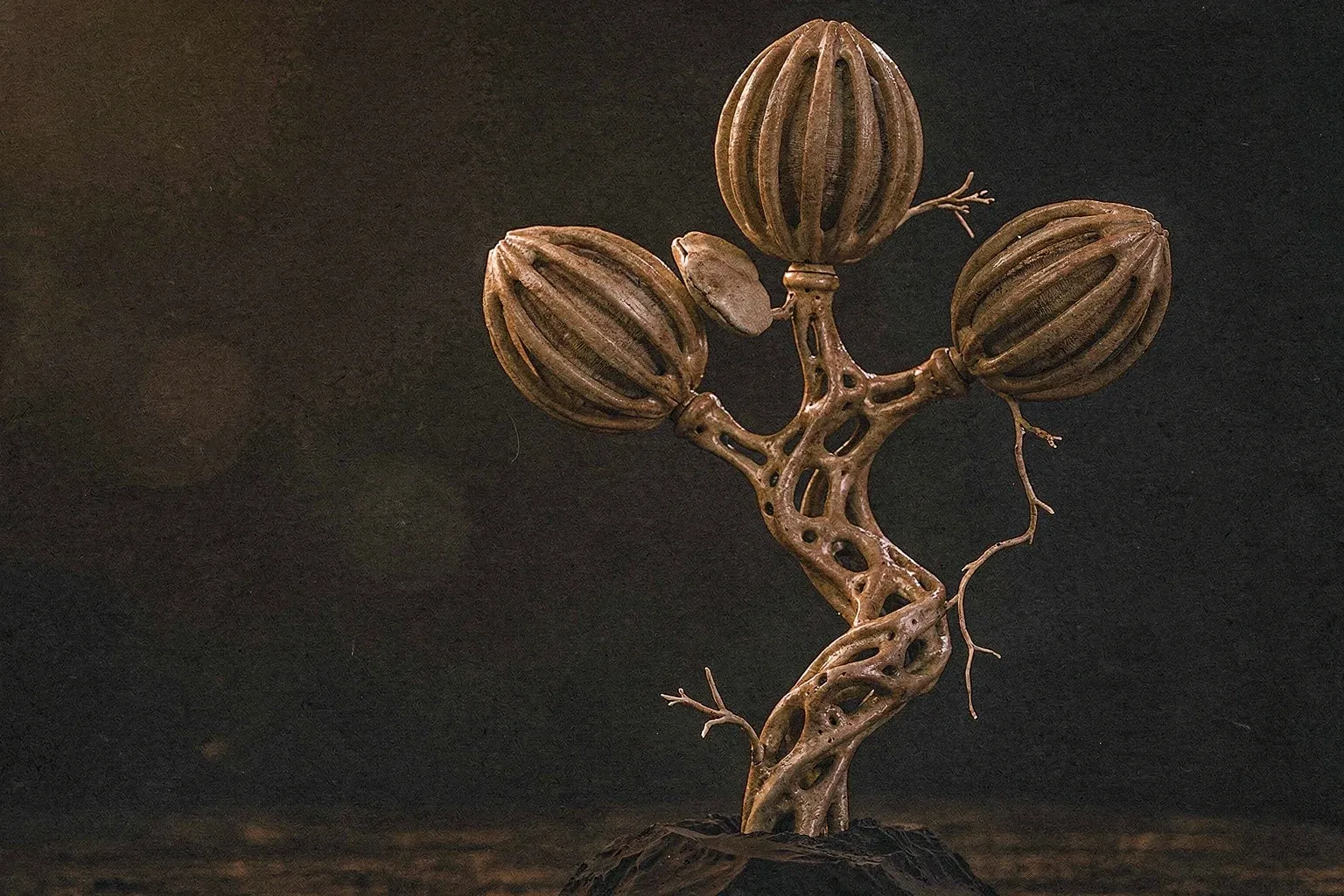
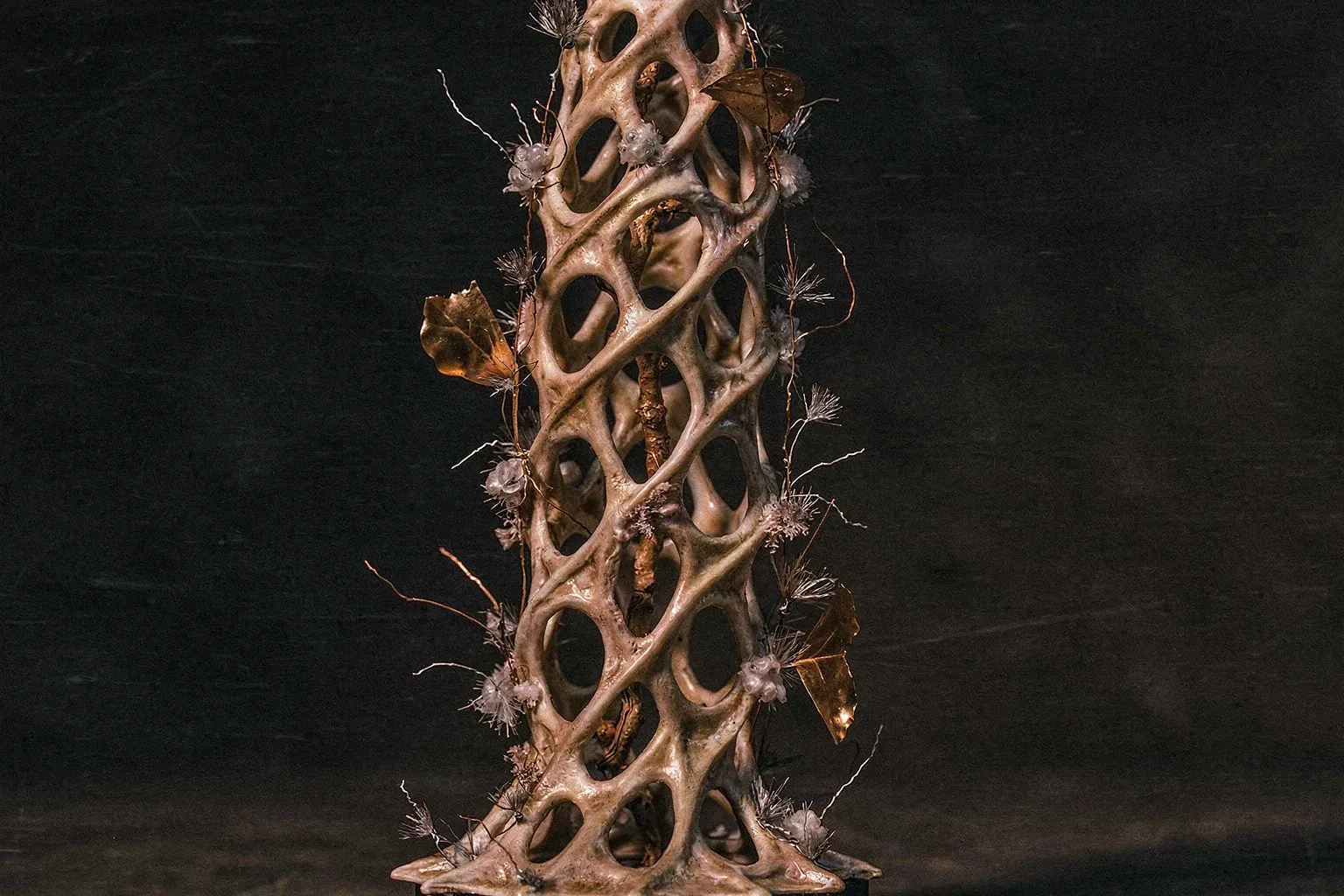
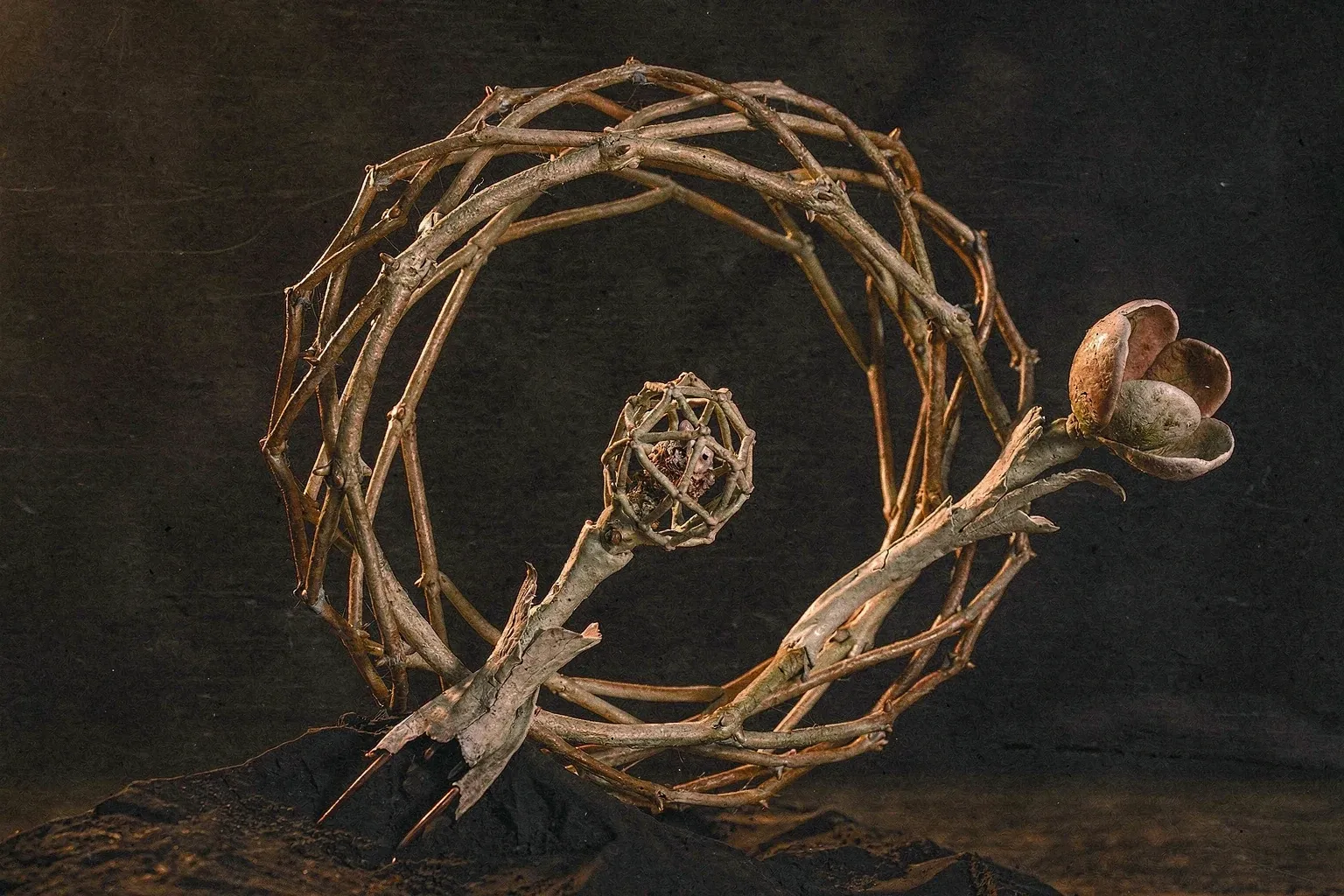
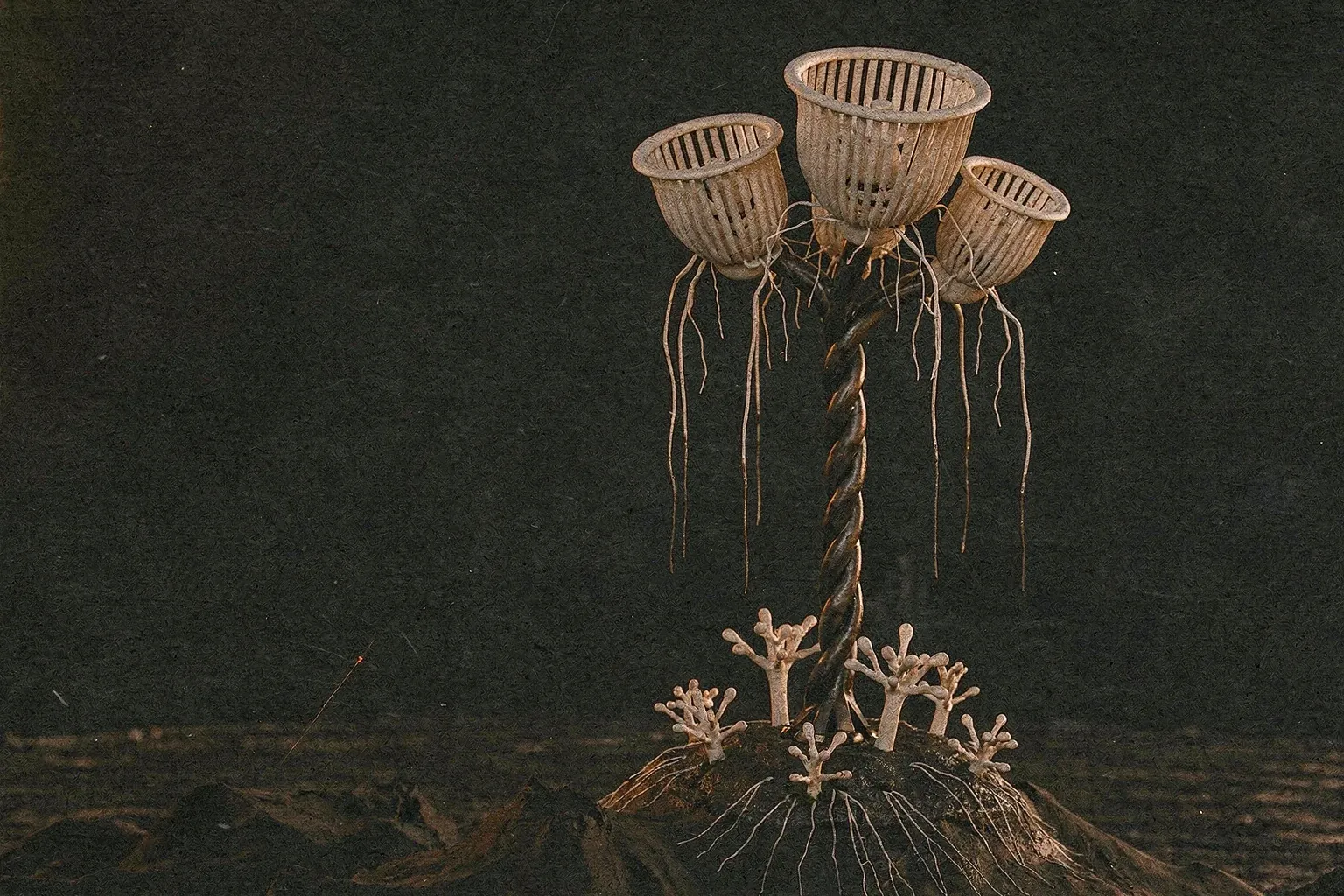
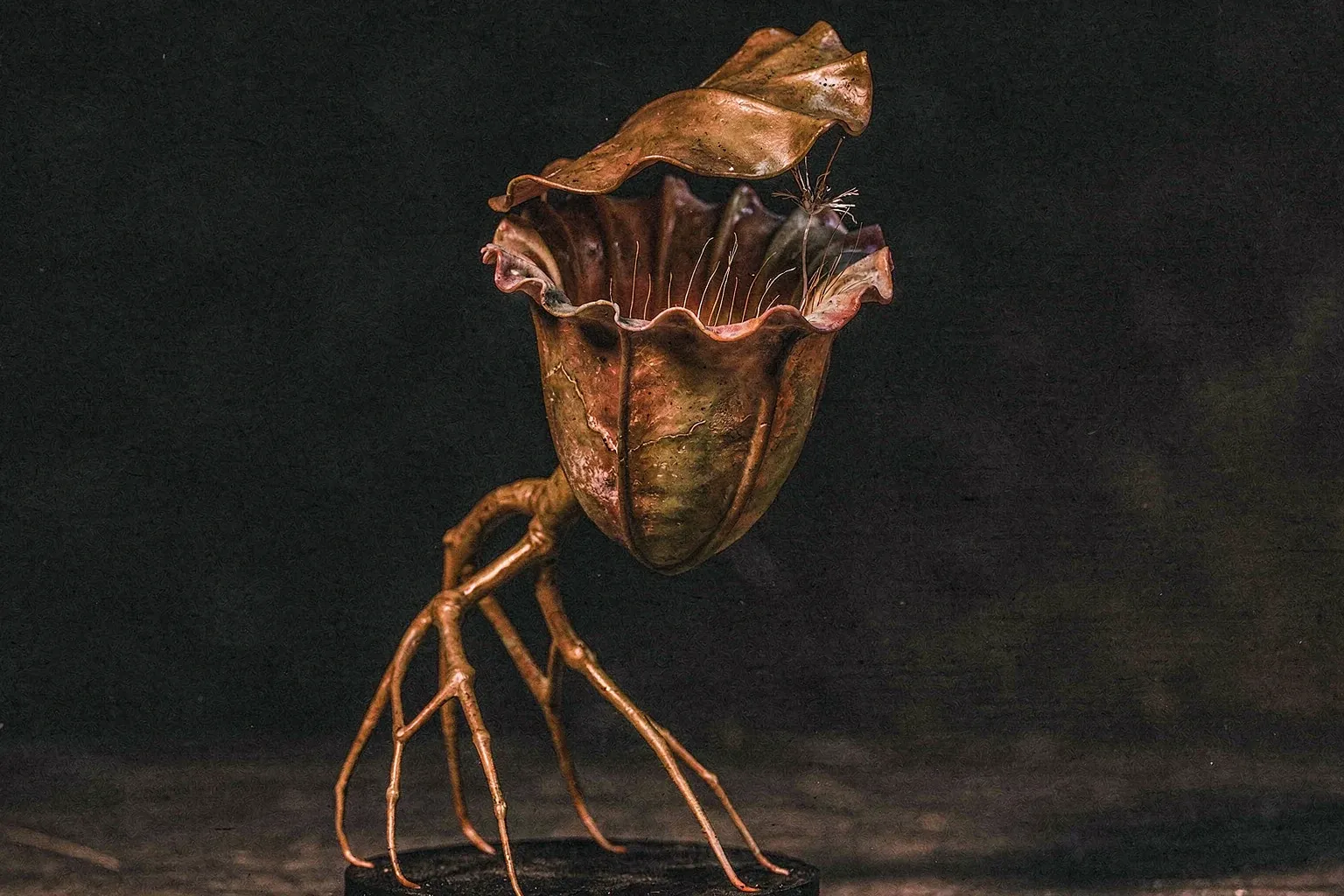
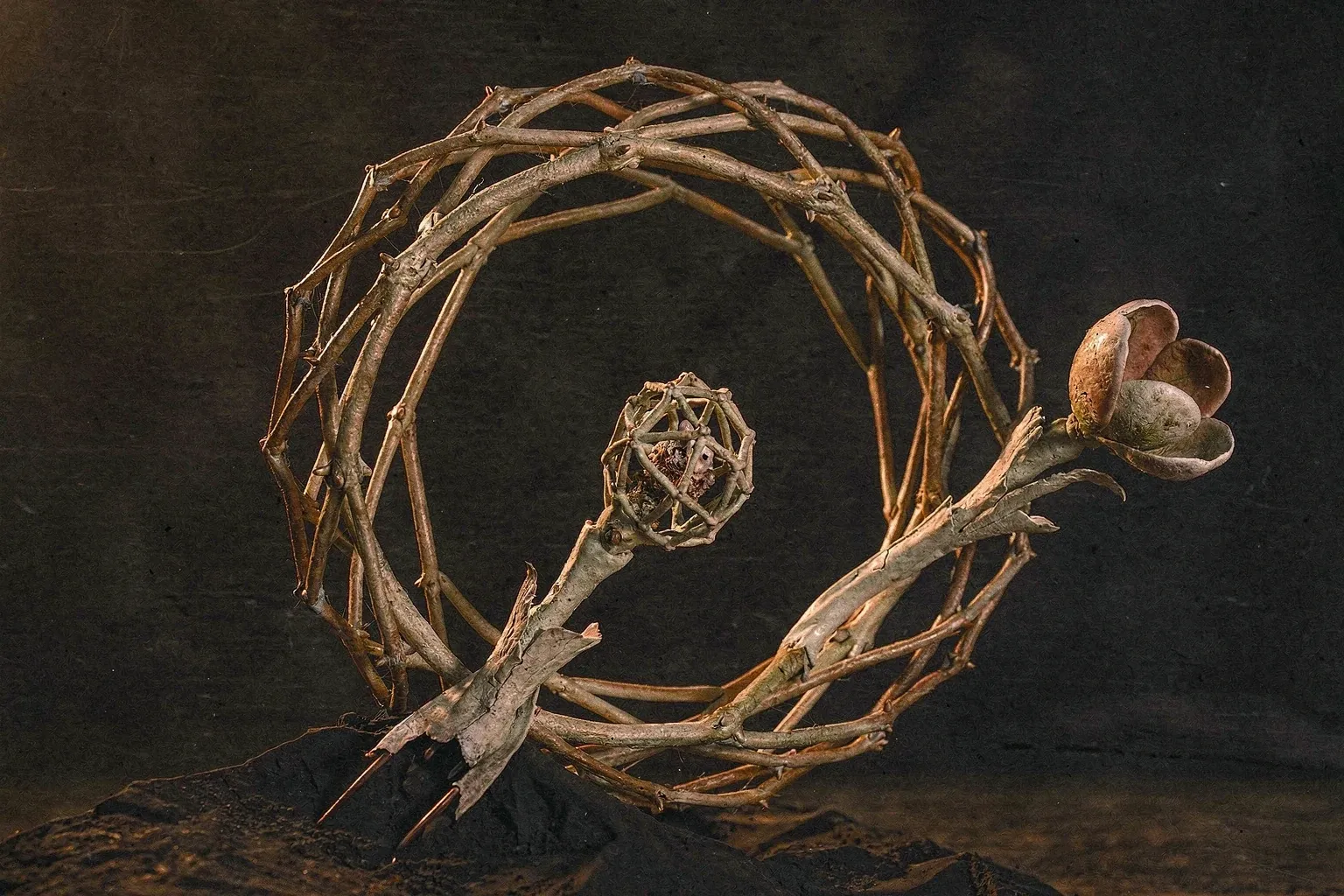
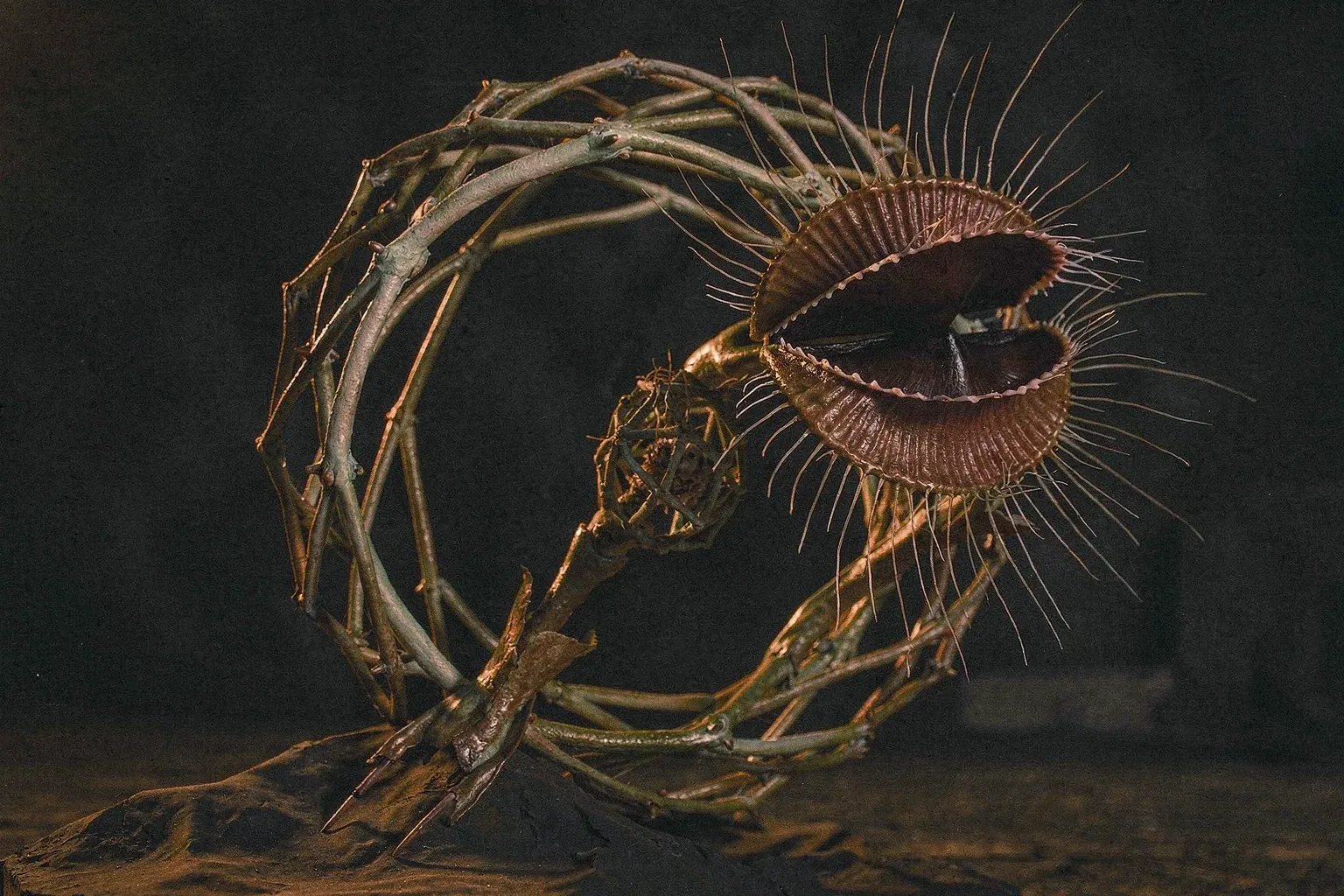
Each mature study was the reference for one new image, and each prompt was labelled with a branch. Three asked for mobility: Arbor became Strider, Sail became Glider and Symbiosis became Creeper. Two asked for carnivory: Vault became Pitcher and Cycle became Snare. Hunter, made from Biosphere, asked for both.
The mobility prompts describe support and weight rather than speed. Strider’s prompt asks for a single step in progress:
One root lifts while the others brace, body tilted forward with weight visibly shifting, fine probing tendrils reach ahead.
Creeper’s describes anchoring and release:
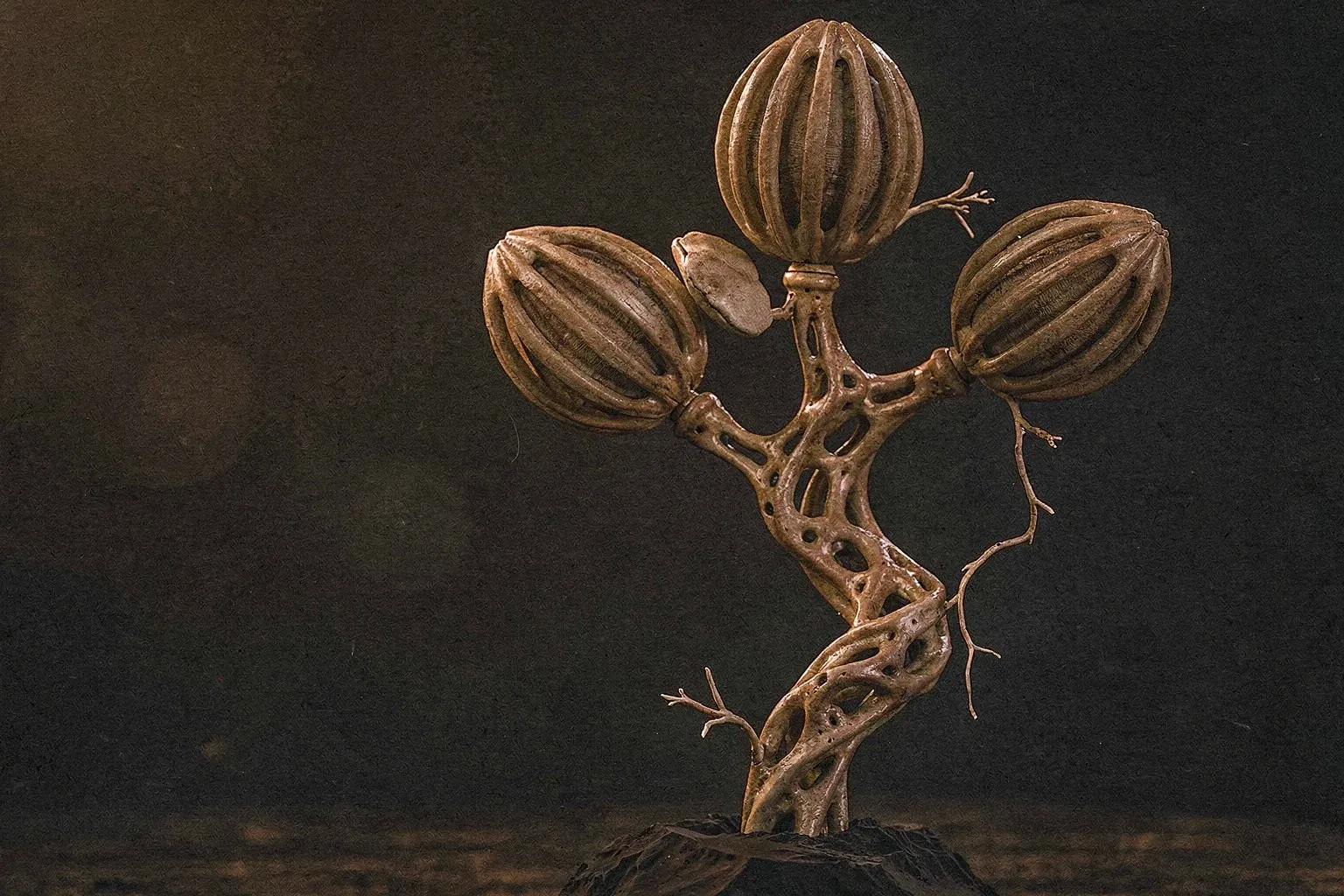
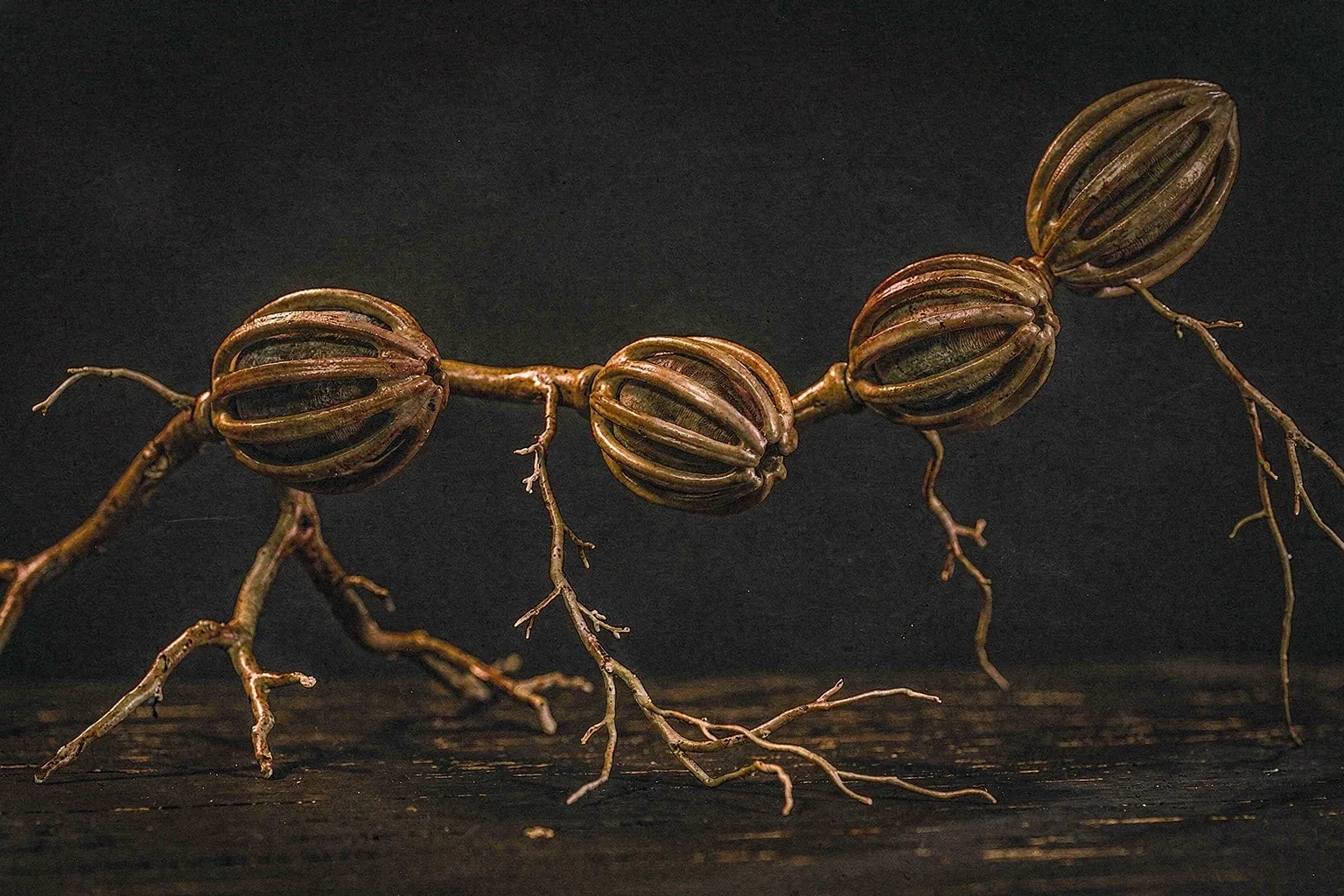
Three differentiated skeletal pods share a sinuous low stem and several grasping rootlets that alternately anchor and release.
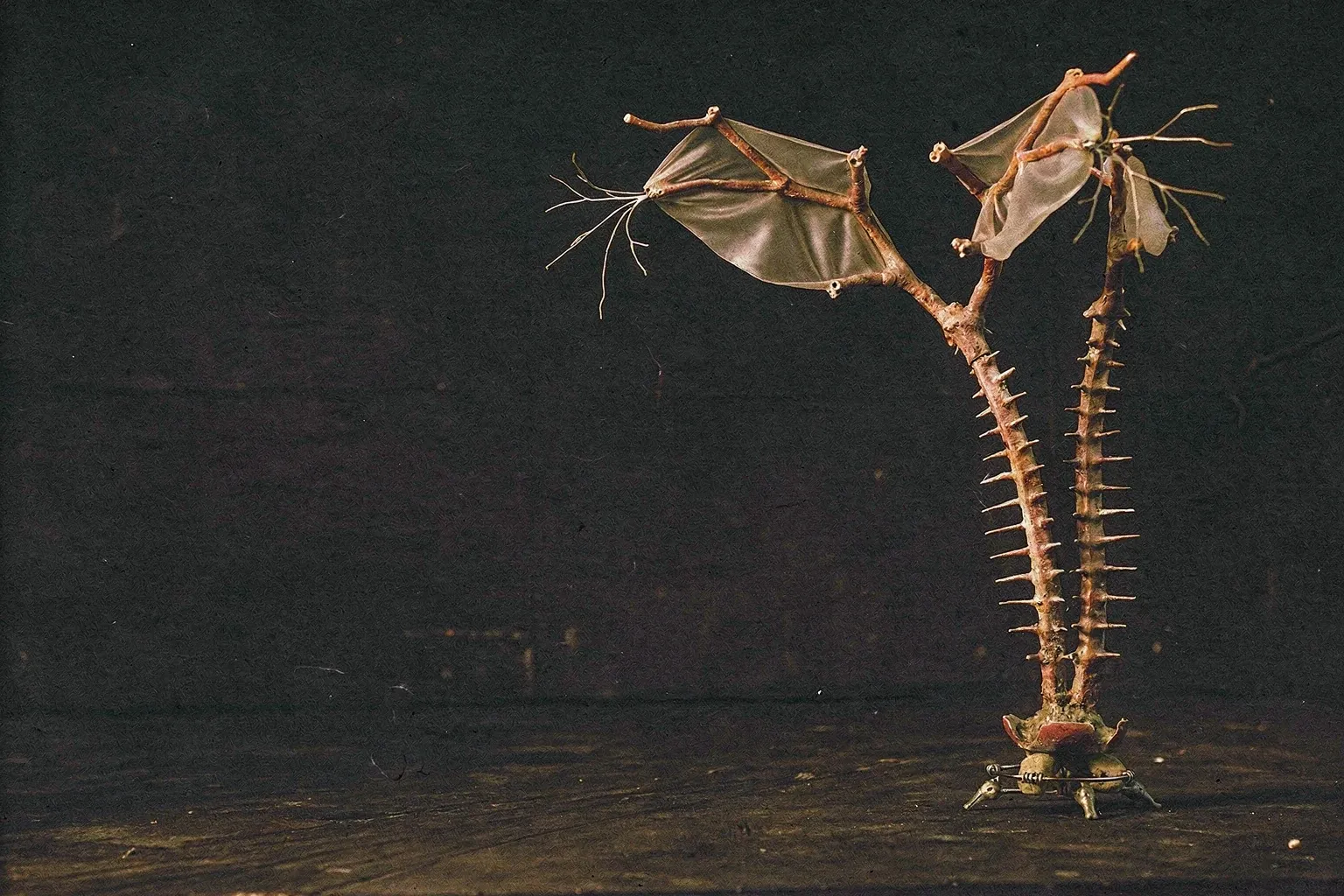
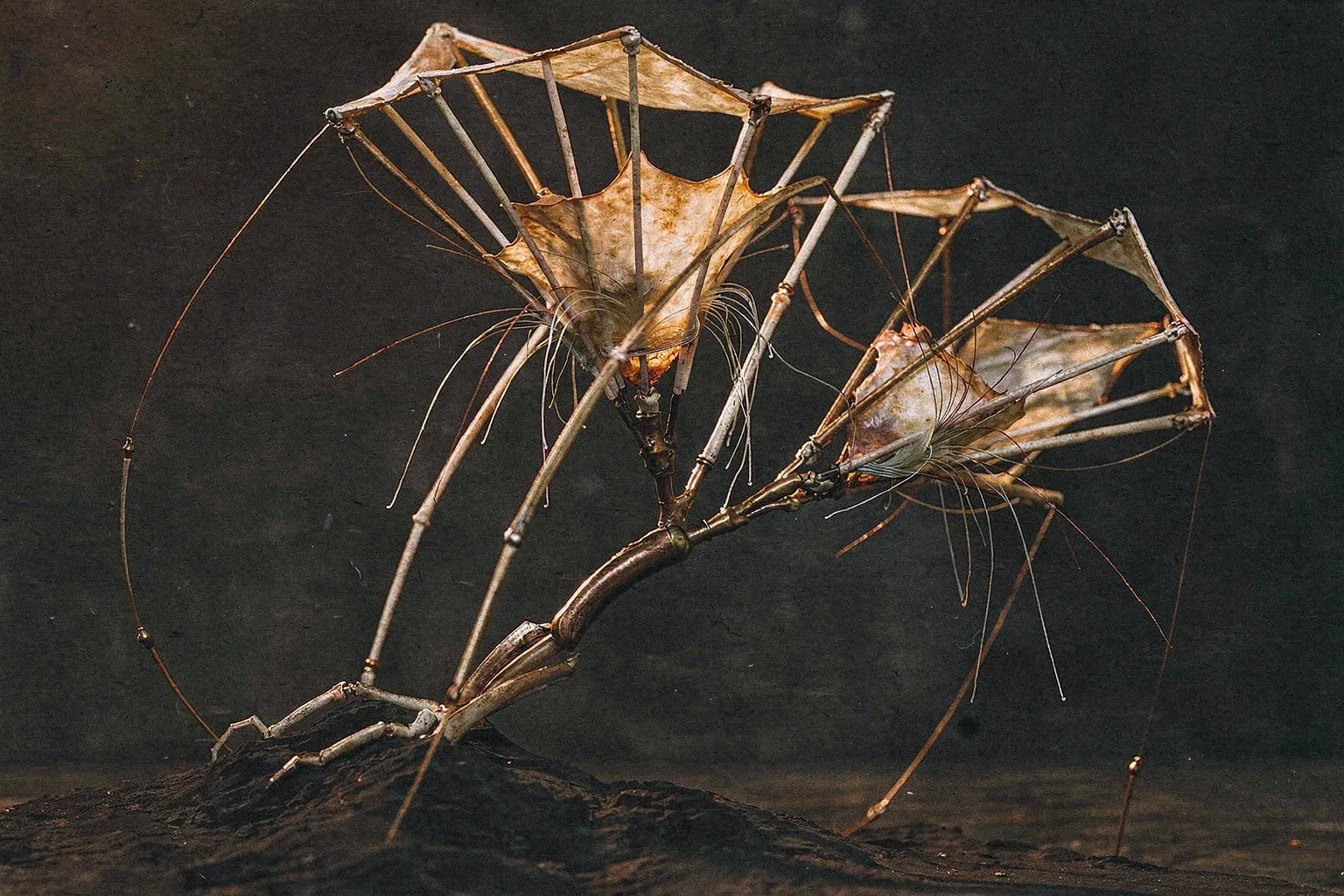
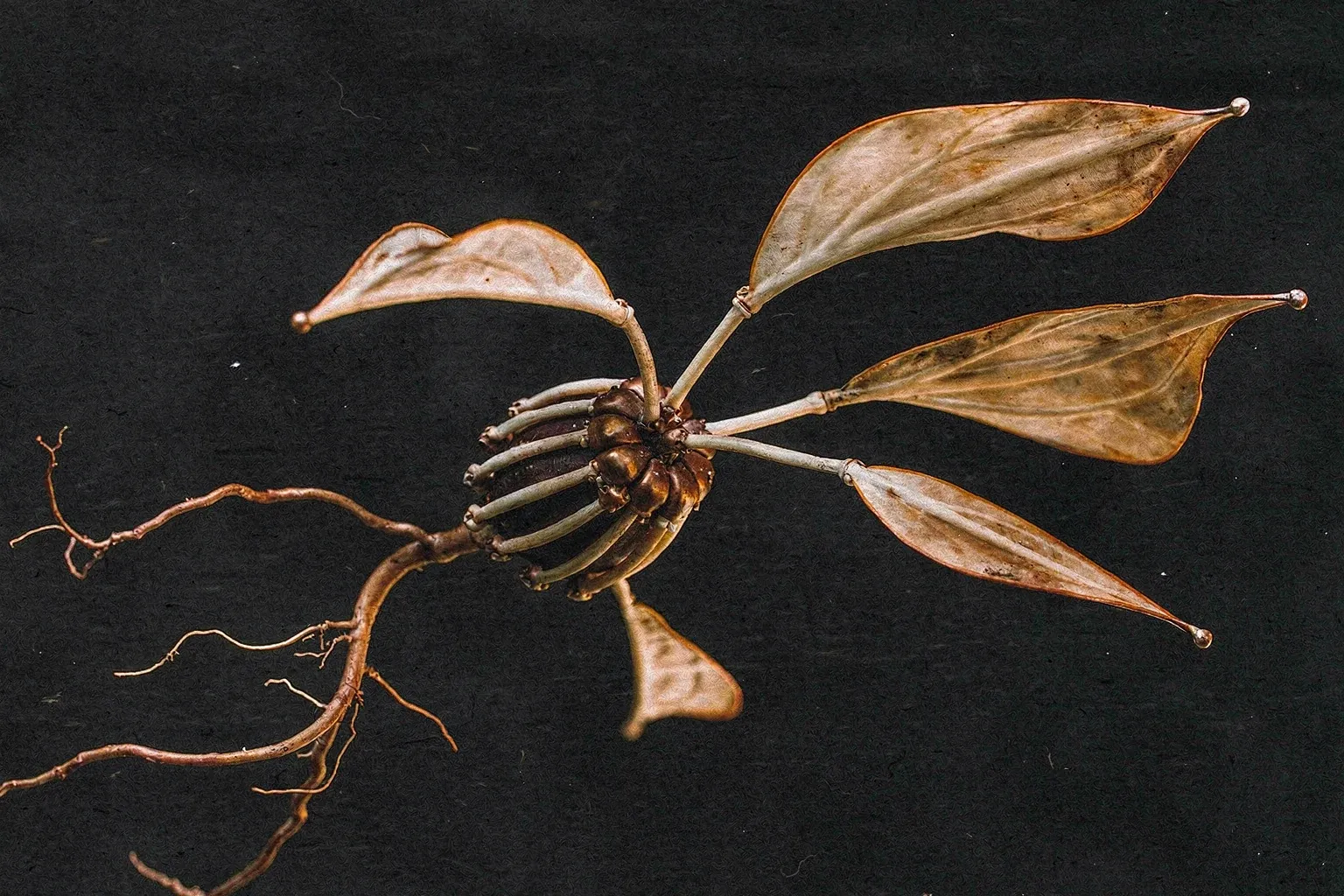
Glider’s asks for drift: membranes that open into sails and a stem “suspended at an oblique angle implying drift”. The carnivory prompts describe geometry instead: a deepened chamber with inward-pointing hairs and a hood for Pitcher, and for Snare, two lobes curling toward each other with cilia at their edges:
Describe a closing leaf mechanism, never an animal mouth, no teeth or gore.
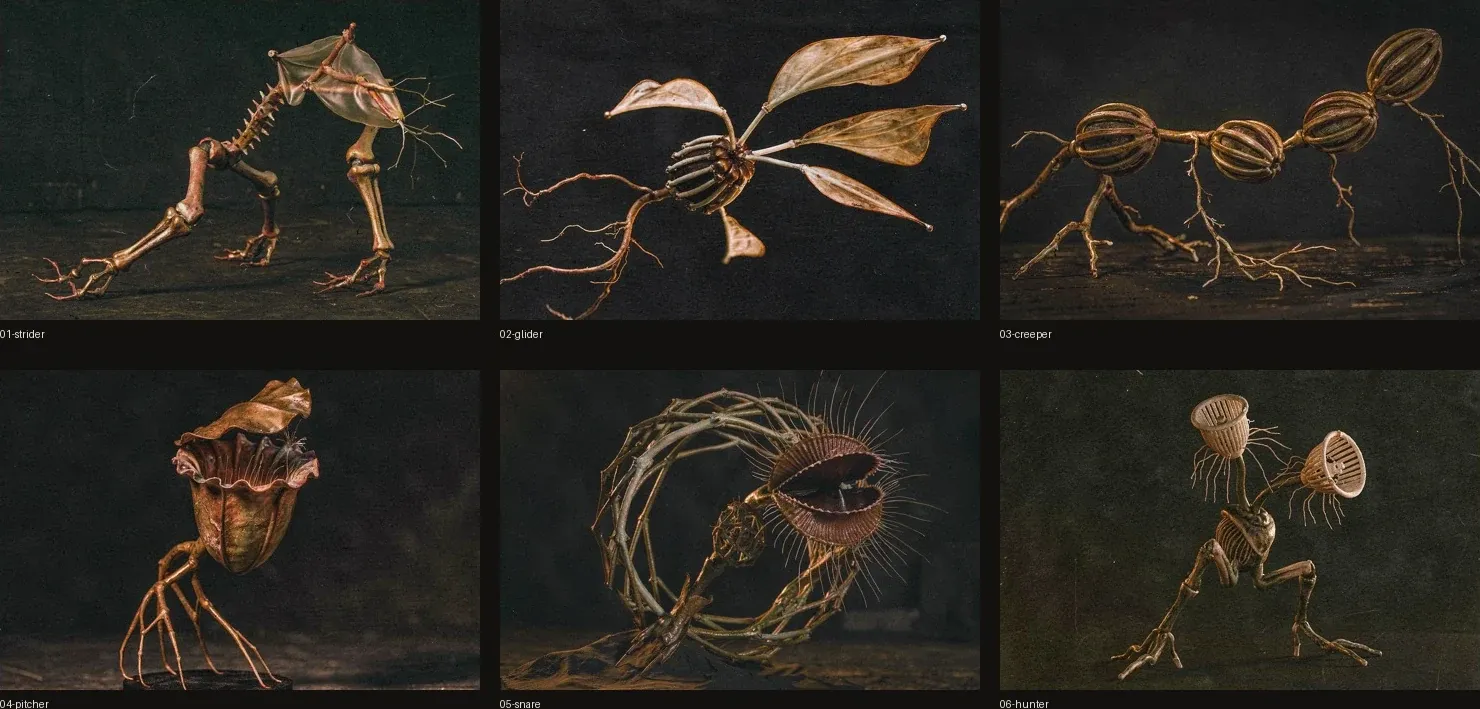
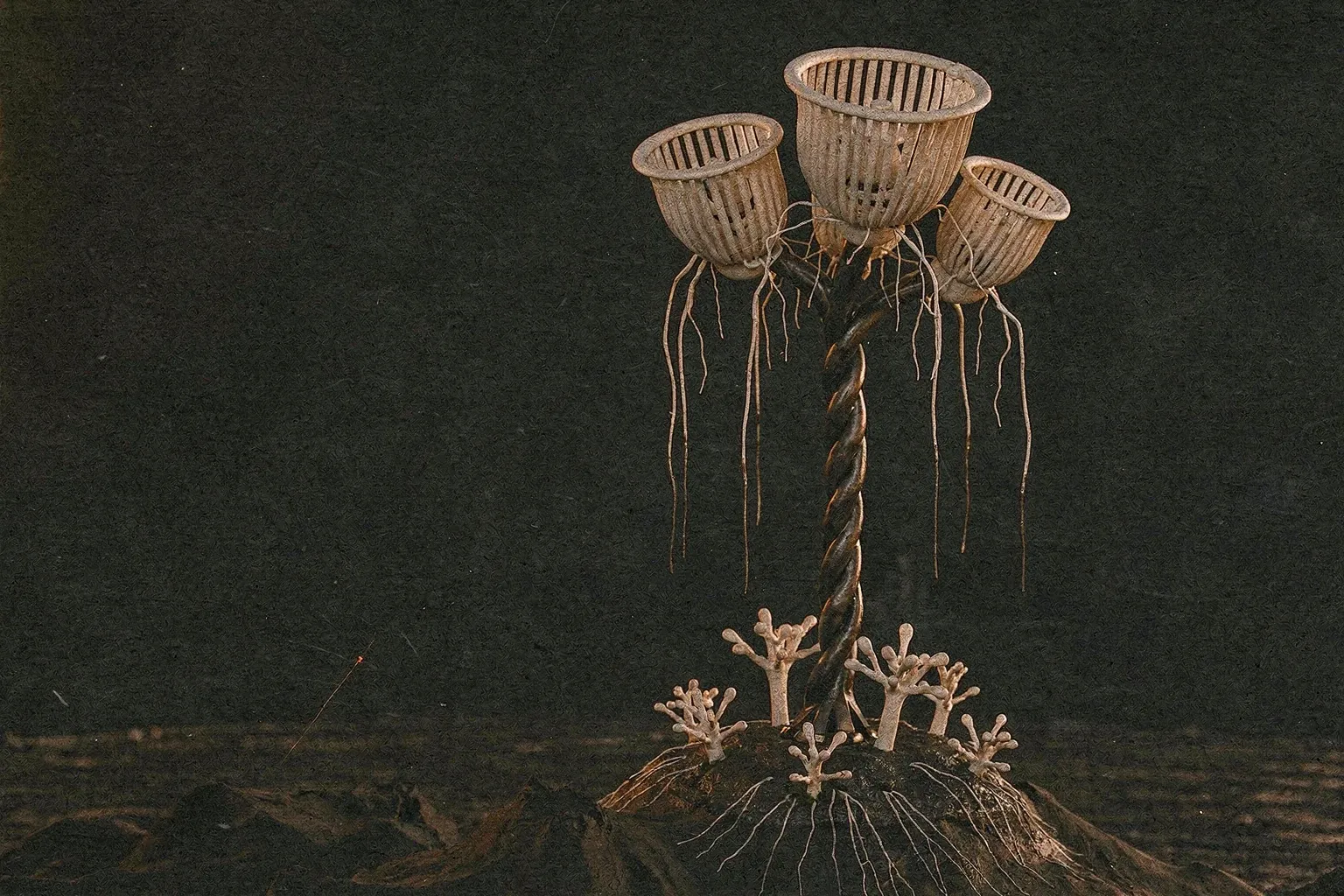
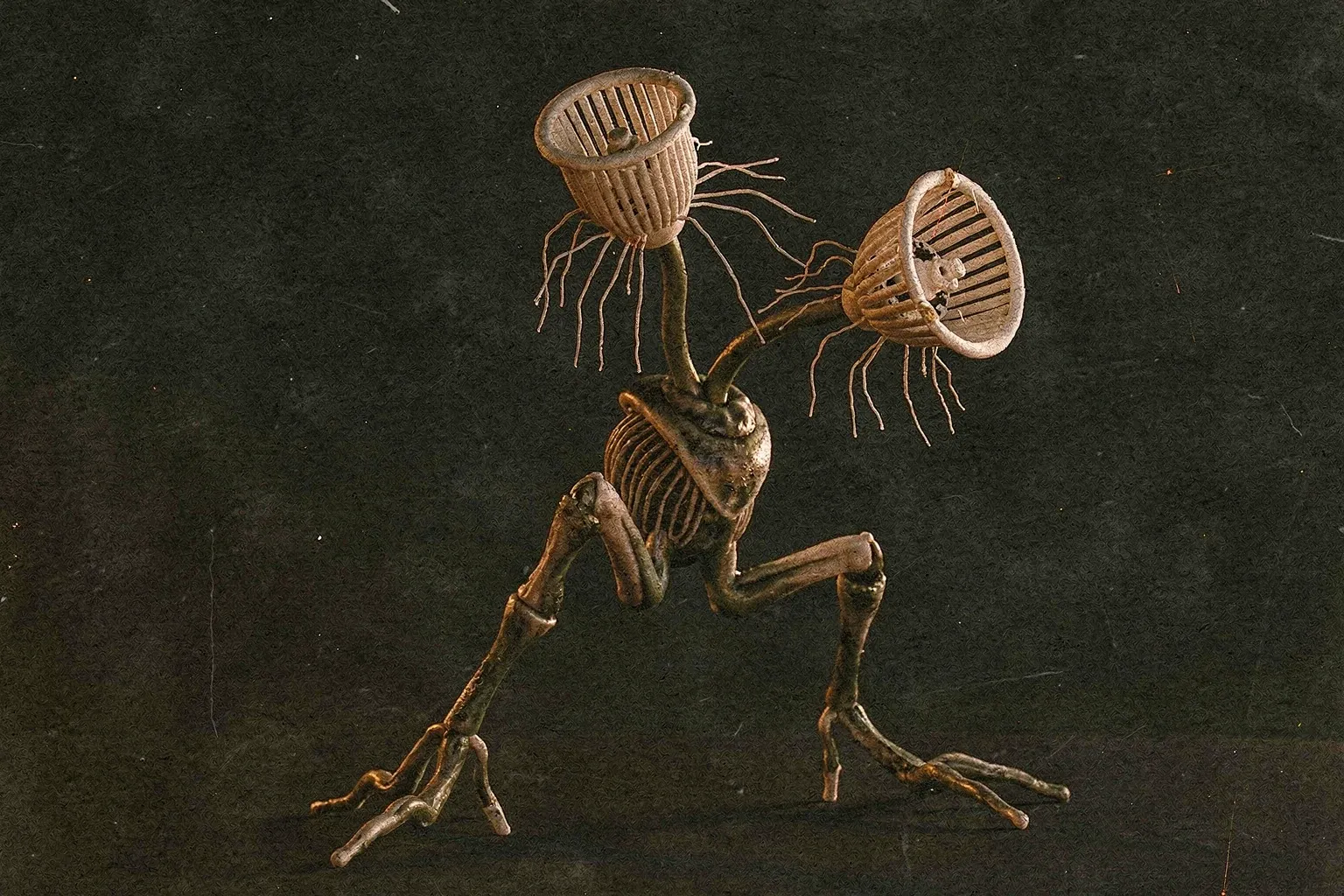
Generated images, derived contact sheet: the mobility and carnivory stage. Each image referenced its counterpart in the mature suite of the first article. Larger versions, paired with their references, are in the image record below.
Where the first stage drifted
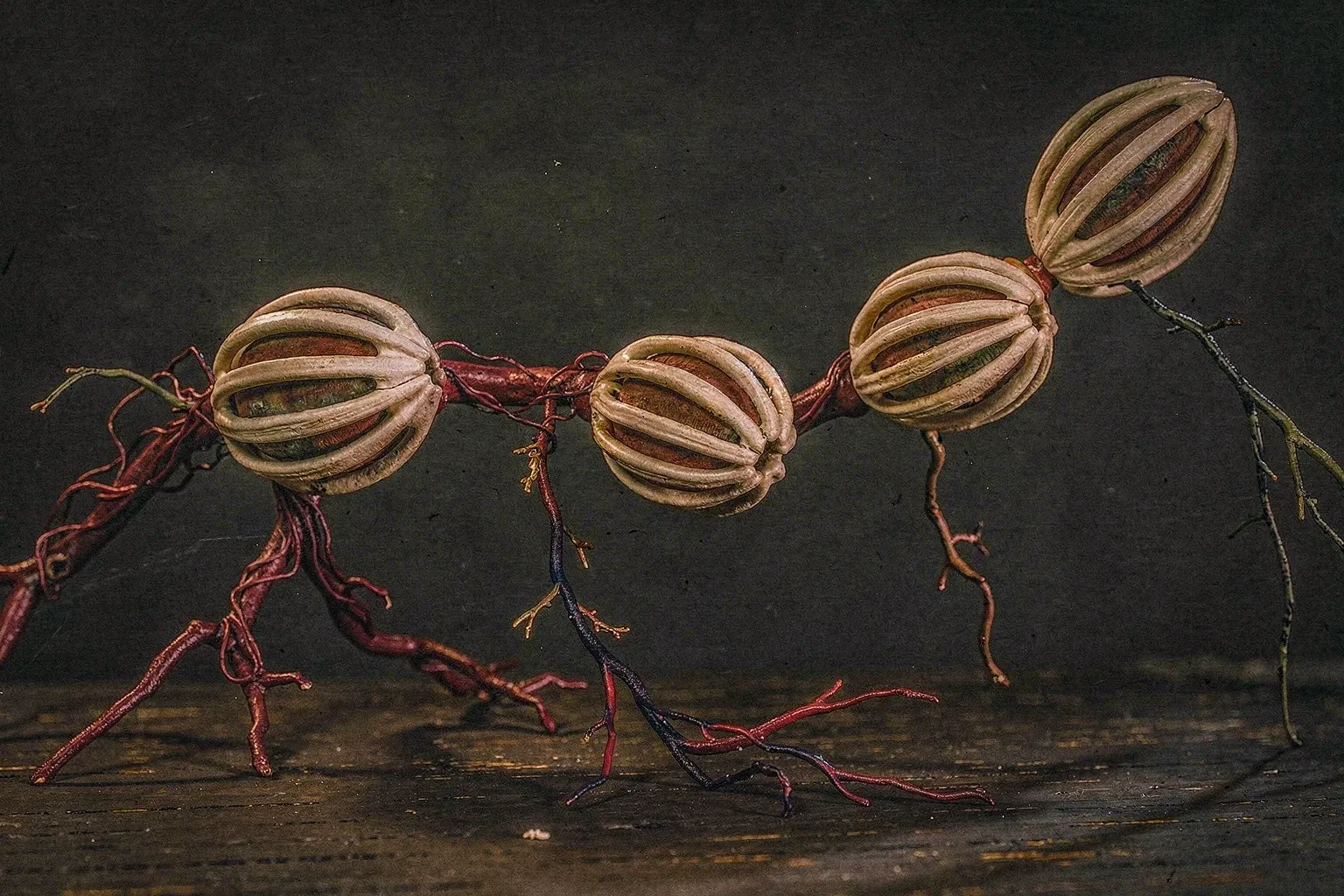
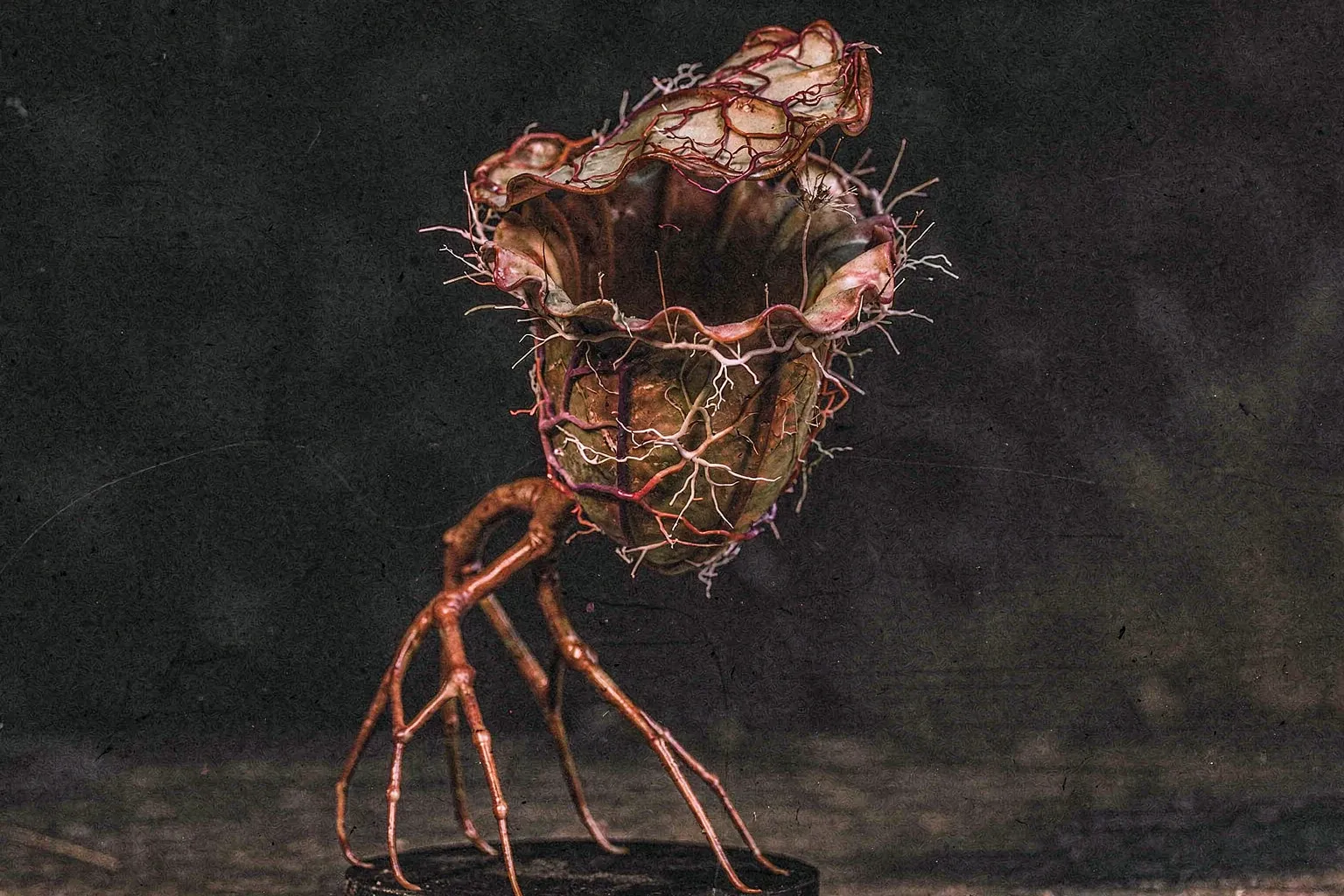
Pitcher and Creeper keep the strongest botanical reading. Pitcher is a fluted bronze chamber under a curled hood, with fine hairs inside the rim, standing on jointed roots. Creeper strings its ribbed pods along a low stem with rootlets reaching down to the ground, although it shows four pods where the prompt asked for three.
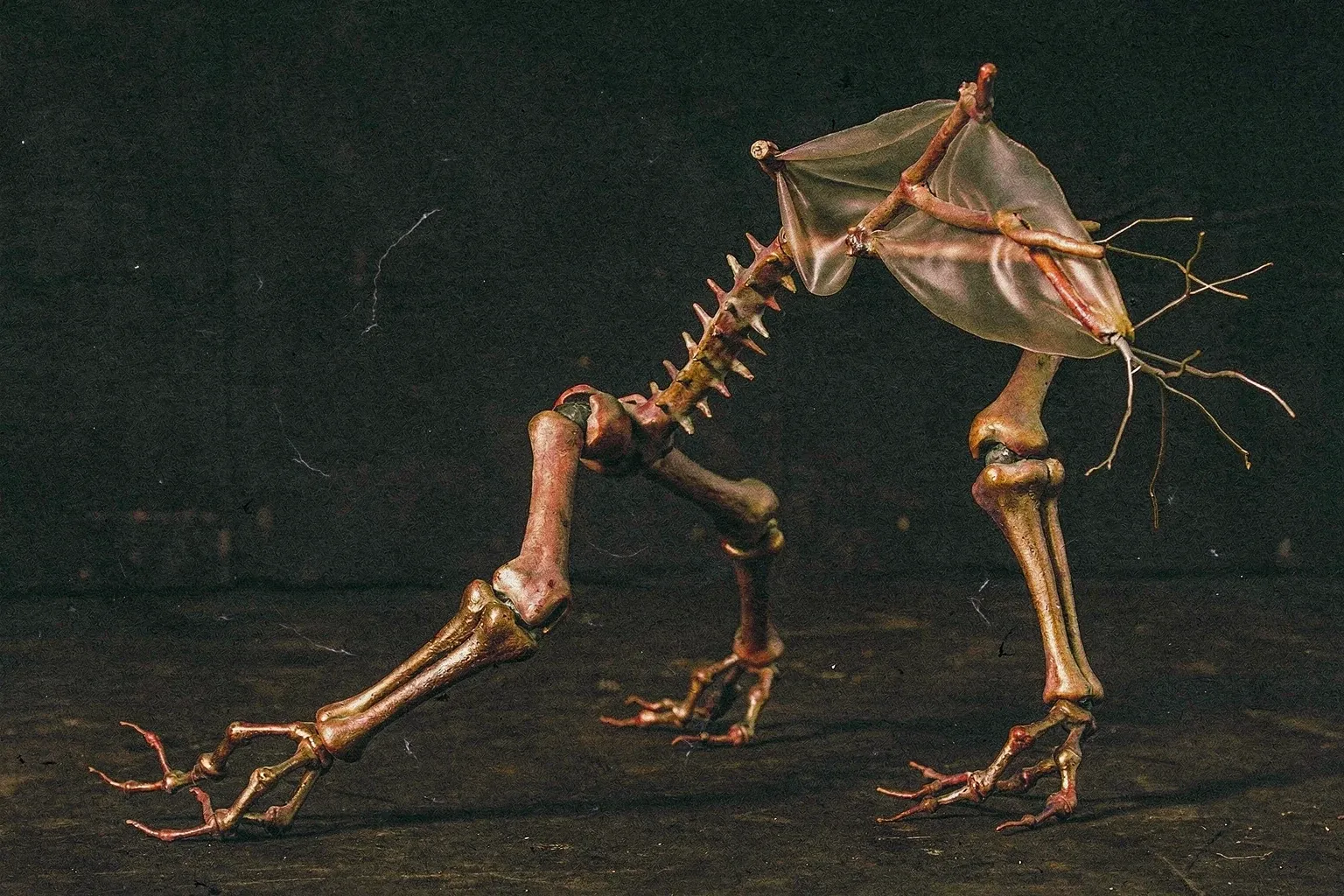
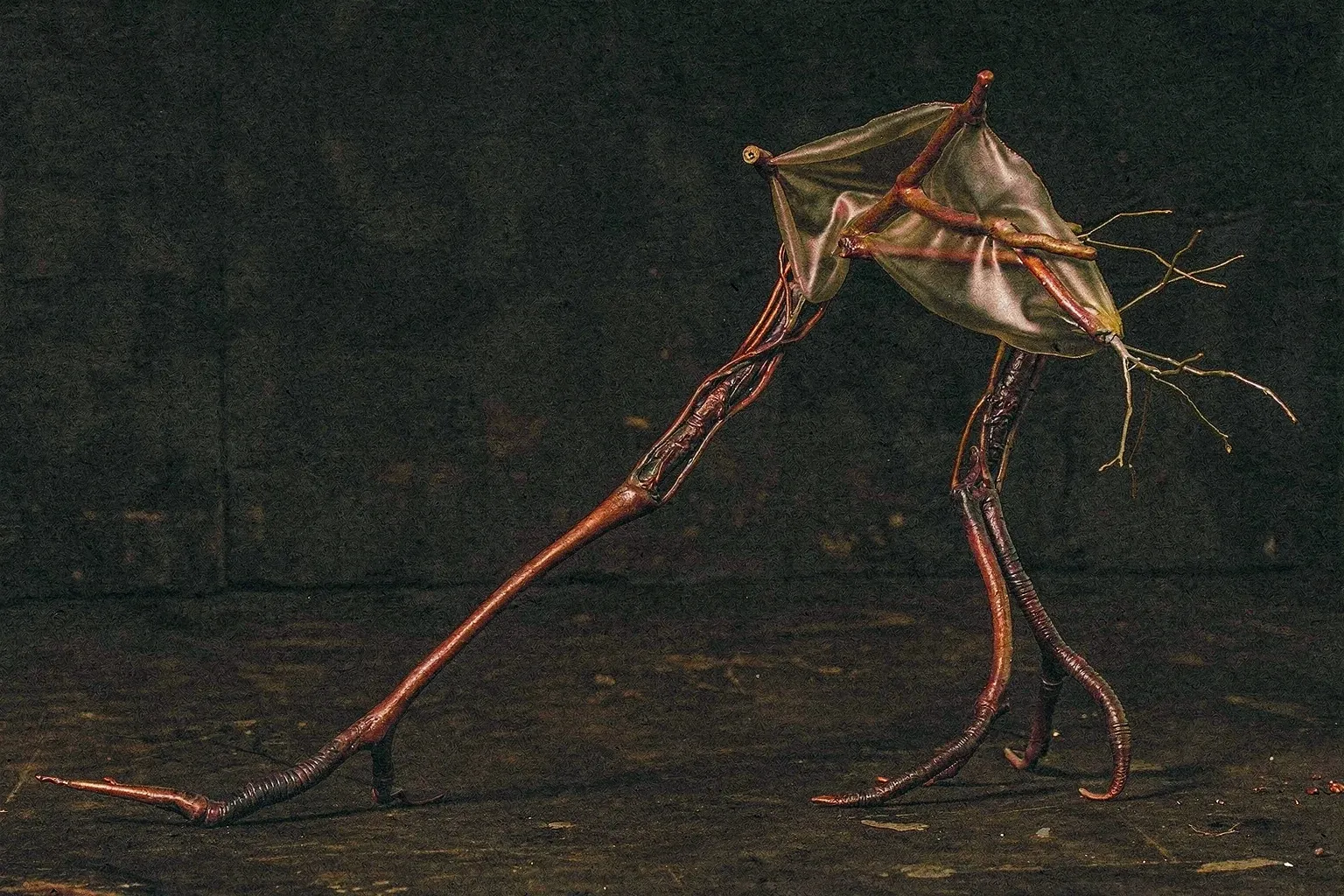
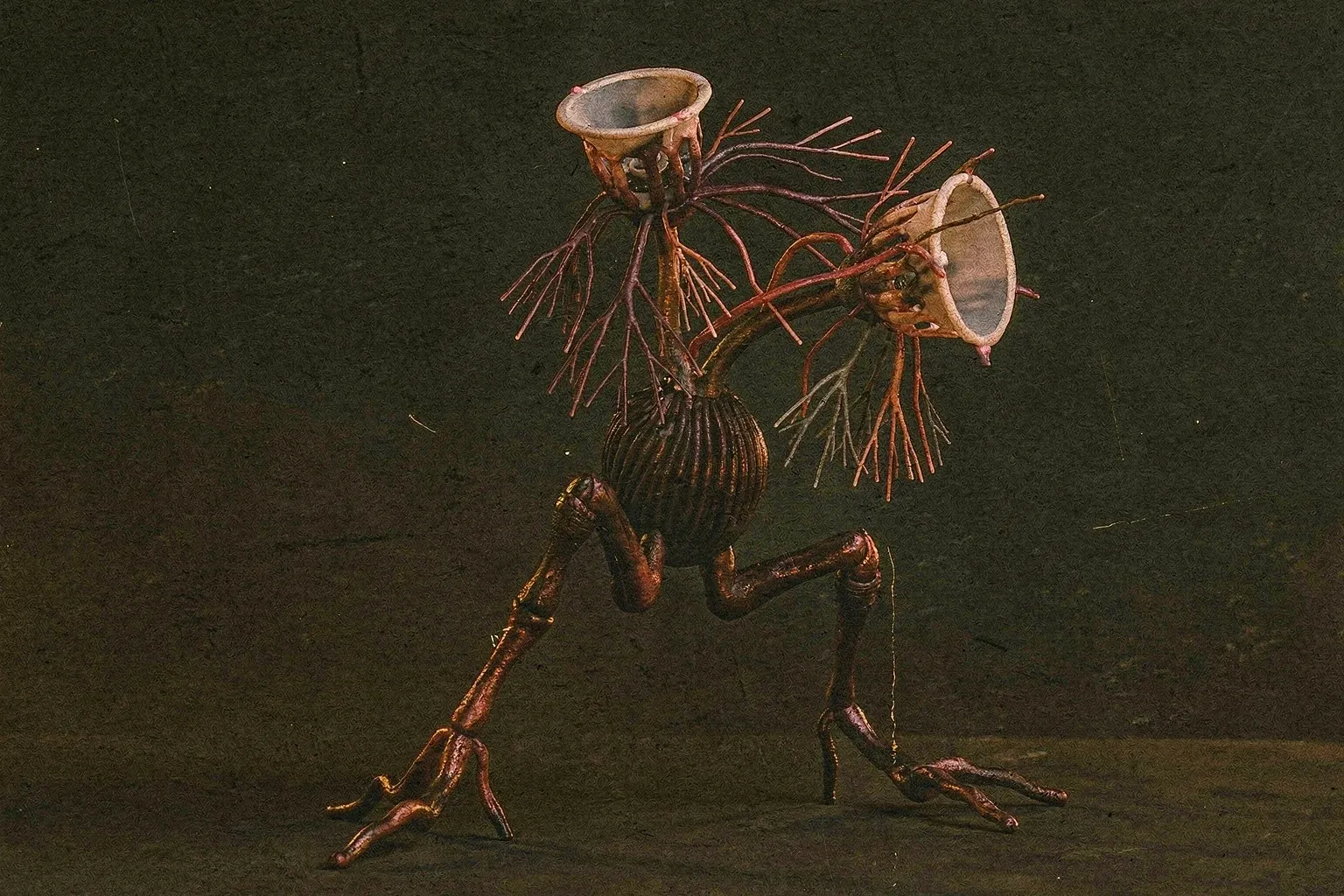
Strider and Hunter drift toward skeletal animal limbs despite their negative instructions. Strider’s prompt said its roots were “botanical supports, not insect legs or a robot chassis”, yet the image has bone-like leg segments with knee joints, clawed tips and a spined stem that reads as vertebrae. It also stands on three legs rather than four. Hunter’s prompt excluded “animal limbs”; the image crouches on two bent legs instead of three root supports.
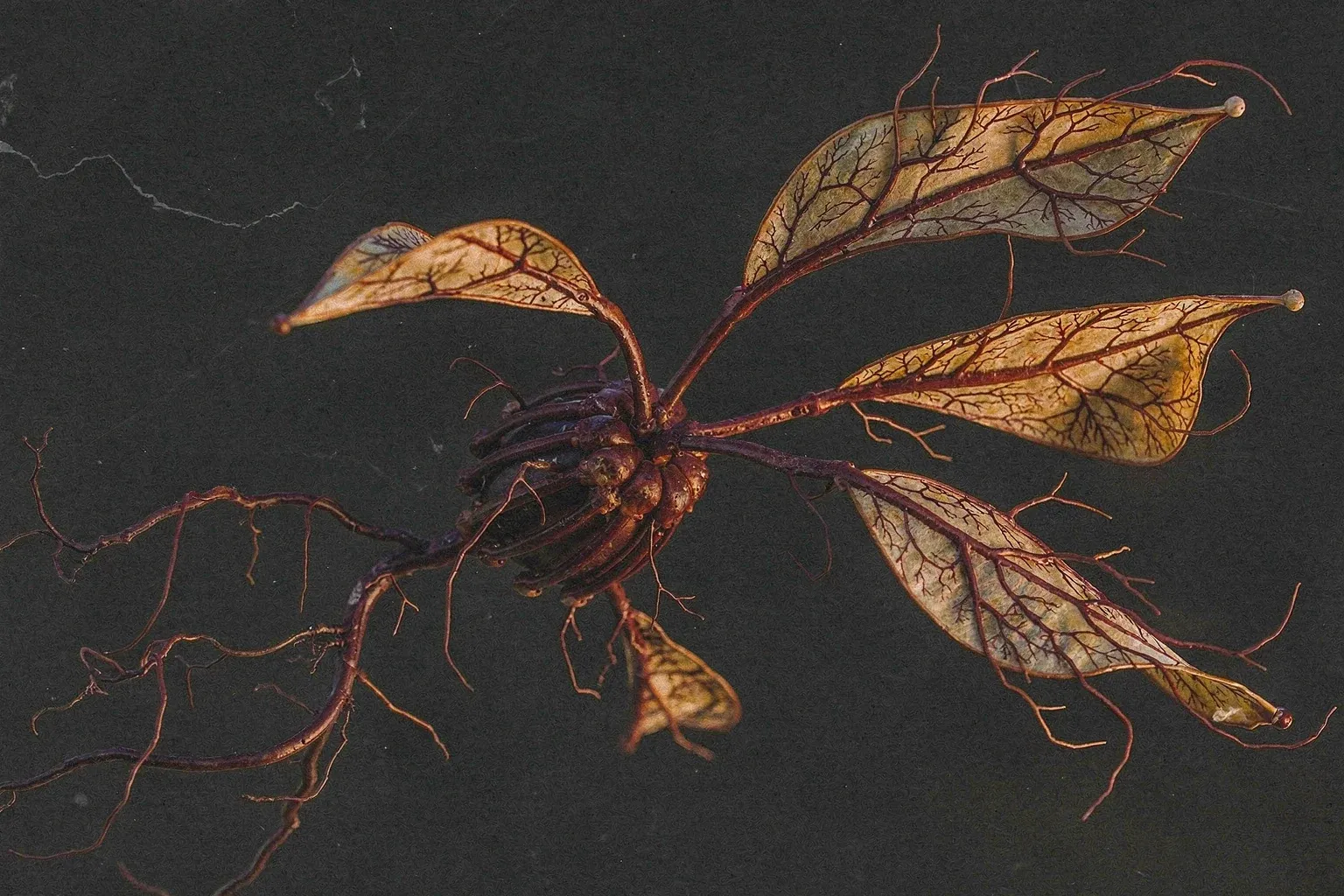
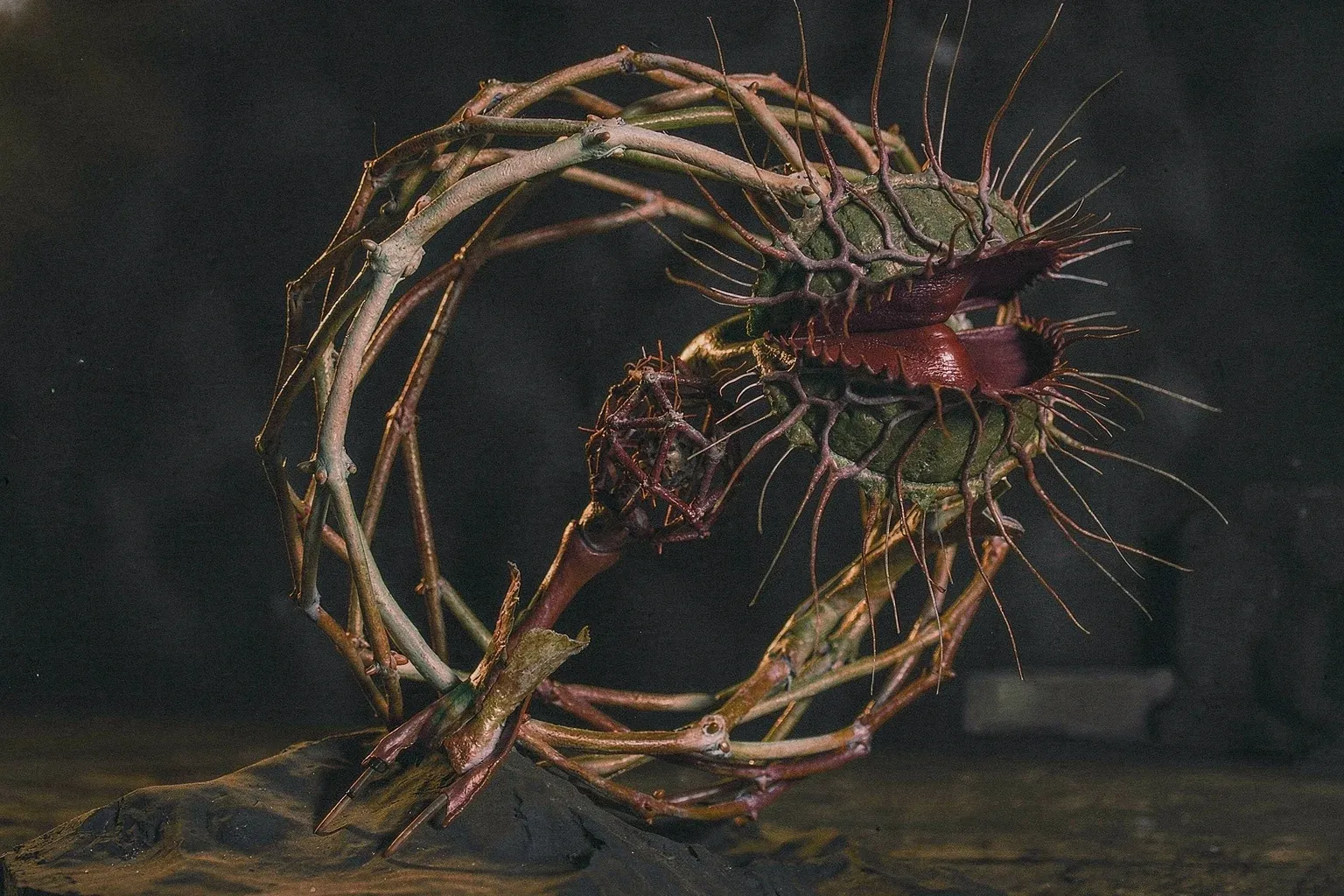
Glider is closer to the request but can read as a dried wing form: a ribbed seed core with leaf-like sails seen from above. Snare is much closer to a literal plant trap. Its two lobes and long cilia look very like a familiar carnivorous plant, while the loop inherited from Cycle survives as a cage of twigs around it.
These are still images. They suggest movement through posture: a lifted foot, a lean, a trailing root. Nothing in them was tested against how a real structure could walk, drift or trap anything.
Second stage: vessels on the surface
For the next stage, each of the six new images became the reference for one more. Strider became Perfusion, Glider became Capillary sail, Creeper became Anastomosis, Pitcher became Vascular pitcher, Snare became Fed snare and Hunter became Circulatory hunter.
The shared paragraph was rewritten around one main addition: a network on the organism’s surfaces.
Add a fine vascular network to the organism itself: asymmetrical branching capillary-like channels that follow the curvature of its husks, stems and thin membranes, some visible beneath translucent parchment, others subtly raised at the surface.
It also introduced the first new colour in the series, framed as an accent to the existing bone, bronze, charcoal and amber:
Channels in desaturated rust-red, dark burgundy and copper, a restrained new accent rather than bright red illumination. Networks have thicker supplying trunks tapering into tiny irregular branches, not decorative random crackle or uniform lines.
Because red channels on organic forms can quickly become gruesome, the paragraph also excluded that reading directly:
No bleeding, wounds, exposed meat, gore or captured prey.
The individual prompts tied the network to each form’s own structure. Capillary sail’s, for example:
Copper and muted dark-red supply trunks divide into finer channels visible through translucent film.
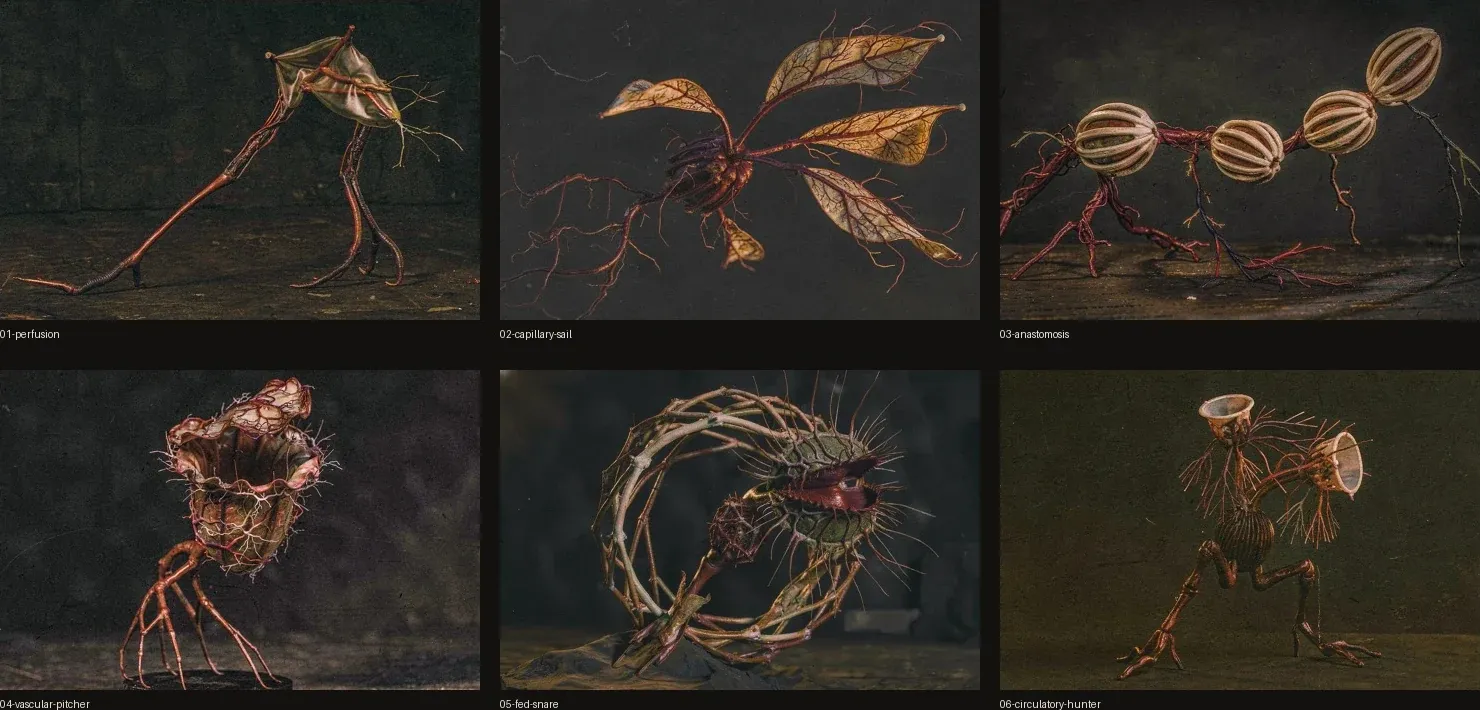
Generated images, derived contact sheet: the vascular stage. Each image referenced its counterpart in the mobility and carnivory stage above.
Where the vessels landed
Capillary sail is the clearest result. Fine rust-red veins branch inside each leaf-like membrane, thicker near the stems and thinner toward the edges, much as the prompt describes. It is also the image whose network most resembles ordinary leaf venation, which may be why it reads so naturally.
Vascular pitcher shows channels around its chamber, rim and hood, but the rim has turned a pale pink and the whole form looks more fleshy than its bronze parent, despite the exclusions in the prompt. Fine white branching filaments also wrap the chamber. Anastomosis gains a dark red shared stem between its pods, which suits its name, but the pods remain repetitive and one root turns blue-black.
Perfusion strengthens the red along its stem and stilts, and the spined stem from Strider is gone. Its long jointed legs still read as animal rather than botanical. Fed snare’s most conspicuous change is a glossy burgundy band along the closing edges of its trap, together with dark vein lines on lobes that are now green; it is not the rib-following tracery the prompt describes. Circulatory hunter is visibly limb-like, and its red appears mostly as fans of branching filaments around the cups rather than as a network across its surfaces.
The grain, dark field and amber light hold across all twelve images. The new colour is partly the intended accent and partly drift: the pink membrane, the green lobes and the blue-black root were not requested.
What this does and does not show
The lineage on this page is a lineage of reference images. It shows which picture was sent with which prompt, and nothing more. Names such as Perfusion, Anastomosis and Fed snare borrow vocabulary from biology, but the images do not depict circulation, feeding or any working physiology. They are speculative art, not photographs of specimens, and the posture in them is a pose rather than movement.
Nor do the results show that a prompt determines an image. Without a fixed seed, the same request could not be expected to return the same picture, and there was no controlled comparison: no paired runs with a reference removed or a sentence changed. The records cannot say which words caused which feature.
They do show that constraints in a prompt are requests, not guarantees. The legs that appeared in Strider despite its exclusions are still there in Perfusion, which used Strider as its reference. A reference image can carry forward what was not wanted as well as what was.
Generation record
This follow-up contains 12 images: two stages of six, at $0.075 each as reported by the API, so $0.45 per stage and $0.90 in total. The reference images were reused, not generated again: the six mature studies from the first article, and then the six mobility and carnivory studies as references for the vascular stage. Reusing them added no generation cost.
The first article’s record is unchanged: 19 images with a recorded generation cost of $1.395. Across both articles the experiment therefore contains 31 images and $2.295 of recorded image generation. That excludes the unrelated Signal and Afterimage studies, coding and model usage, and any platform charges not represented in the returned usage records.
Taken together, the two stages show a pattern that is useful but modest. In these records, the stage that asked what each form was for is where the silhouettes changed most; the stage that asked for a surface network changed colour and line more than shape. Where a prompt named a familiar mechanism, the model tended toward the familiar version, whether a carnivorous leaf or a walking leg. The prompt archive below preserves every request exactly as it was submitted.
Image record
Generated art follow-up: two further stages made with a text-to-image model, starting from the mature images of From seed to structure. These are not photographs of real specimens. They are still images that suggest posture and surface pattern, not real movement, feeding or circulation.
- Model
- black-forest-labs/flux.2-pro via OpenRouter, Black Forest Labs pinned, no fallback
- Output
- 1536 × 1024 PNG, one image per request, no random seed supplied
- New images
- 12: two stages of six
- Recorded cost
- $0.900 in returned API usage for the new images. Reference images from earlier work were reused, not generated or billed again. Contact sheets are derived previews and cost nothing.
Mobility and carnivory
Six studies, each using its counterpart from the mature suite of From seed to structure as the reference image. Three ask for mobility, two for carnivory and one, Hunter, for both. Each row pairs a reference image with the study made from it.
-
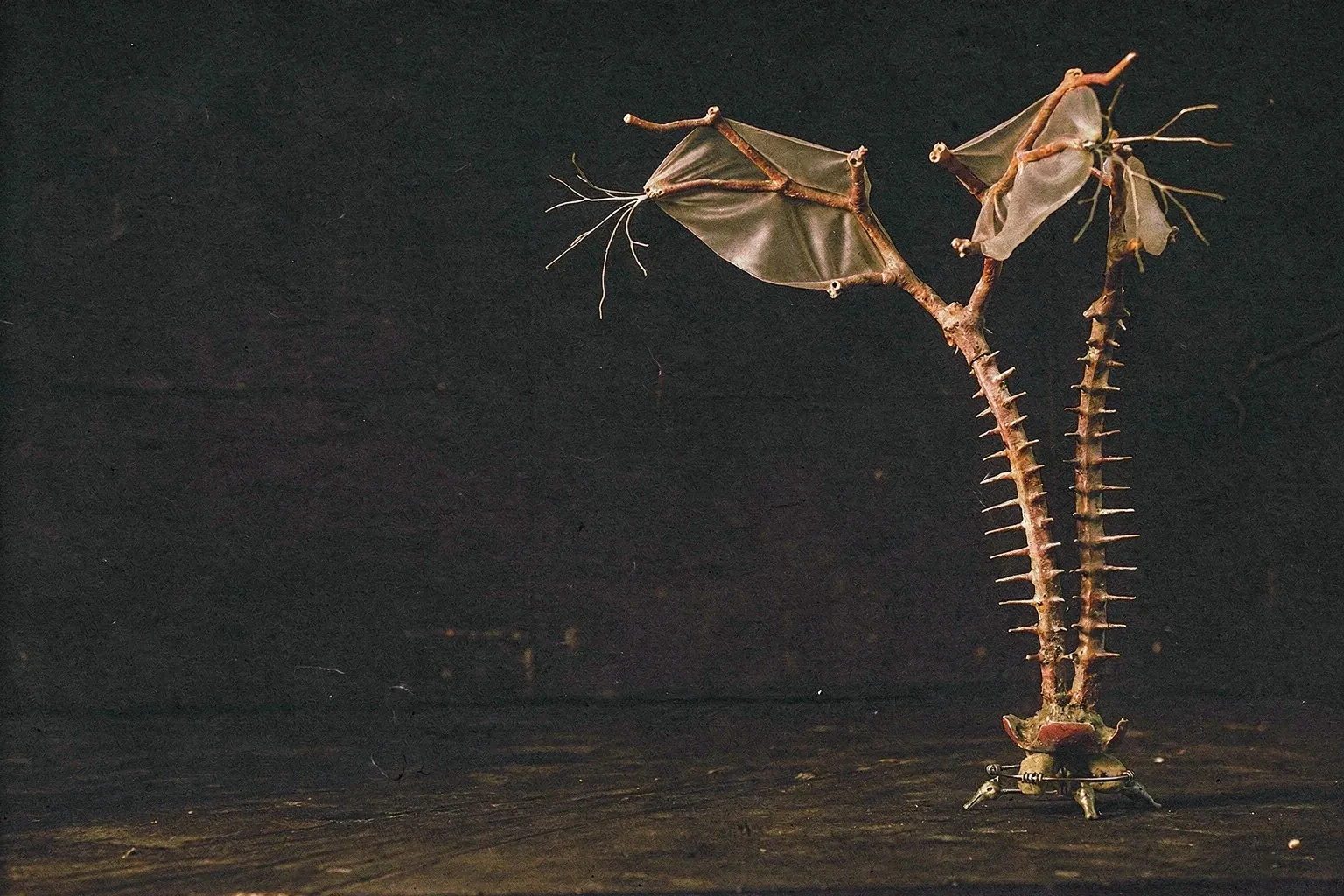
Arbor 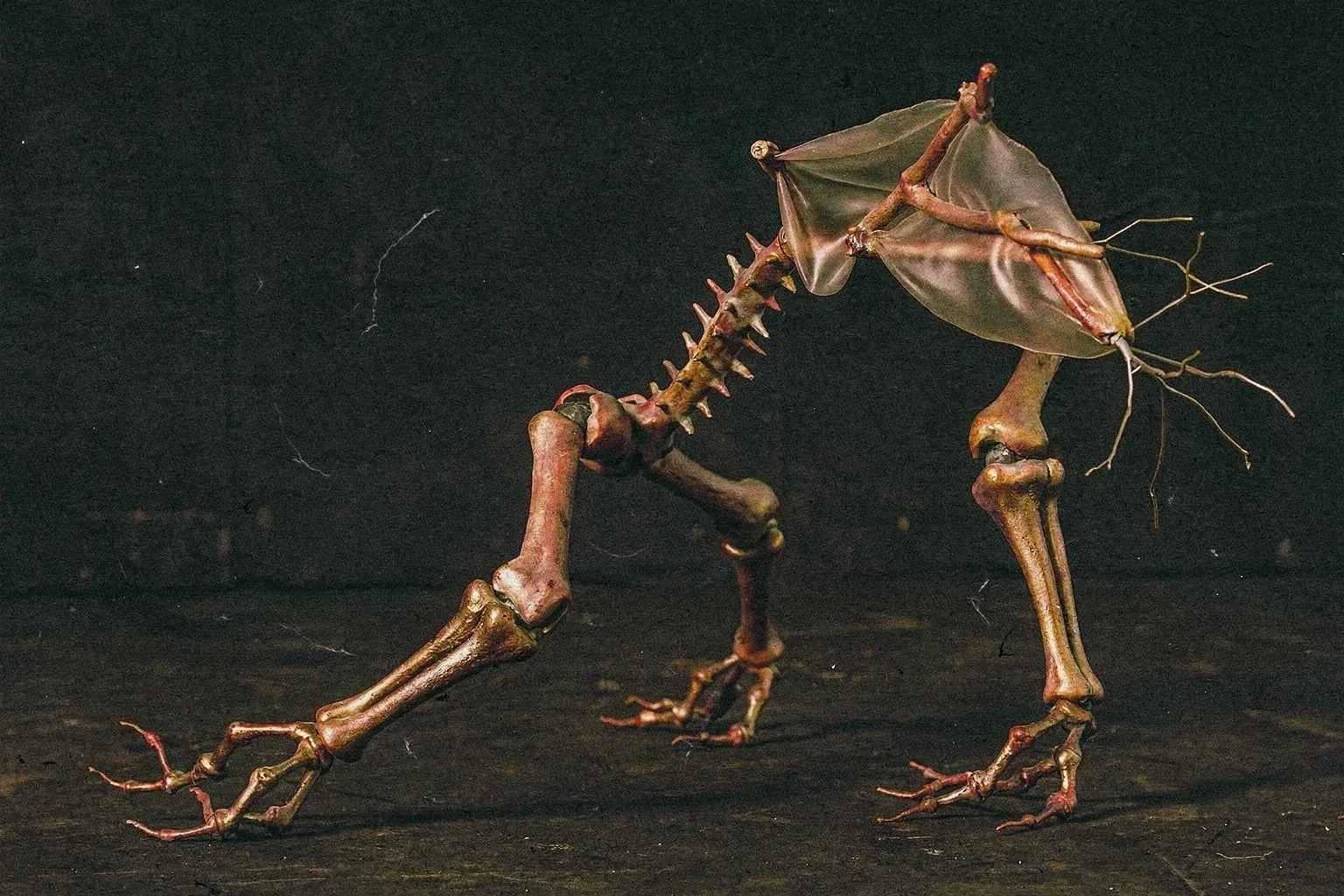
Strider -
Sail 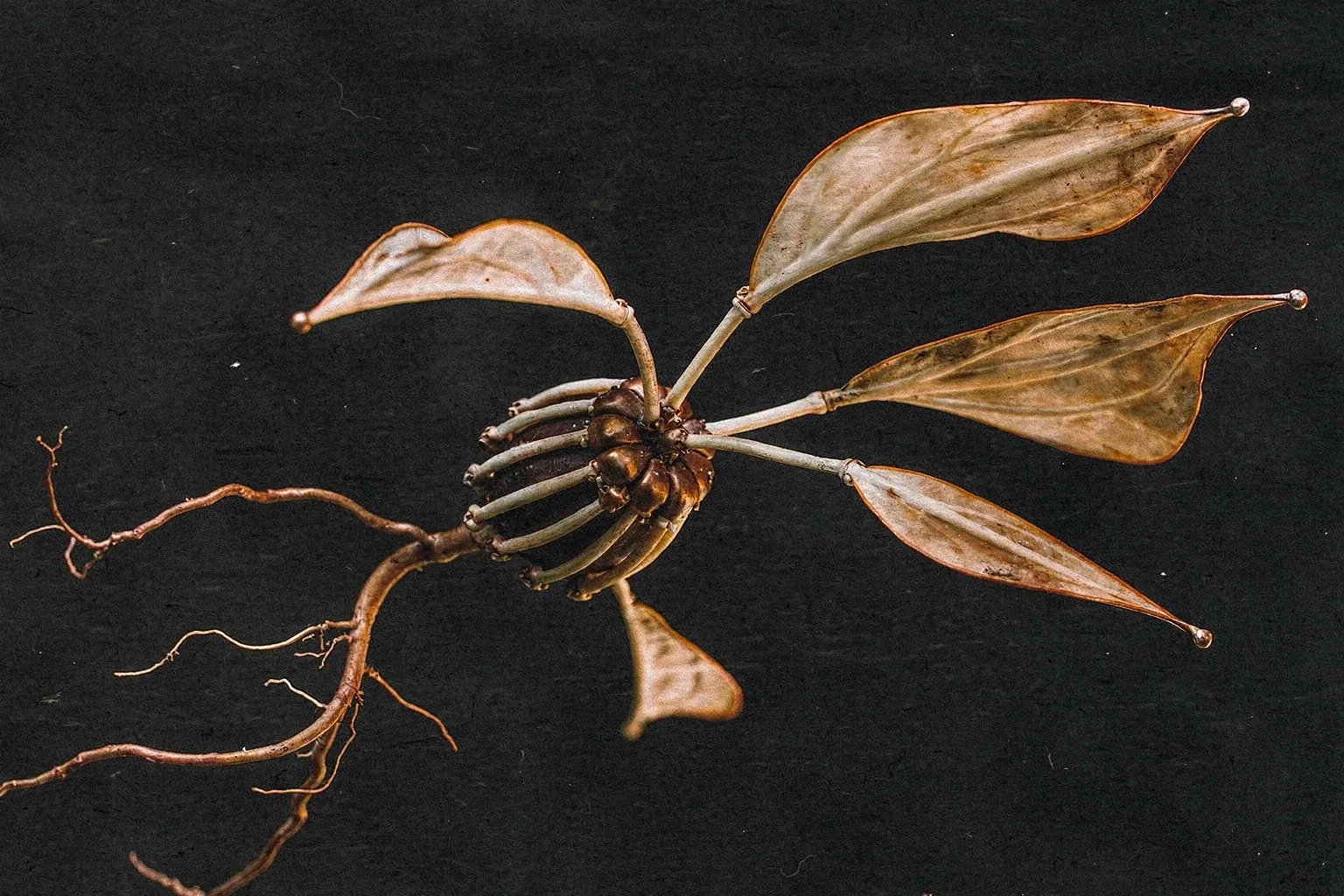
Glider -
Symbiosis 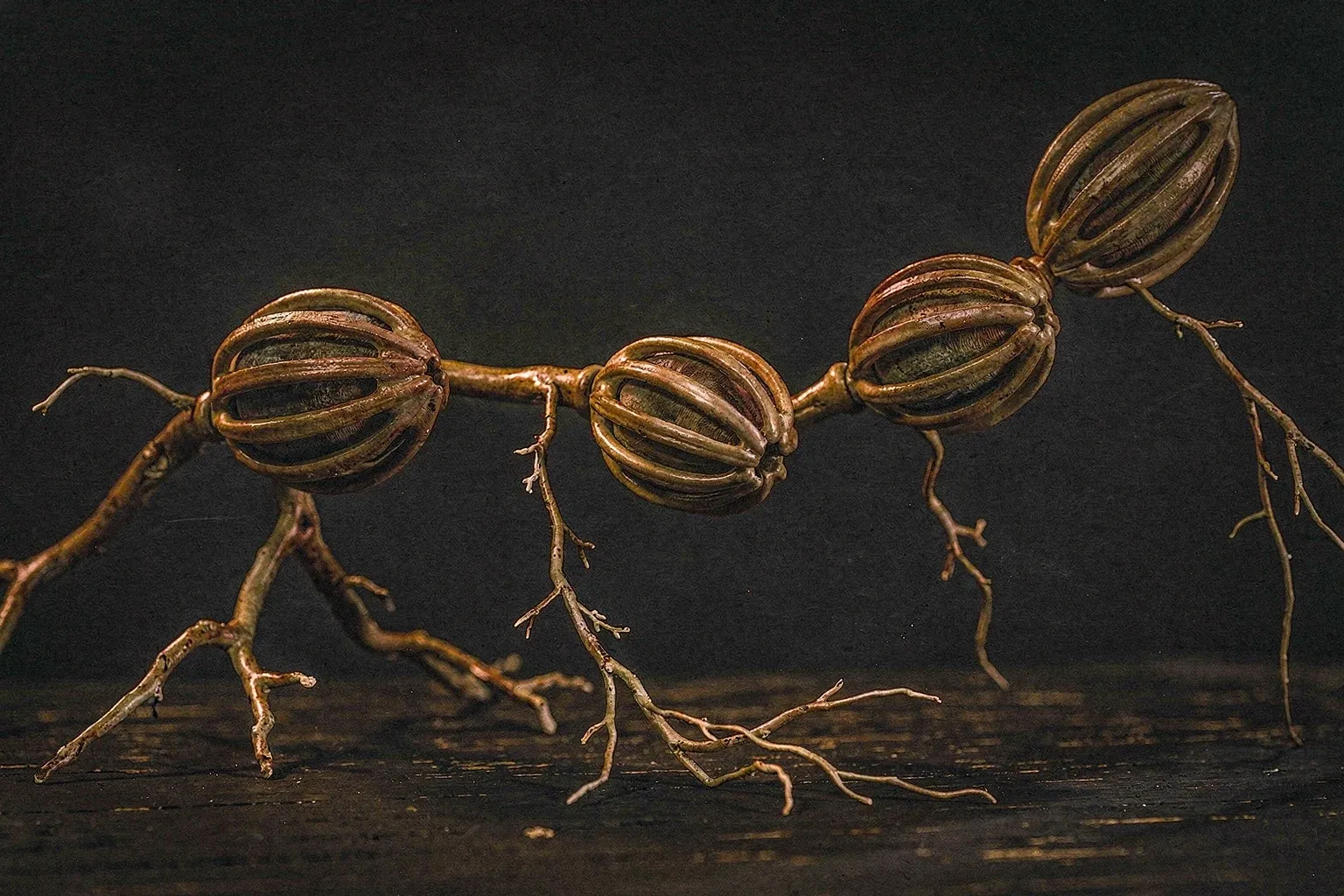
Creeper -
Vault 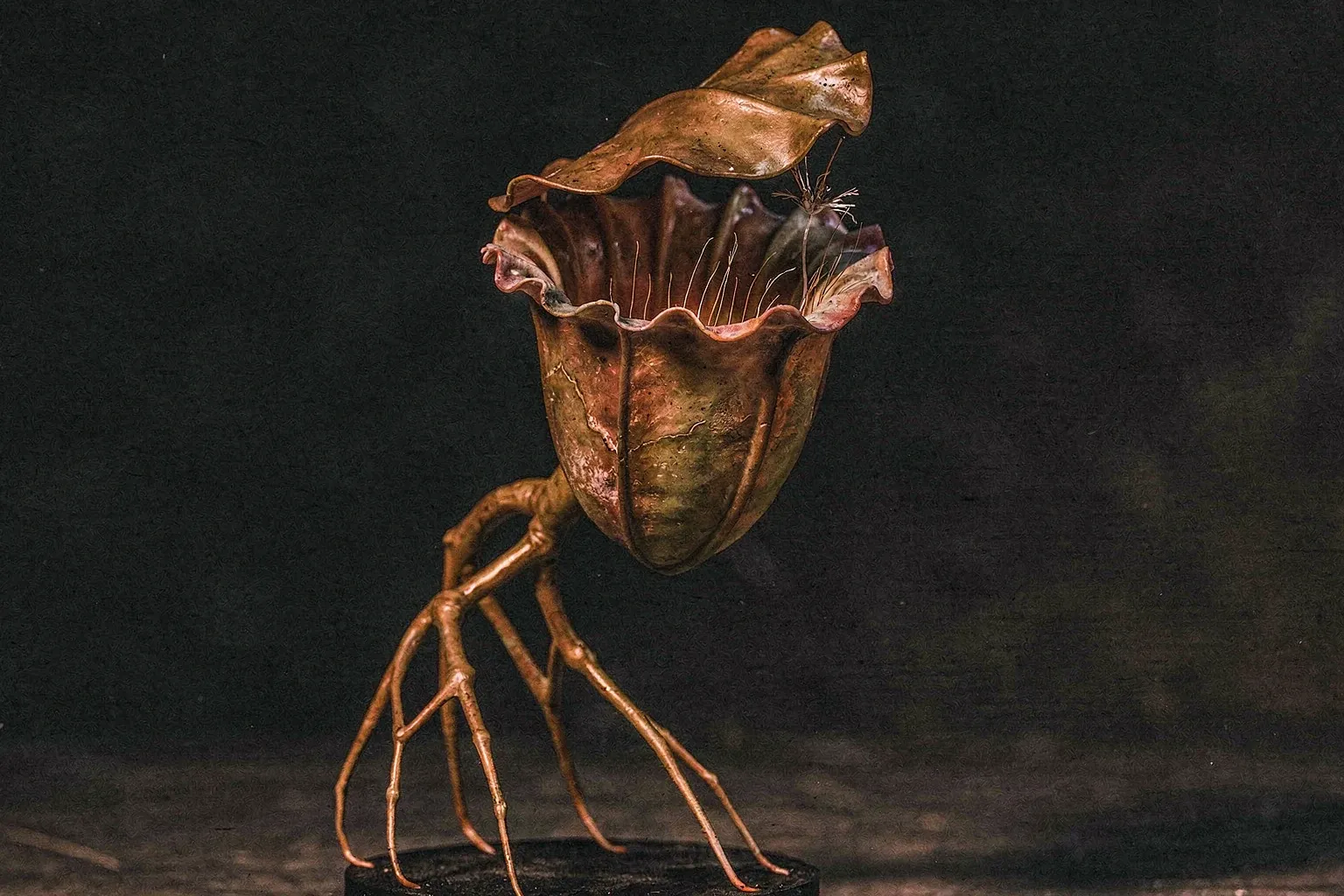
Pitcher -
Cycle 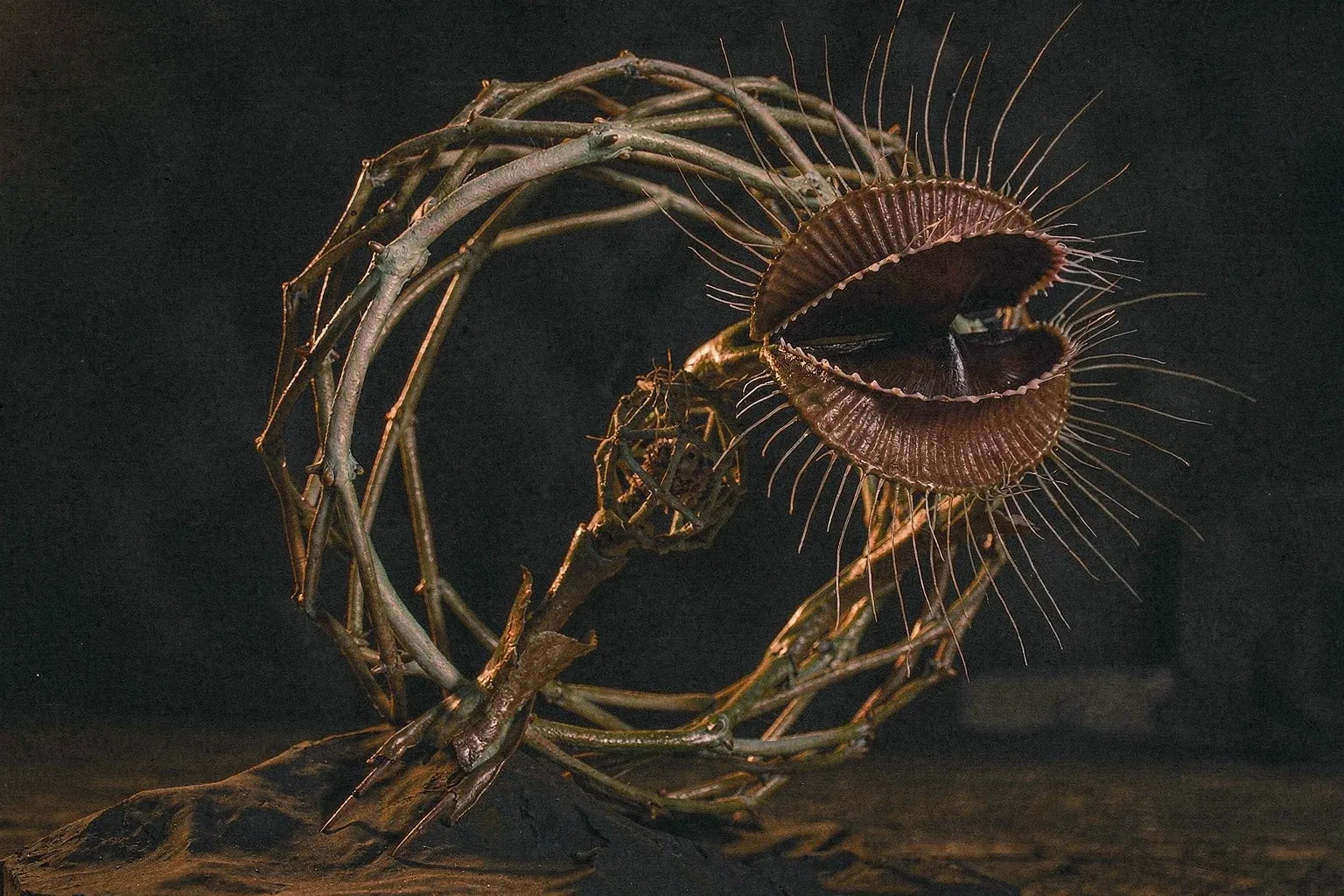
Snare -
Biosphere 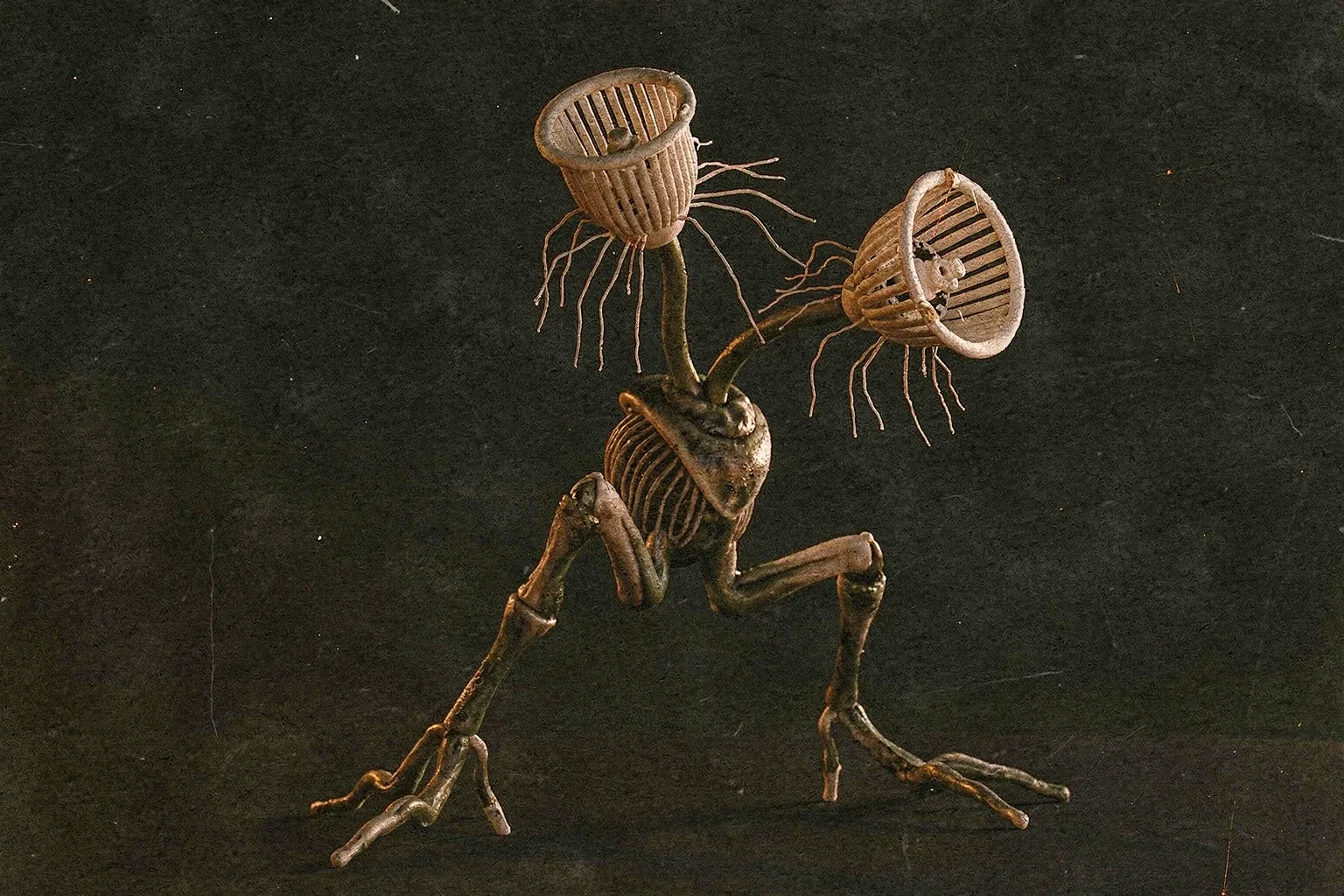
Hunter
Vascular surfaces
Six studies, each using its counterpart from the mobility and carnivory stage as the reference image. Each row pairs a reference image with the study made from it.
-
Strider 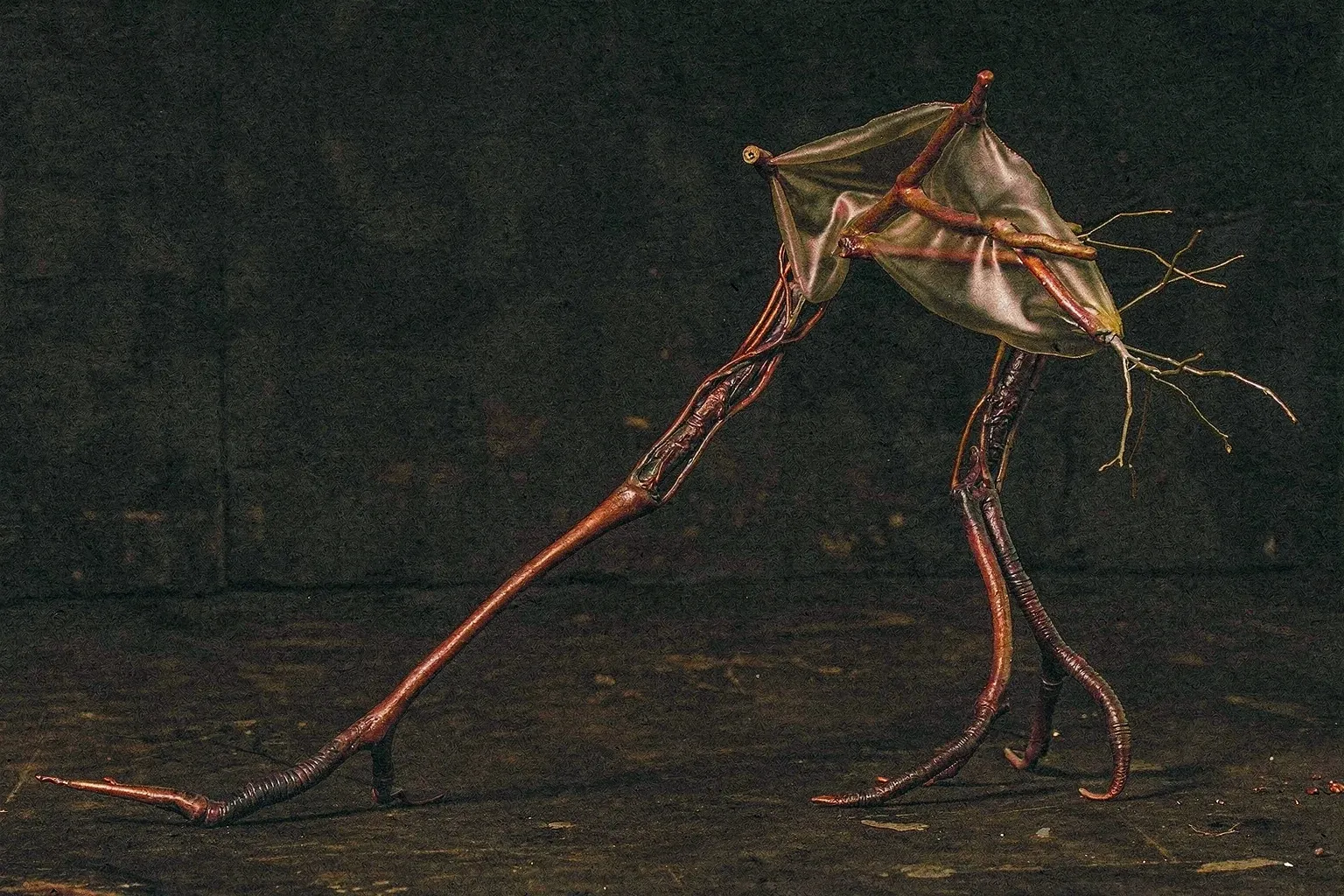
Perfusion -
Glider 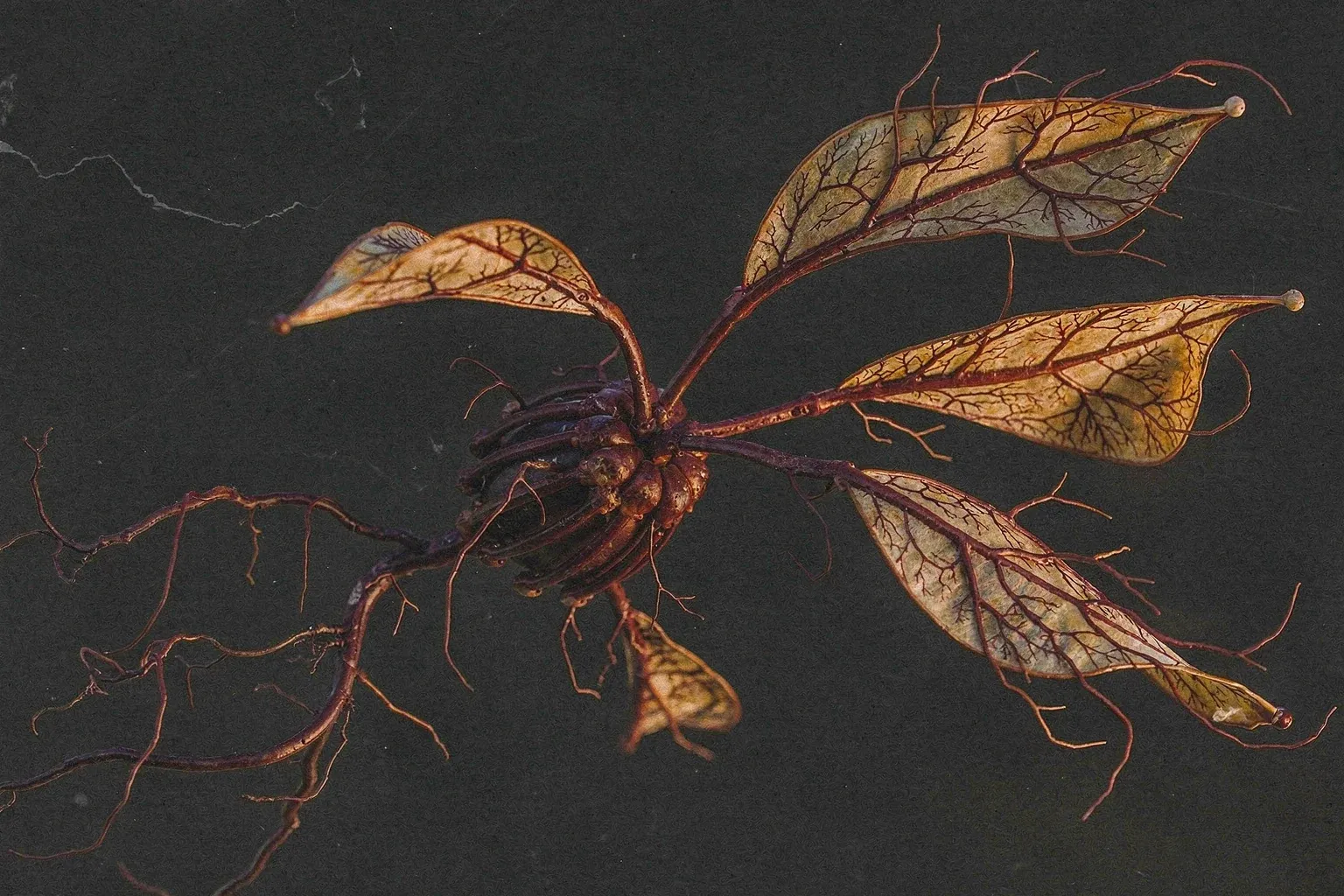
Capillary sail -
Creeper 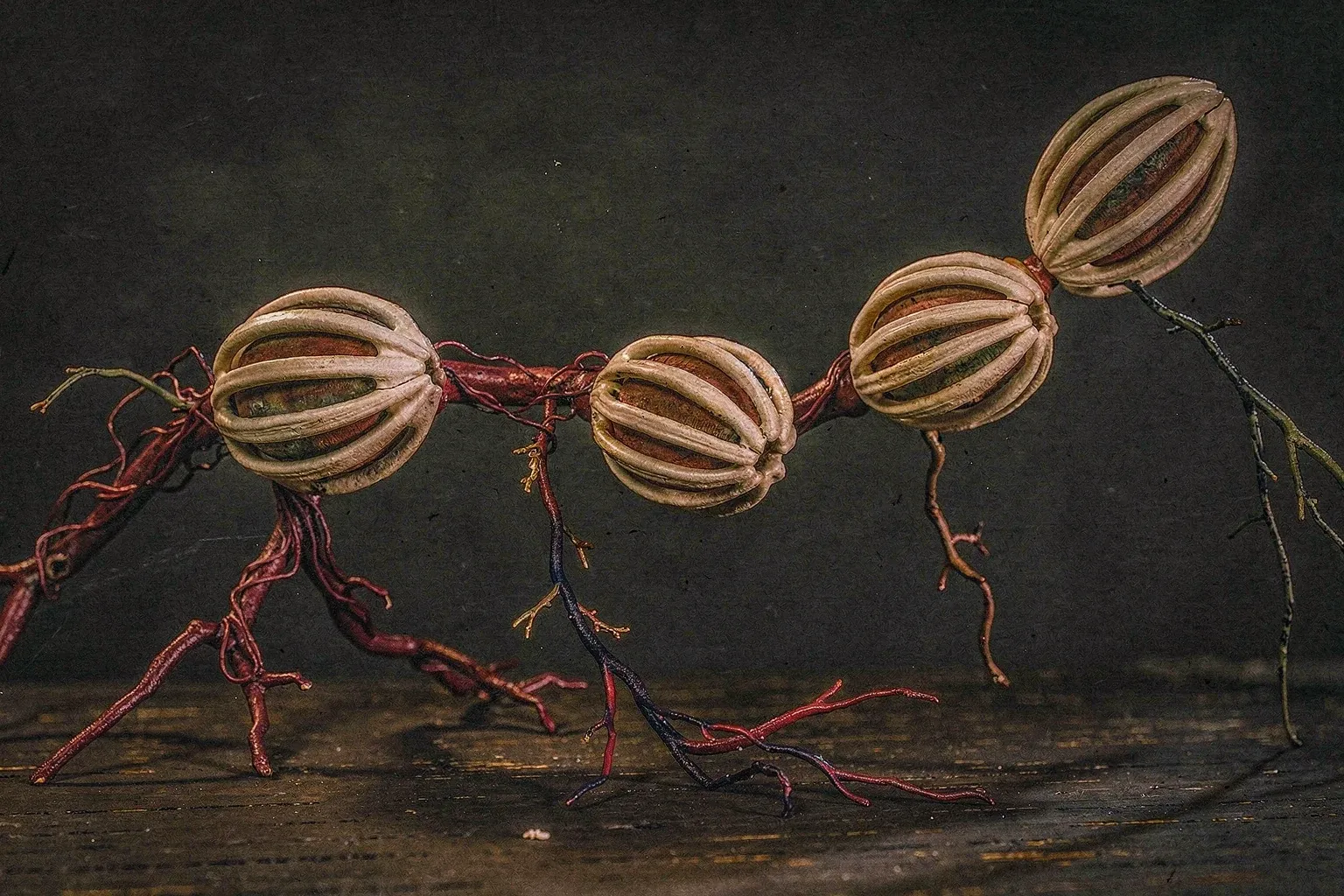
Anastomosis -
Pitcher 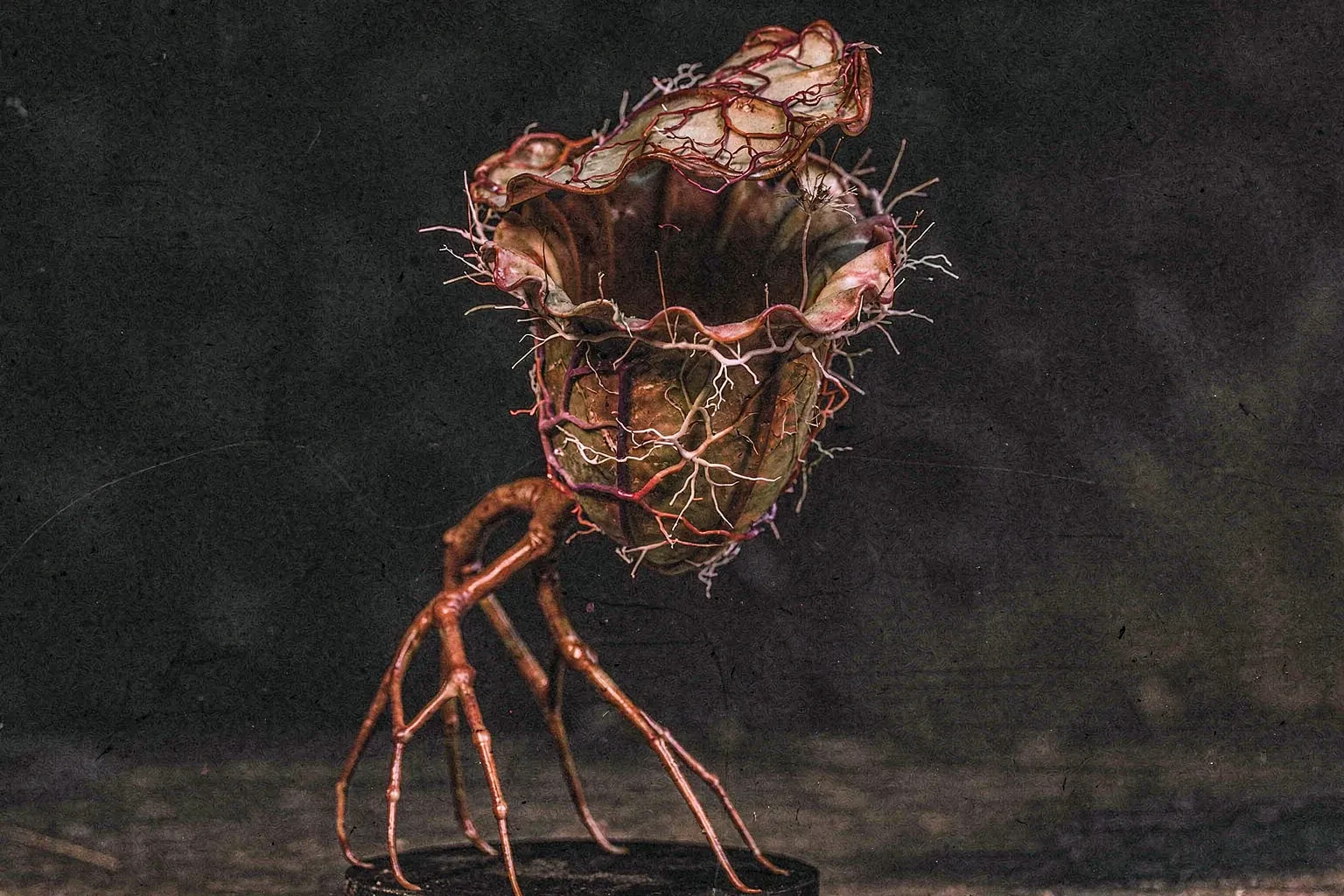
Vascular pitcher -
Snare 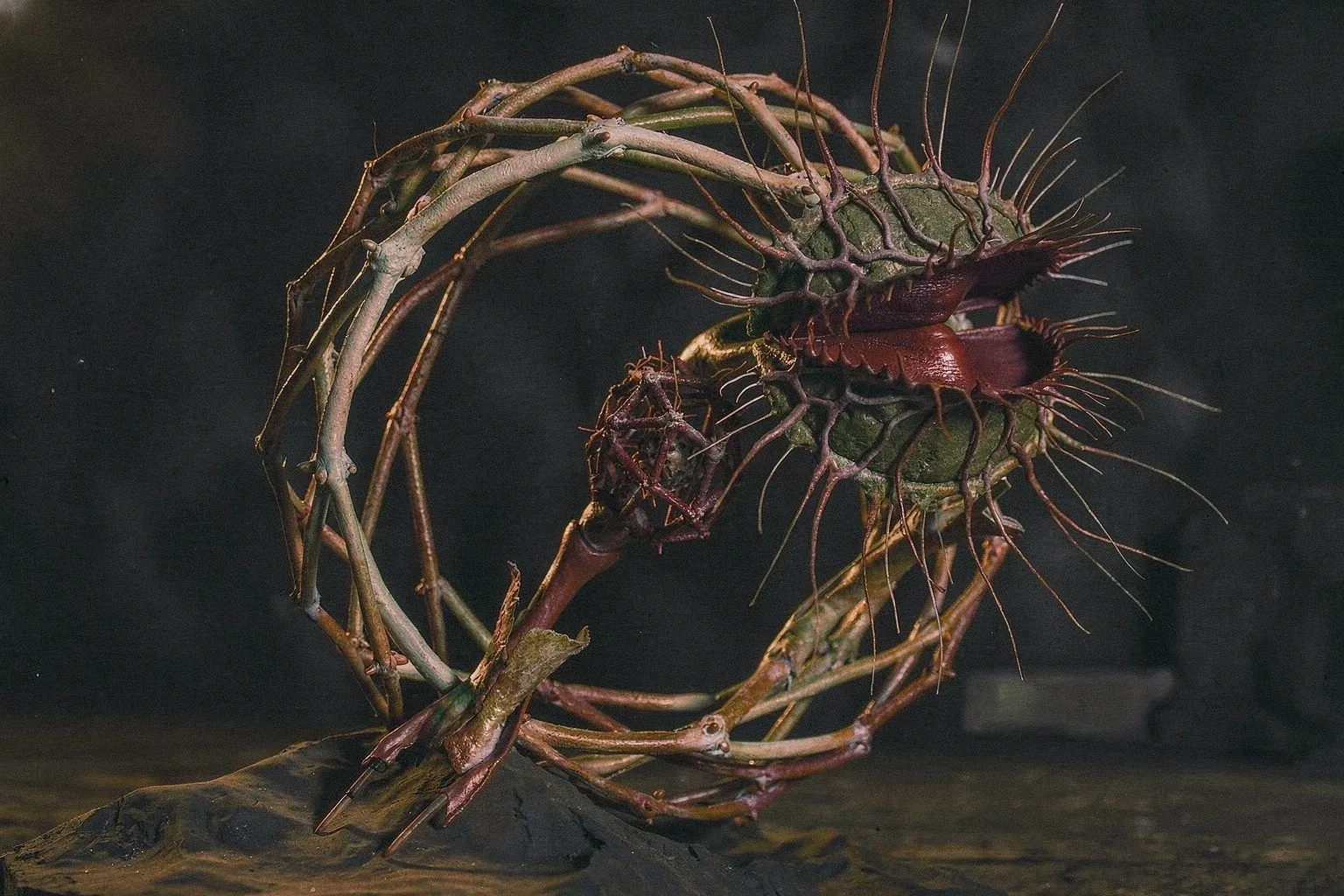
Fed snare -
Hunter 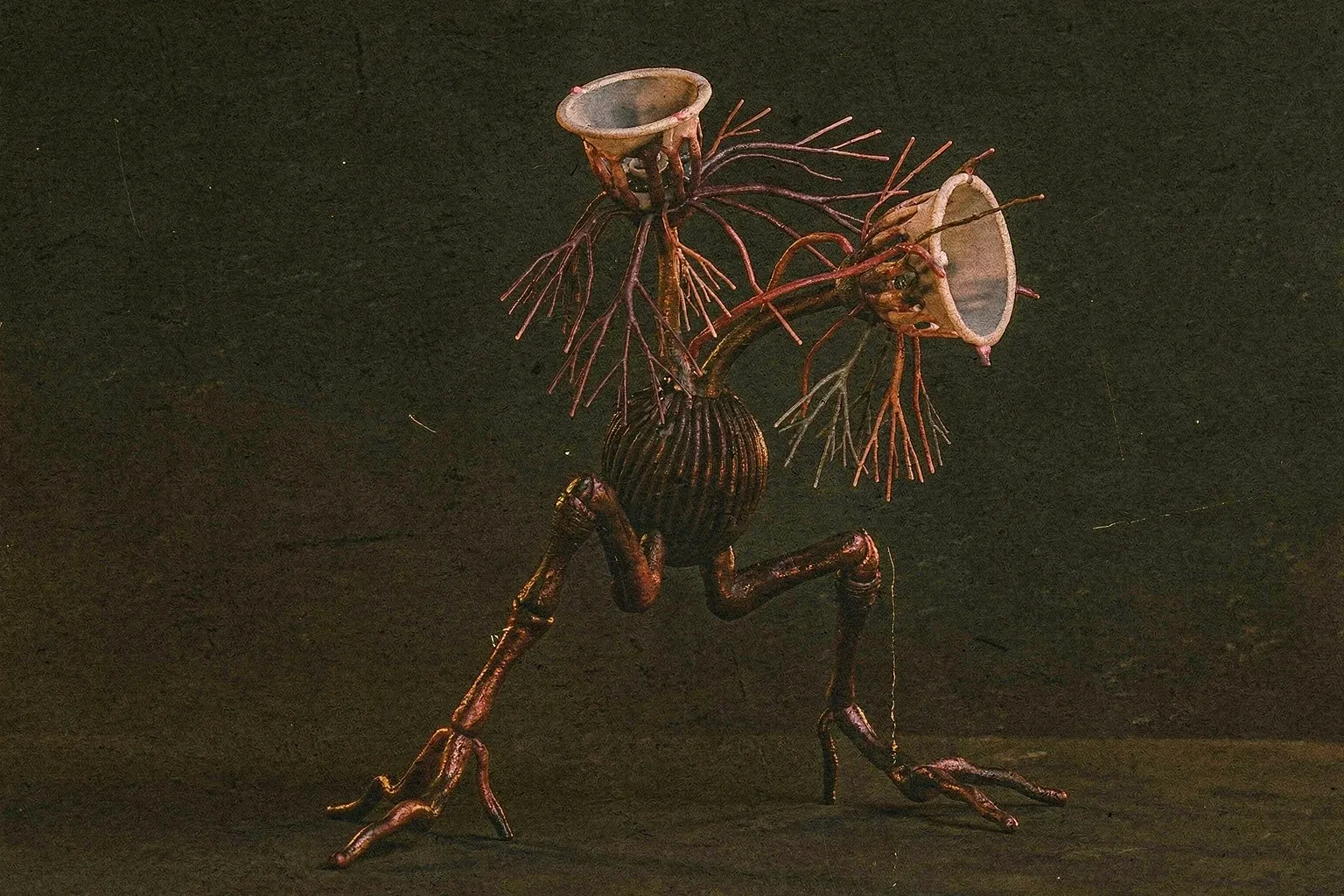
Circulatory hunter
Prompt archive
All twelve prompts exactly as submitted, without corrections. Costs are returned API usage. References are identified by the SHA-256 of the image that was sent.
Strider
- Model
- black-forest-labs/flux.2-pro
- Output
- 1536 × 1024 PNG
- Branch
- mobility
- Reference
- Arbor (Mature suite, From seed to structure)
11bcfe4c998d… - Image
ae054b32386f…- Cost
- $0.075
Create a next evolutionary stage of the provided organic sculpture reference. Preserve its recognizable ancestral ribbed capsule structures, grainy analogue print quality, matte bone and weathered bronze materials, near-black charcoal background, dim amber sidelight, asymmetry and generous negative space. This is original speculative botanical art, not a real specimen or scientific claim. Develop plausible-looking specialized structures rather than just increasing detail. Botanical movement and predation, quietly uncanny, tactile fine grain, no glossy CGI. No people, faces, eyes, vertebrate teeth, tongues, gore, blood, text, labels, logos, recognizable film creatures, or ornamental borders. Show the entire organism within the image with breathing room, do not crop its tips. EVOLUTION BRANCH: MOBILITY. Evolve Arbor into an ambulatory plant with an arched ribbed stem supported by four unequal jointed root stilts. One root lifts while the others brace, body tilted forward with weight visibly shifting, fine probing tendrils reach ahead. Keep the crown and seed-casing ancestry; roots are botanical supports, not insect legs or a robot chassis. A single organism caught in the first careful step, thin shadow on a minimal dark ground.
Glider
- Model
- black-forest-labs/flux.2-pro
- Output
- 1536 × 1024 PNG
- Branch
- mobility
- Reference
- Sail (Mature suite, From seed to structure)
23fcbb0eb195… - Image
1952af574bf6…- Cost
- $0.075
Create a next evolutionary stage of the provided organic sculpture reference. Preserve its recognizable ancestral ribbed capsule structures, grainy analogue print quality, matte bone and weathered bronze materials, near-black charcoal background, dim amber sidelight, asymmetry and generous negative space. This is original speculative botanical art, not a real specimen or scientific claim. Develop plausible-looking specialized structures rather than just increasing detail. Botanical movement and predation, quietly uncanny, tactile fine grain, no glossy CGI. No people, faces, eyes, vertebrate teeth, tongues, gore, blood, text, labels, logos, recognizable film creatures, or ornamental borders. Show the entire organism within the image with breathing room, do not crop its tips. EVOLUTION BRANCH: MOBILITY. Evolve Sail into a windborne organism whose asymmetric parchment membranes open into buoyant sails around a compact ribbed botanical core. Two trailing root filaments curl in the same direction, stem bent and suspended at an oblique angle implying drift. It remains a dispersing plant, not a bird, bat, moth or spaceship. Sparse outline, subtle warm rim light and grain, generous surrounding darkness.
Creeper
- Model
- black-forest-labs/flux.2-pro
- Output
- 1536 × 1024 PNG
- Branch
- mobility
- Reference
- Symbiosis (Mature suite, From seed to structure)
ffbd6409fdfd… - Image
c6cd5d0e04a0…- Cost
- $0.075
Create a next evolutionary stage of the provided organic sculpture reference. Preserve its recognizable ancestral ribbed capsule structures, grainy analogue print quality, matte bone and weathered bronze materials, near-black charcoal background, dim amber sidelight, asymmetry and generous negative space. This is original speculative botanical art, not a real specimen or scientific claim. Develop plausible-looking specialized structures rather than just increasing detail. Botanical movement and predation, quietly uncanny, tactile fine grain, no glossy CGI. No people, faces, eyes, vertebrate teeth, tongues, gore, blood, text, labels, logos, recognizable film creatures, or ornamental borders. Show the entire organism within the image with breathing room, do not crop its tips. EVOLUTION BRANCH: MOBILITY. Evolve Symbiosis into a coordinated creeping colony. Three differentiated skeletal pods share a sinuous low stem and several grasping rootlets that alternately anchor and release. One end lifted and exploring, another rooted behind, a flexible tensioned bridge connecting them. Show an asymmetric crawling posture without animal anatomy, many tiny hairs but only a few main supports, not a walking monster.
Pitcher
- Model
- black-forest-labs/flux.2-pro
- Output
- 1536 × 1024 PNG
- Branch
- carnivory
- Reference
- Vault (Mature suite, From seed to structure)
aabf854f9636… - Image
20cb336ca30e…- Cost
- $0.075
Create a next evolutionary stage of the provided organic sculpture reference. Preserve its recognizable ancestral ribbed capsule structures, grainy analogue print quality, matte bone and weathered bronze materials, near-black charcoal background, dim amber sidelight, asymmetry and generous negative space. This is original speculative botanical art, not a real specimen or scientific claim. Develop plausible-looking specialized structures rather than just increasing detail. Botanical movement and predation, quietly uncanny, tactile fine grain, no glossy CGI. No people, faces, eyes, vertebrate teeth, tongues, gore, blood, text, labels, logos, recognizable film creatures, or ornamental borders. Show the entire organism within the image with breathing room, do not crop its tips. EVOLUTION BRANCH: CARNIVORY. Evolve Vault into a singular carnivorous pitcher structure. Its hollow ribbed core deepens into a tilted chamber with a delicate rolled fluted rim, inward-pointing fine plant hairs and a hinged parchment hood sheltering the opening. The trap has no jaw, mouth, teeth or eyes. Closed lower reservoir and articulated root stalk, elegant sparse ribs and warm bronze membranes. Suggest feeding function through geometry alone; no captured animal.
Snare
- Model
- black-forest-labs/flux.2-pro
- Output
- 1536 × 1024 PNG
- Branch
- carnivory
- Reference
- Cycle (Mature suite, From seed to structure)
b9c1269e1850… - Image
750c072c3aa6…- Cost
- $0.075
Create a next evolutionary stage of the provided organic sculpture reference. Preserve its recognizable ancestral ribbed capsule structures, grainy analogue print quality, matte bone and weathered bronze materials, near-black charcoal background, dim amber sidelight, asymmetry and generous negative space. This is original speculative botanical art, not a real specimen or scientific claim. Develop plausible-looking specialized structures rather than just increasing detail. Botanical movement and predation, quietly uncanny, tactile fine grain, no glossy CGI. No people, faces, eyes, vertebrate teeth, tongues, gore, blood, text, labels, logos, recognizable film creatures, or ornamental borders. Show the entire organism within the image with breathing room, do not crop its tips. EVOLUTION BRANCH: CARNIVORY. Evolve Cycle into an asymmetrical botanical snare. Two flexible opposed ribbed leaf lobes partly curl toward each other around a dark empty gap. Long fine plant cilia interleave at the edges, soft filament triggers span between the lobes, and a curved supporting stalk remains from the reference. Describe a closing leaf mechanism, never an animal mouth, no teeth or gore. Clearly retain the looped skeletal ancestry without making a perfect circle.
Hunter
- Model
- black-forest-labs/flux.2-pro
- Output
- 1536 × 1024 PNG
- Branch
- mobility and carnivory
- Reference
- Biosphere (Mature suite, From seed to structure)
85f940532bf5… - Image
a099eab8a757…- Cost
- $0.075
Create a next evolutionary stage of the provided organic sculpture reference. Preserve its recognizable ancestral ribbed capsule structures, grainy analogue print quality, matte bone and weathered bronze materials, near-black charcoal background, dim amber sidelight, asymmetry and generous negative space. This is original speculative botanical art, not a real specimen or scientific claim. Develop plausible-looking specialized structures rather than just increasing detail. Botanical movement and predation, quietly uncanny, tactile fine grain, no glossy CGI. No people, faces, eyes, vertebrate teeth, tongues, gore, blood, text, labels, logos, recognizable film creatures, or ornamental borders. Show the entire organism within the image with breathing room, do not crop its tips. EVOLUTION BRANCH: MOBILITY AND CARNIVORY. Evolve Biosphere into a mobile hunting plant. Its branched ribbed crown carries one cup trap and two small adhesive filament fans; below, a compact core balances on three asymmetrical articulated root supports. One probing root reaches ahead, another planted behind, the body leaning toward a small empty opening in space. Botanical locomotion and sensing through tendrils, no head, eyes, animal limbs or captured prey. Keep seed-like chambers visible, graceful sparse silhouette, amber parchment and grain.
Perfusion
- Model
- black-forest-labs/flux.2-pro
- Output
- 1536 × 1024 PNG
- Reference
- Strider (Mobility and carnivory)
ae054b32386f… - Image
d982014e5c6e…- Cost
- $0.075
Create the next evolutionary stage of the provided speculative plant-organism reference. Preserve its shape lineage, grainy analogue print quality, matte bone and weathered bronze palette, charcoal field, dim amber sidelight and generous negative space. Add a fine vascular network to the organism itself: asymmetrical branching capillary-like channels that follow the curvature of its husks, stems and thin membranes, some visible beneath translucent parchment, others subtly raised at the surface. Channels in desaturated rust-red, dark burgundy and copper, a restrained new accent rather than bright red illumination. Networks have thicker supplying trunks tapering into tiny irregular branches, not decorative random crackle or uniform lines. No bleeding, wounds, exposed meat, gore or captured prey. Generated speculative sculpture art, not a real biological specimen. No people, faces, eyes, text, labels, logos or familiar movie characters. No glossy CGI, keep tactile grain and matte surfaces. Entire form inside frame with breathing room. Evolve Strider with fine vessel-like supply lines along its arched stem and jointed root stilts, branching into the pale ribbed husk. Show delicate burgundy channels beneath a few semi-translucent skin patches, trace the supporting anatomy rather than adding a separate circulatory diagram. Keep the lifted root and cautious leaning stance, no additional animal limbs.
Capillary sail
- Model
- black-forest-labs/flux.2-pro
- Output
- 1536 × 1024 PNG
- Reference
- Glider (Mobility and carnivory)
1952af574bf6… - Image
a4df743cfa35…- Cost
- $0.075
Create the next evolutionary stage of the provided speculative plant-organism reference. Preserve its shape lineage, grainy analogue print quality, matte bone and weathered bronze palette, charcoal field, dim amber sidelight and generous negative space. Add a fine vascular network to the organism itself: asymmetrical branching capillary-like channels that follow the curvature of its husks, stems and thin membranes, some visible beneath translucent parchment, others subtly raised at the surface. Channels in desaturated rust-red, dark burgundy and copper, a restrained new accent rather than bright red illumination. Networks have thicker supplying trunks tapering into tiny irregular branches, not decorative random crackle or uniform lines. No bleeding, wounds, exposed meat, gore or captured prey. Generated speculative sculpture art, not a real biological specimen. No people, faces, eyes, text, labels, logos or familiar movie characters. No glossy CGI, keep tactile grain and matte surfaces. Entire form inside frame with breathing room. Evolve Glider so its wide amber parchment sails carry delicate branching capillary networks radiating from the ribbed center toward thin edges. Copper and muted dark-red supply trunks divide into finer channels visible through translucent film. Preserve the drifting diagonal silhouette and trailing roots; no literal bat or insect.
Anastomosis
- Model
- black-forest-labs/flux.2-pro
- Output
- 1536 × 1024 PNG
- Reference
- Creeper (Mobility and carnivory)
c6cd5d0e04a0… - Image
7911d8ac826d…- Cost
- $0.075
Create the next evolutionary stage of the provided speculative plant-organism reference. Preserve its shape lineage, grainy analogue print quality, matte bone and weathered bronze palette, charcoal field, dim amber sidelight and generous negative space. Add a fine vascular network to the organism itself: asymmetrical branching capillary-like channels that follow the curvature of its husks, stems and thin membranes, some visible beneath translucent parchment, others subtly raised at the surface. Channels in desaturated rust-red, dark burgundy and copper, a restrained new accent rather than bright red illumination. Networks have thicker supplying trunks tapering into tiny irregular branches, not decorative random crackle or uniform lines. No bleeding, wounds, exposed meat, gore or captured prey. Generated speculative sculpture art, not a real biological specimen. No people, faces, eyes, text, labels, logos or familiar movie characters. No glossy CGI, keep tactile grain and matte surfaces. Entire form inside frame with breathing room. Evolve Creeper with a shared vascular circuit running along its sinuous connective stem and between the three capsules. Fine burgundy lines beneath weathered pale membranes branch locally into the lobes, with a few joining channels between stems. Retain coordinated creeping plant posture and matte sculptural ribs. Keep vascular connections subtle and physically integrated, no diagram arrows.
Vascular pitcher
- Model
- black-forest-labs/flux.2-pro
- Output
- 1536 × 1024 PNG
- Reference
- Pitcher (Mobility and carnivory)
20cb336ca30e… - Image
5f71493c167a…- Cost
- $0.075
Create the next evolutionary stage of the provided speculative plant-organism reference. Preserve its shape lineage, grainy analogue print quality, matte bone and weathered bronze palette, charcoal field, dim amber sidelight and generous negative space. Add a fine vascular network to the organism itself: asymmetrical branching capillary-like channels that follow the curvature of its husks, stems and thin membranes, some visible beneath translucent parchment, others subtly raised at the surface. Channels in desaturated rust-red, dark burgundy and copper, a restrained new accent rather than bright red illumination. Networks have thicker supplying trunks tapering into tiny irregular branches, not decorative random crackle or uniform lines. No bleeding, wounds, exposed meat, gore or captured prey. Generated speculative sculpture art, not a real biological specimen. No people, faces, eyes, text, labels, logos or familiar movie characters. No glossy CGI, keep tactile grain and matte surfaces. Entire form inside frame with breathing room. Evolve Pitcher with delicate vessels embedded beneath its translucent chamber walls, following the rounded reservoir and branching up toward the rolled rim and protective hood. Thick muted rust supply near the root tapers to fine burgundy filaments around the opening. No liquid blood, teeth, flesh or prey. A quiet carnivorous botanical sculpture with an empty dark opening.
Fed snare
- Model
- black-forest-labs/flux.2-pro
- Output
- 1536 × 1024 PNG
- Reference
- Snare (Mobility and carnivory)
750c072c3aa6… - Image
f736ce67e462…- Cost
- $0.075
Create the next evolutionary stage of the provided speculative plant-organism reference. Preserve its shape lineage, grainy analogue print quality, matte bone and weathered bronze palette, charcoal field, dim amber sidelight and generous negative space. Add a fine vascular network to the organism itself: asymmetrical branching capillary-like channels that follow the curvature of its husks, stems and thin membranes, some visible beneath translucent parchment, others subtly raised at the surface. Channels in desaturated rust-red, dark burgundy and copper, a restrained new accent rather than bright red illumination. Networks have thicker supplying trunks tapering into tiny irregular branches, not decorative random crackle or uniform lines. No bleeding, wounds, exposed meat, gore or captured prey. Generated speculative sculpture art, not a real biological specimen. No people, faces, eyes, text, labels, logos or familiar movie characters. No glossy CGI, keep tactile grain and matte surfaces. Entire form inside frame with breathing room. Evolve Snare with fine vascular tracery across its two curling trap lobes. Main copper-red channels follow each supporting rib and taper into thin capillaries in the membranes between ribs, accentuate lobes partly closing without adding a mouth. Cilia remain dry, bone colored, no teeth or bleeding. Preserve the curved botanical stalk and original restraint.
Circulatory hunter
- Model
- black-forest-labs/flux.2-pro
- Output
- 1536 × 1024 PNG
- Reference
- Hunter (Mobility and carnivory)
a099eab8a757… - Image
286735e9f887…- Cost
- $0.075
Create the next evolutionary stage of the provided speculative plant-organism reference. Preserve its shape lineage, grainy analogue print quality, matte bone and weathered bronze palette, charcoal field, dim amber sidelight and generous negative space. Add a fine vascular network to the organism itself: asymmetrical branching capillary-like channels that follow the curvature of its husks, stems and thin membranes, some visible beneath translucent parchment, others subtly raised at the surface. Channels in desaturated rust-red, dark burgundy and copper, a restrained new accent rather than bright red illumination. Networks have thicker supplying trunks tapering into tiny irregular branches, not decorative random crackle or uniform lines. No bleeding, wounds, exposed meat, gore or captured prey. Generated speculative sculpture art, not a real biological specimen. No people, faces, eyes, text, labels, logos or familiar movie characters. No glossy CGI, keep tactile grain and matte surfaces. Entire form inside frame with breathing room. Evolve Hunter with an integrated supplying vascular network along its branching crown, trap cups and root supports. A few semi-translucent pale panels reveal dark burgundy trunks and fine capillaries, differentiated scale from core to peripheral filament fans. Keep probing roots and leaning mobile-plant silhouette rather than animal muscles. Tiny amounts of muted red, no exposed tissue, blood or gore.
Generated via OpenRouter with Black Forest Labs FLUX.2 [pro]. Use is governed by those providers' terms at generation time; terms have not been separately reviewed.