feed and wound
Six generated images in which the invented plant organisms of the earlier notes are torn, broken and feeding on one another. Contains fictional botanical injury, blood-like sap and consumption; no people or real animals. The images stay hidden until opened.
Process article prepared with Hermes, an AI-assisted workflow, from the saved generation records in response to John's direction and feedback. It is not John's first-person writing.
The organisms in this note began as seed sculptures in From seed to structure, gained gaits, traps and vessel networks in From plant to motion, and one of them was set moving in First motion. John then asked for the next step to be more grotesque: wounds, blood and organisms consuming each other. This note records how that request became prompts, what came back, and where the images fall short.
The text can be read without the pictures. The six images, each beside its published parent, are in the record below behind a control that starts closed.
As in the earlier notes, John set the direction and reviewed the results. The prompts were written by the AI-assisted workflow, and every one of the 21 requests is reproduced exactly at the end of the page, including the images that were not used.
Removing one sentence
The vascular stage had ruled this out directly. Every one of its prompts carried the sentence “No bleeding, wounds, exposed meat, gore or captured prey.” This round removed it on purpose. The aim was the same individuals, with the same grain, light and palette, in a damaged or feeding state.
The vascular prompts opened with “Create the next evolutionary stage of the provided speculative plant-organism reference.” The new ones opened:
Create a later state of the provided speculative plant-organism reference: the same individual, now wounded.
The removed sentence was replaced by a clause that describes injury as a change to a plant body:
The injury is botanical and sculptural and must change the form itself: torn parchment membranes, split husk seams, severed vessel channels with visible cut ends, exposed fibrous pith.
Thick dark burgundy sap wells out of the ruptured vessels themselves, beading and running along the existing channels, drying to rust-brown at the edges and staining the ground beneath
The fluid is sap, and that is the intended substance, not a polite stand-in. These are invented plants, and the red was already in the series as the colour of their vessels; the sap is that colour escaping. The prompts never used the word “blood”. The provider accepted all 21 requests and refused none. That shows only that these requests went through, not that any policy approves of the images.
The guard list also grew to exclude skeletons, ribcages, claws, organs, faces and mouths. For the two feeding scenes, the prompt sent two images and said “the first reference image is the predator, the second reference image is the prey.”
Six states
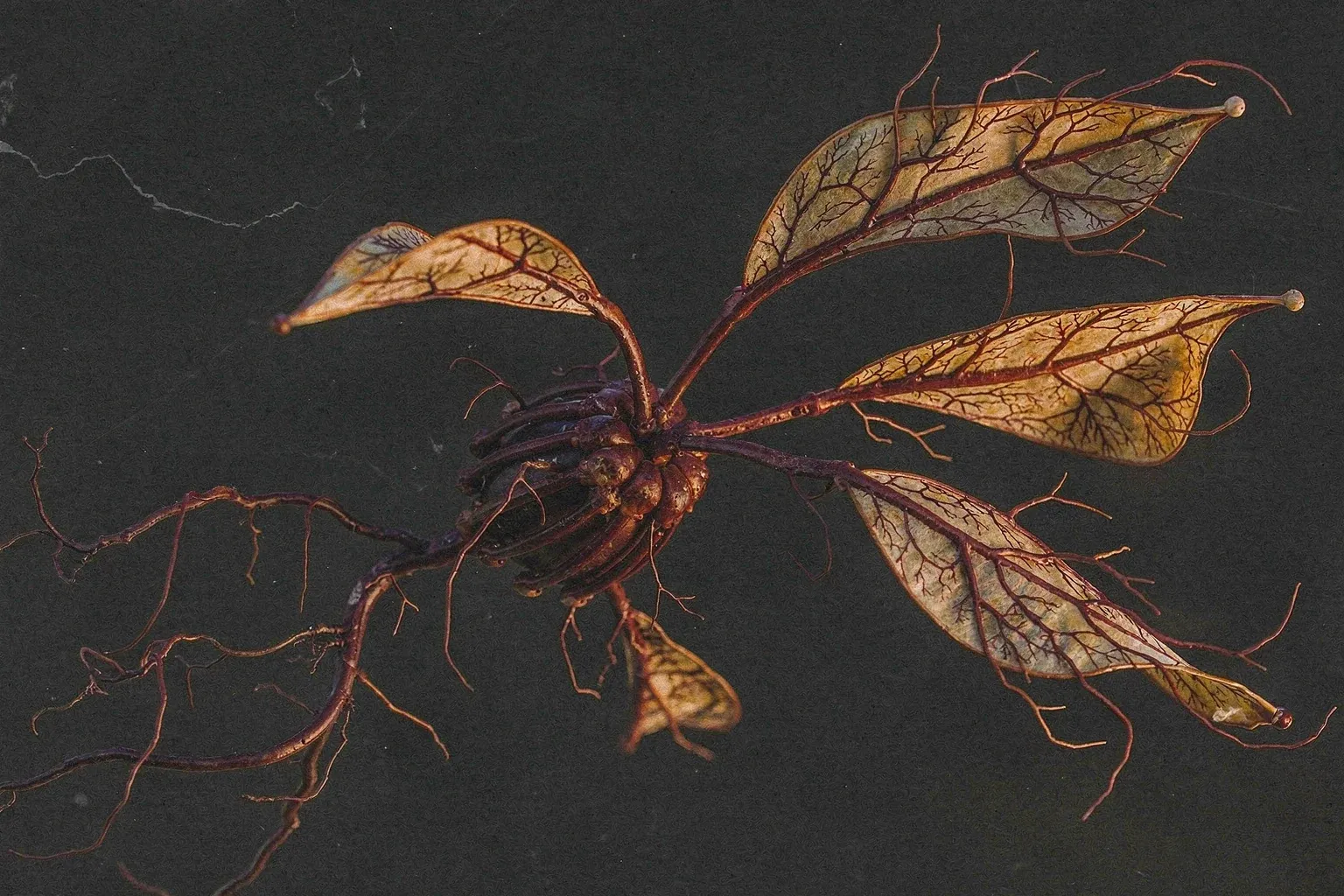
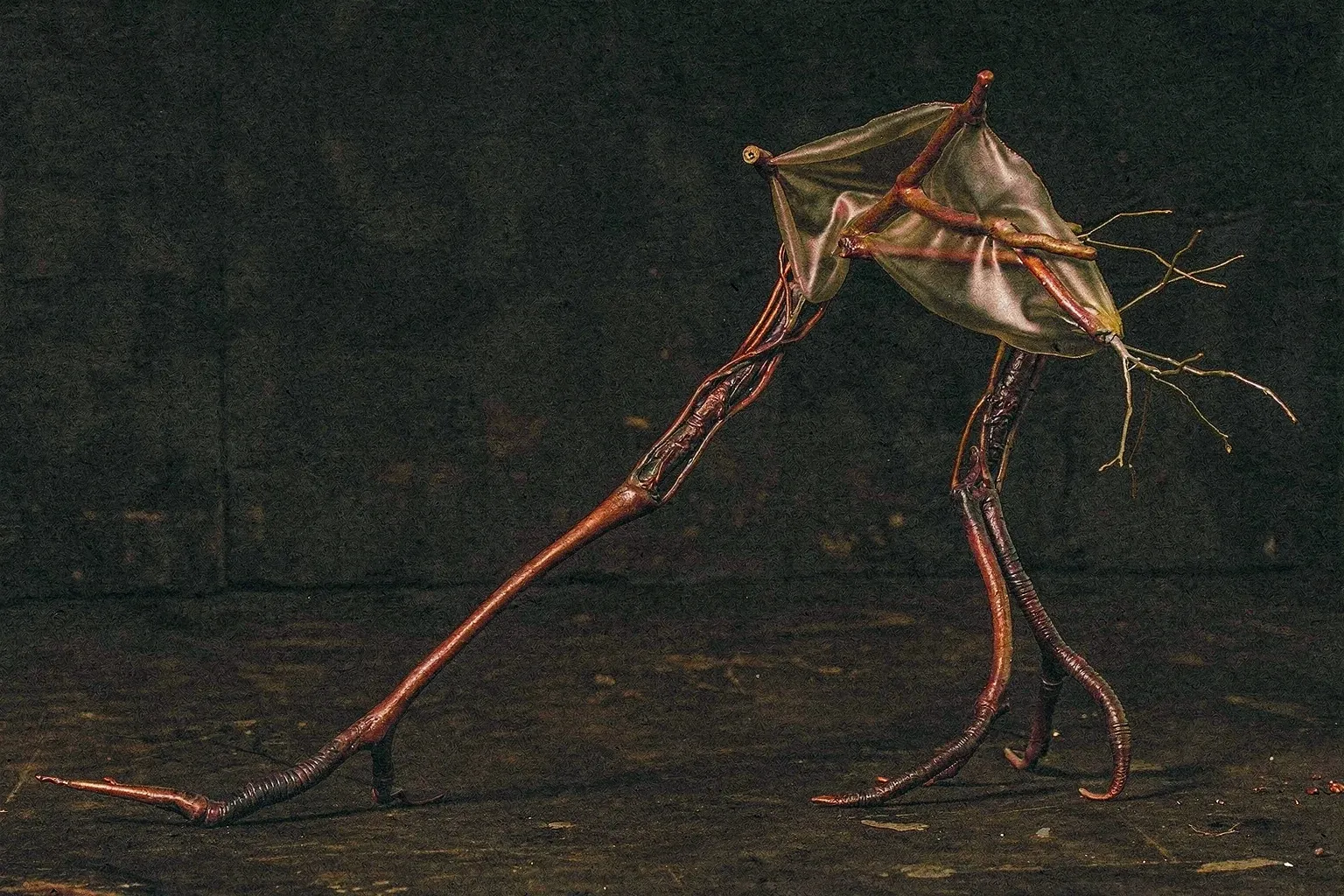
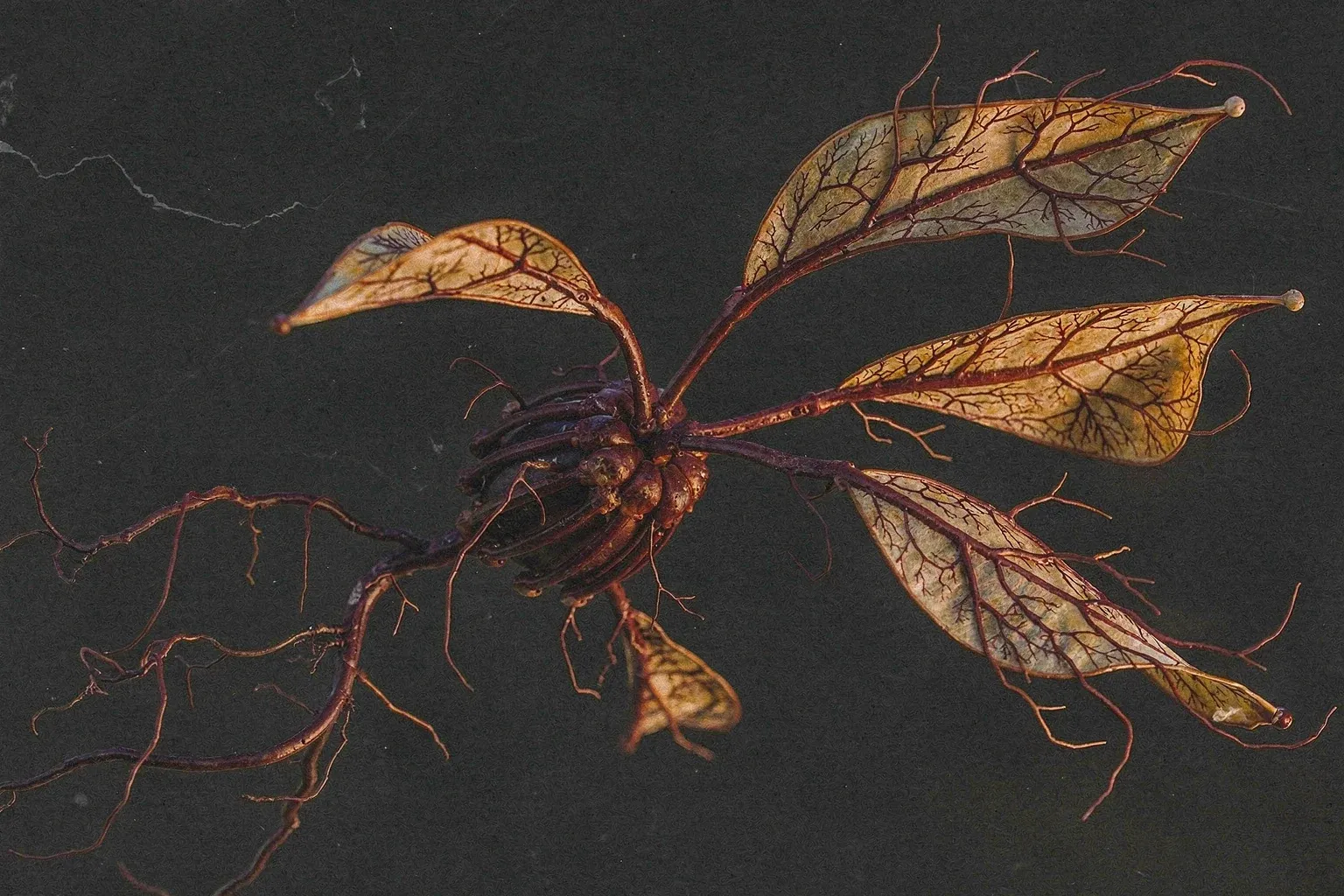
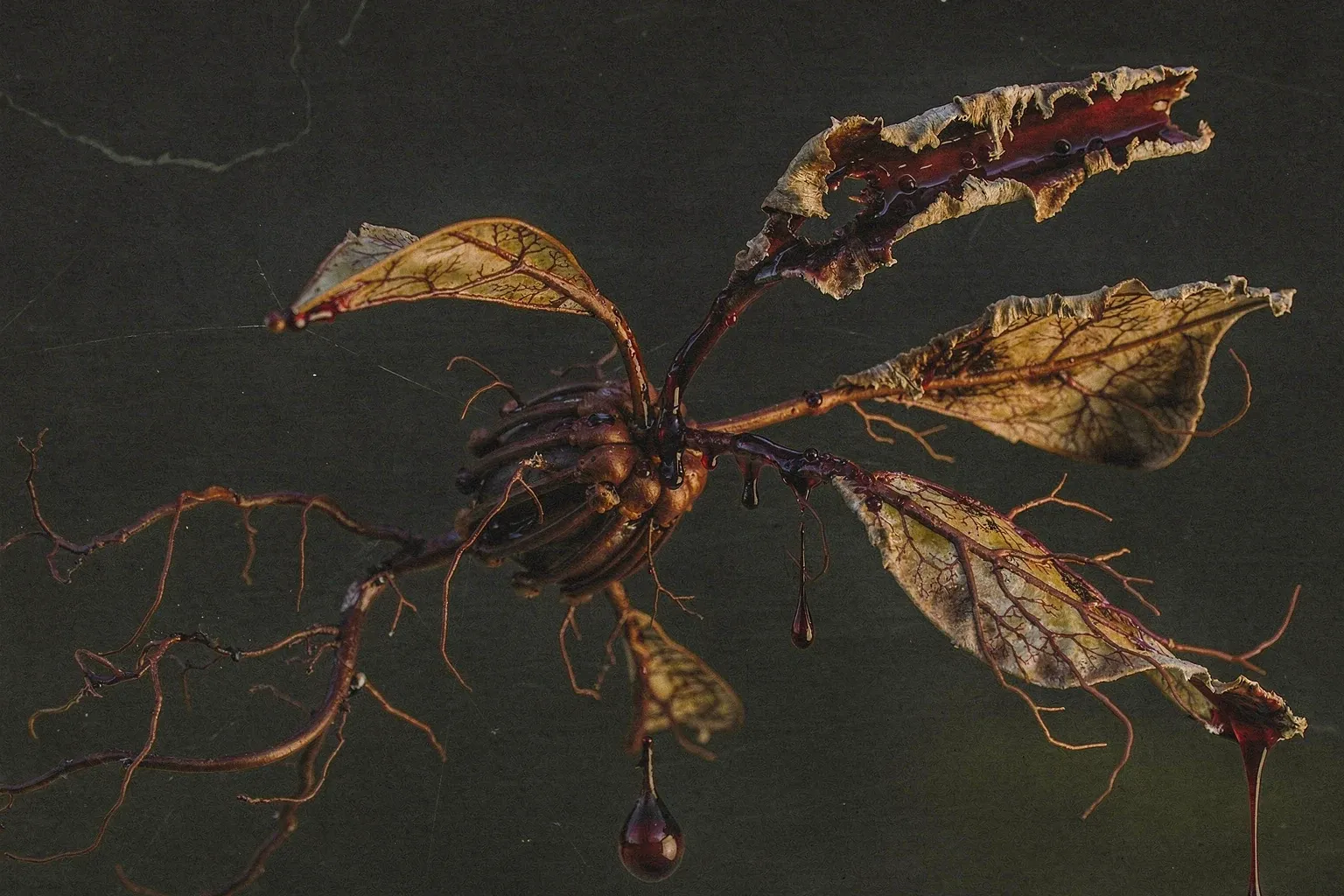
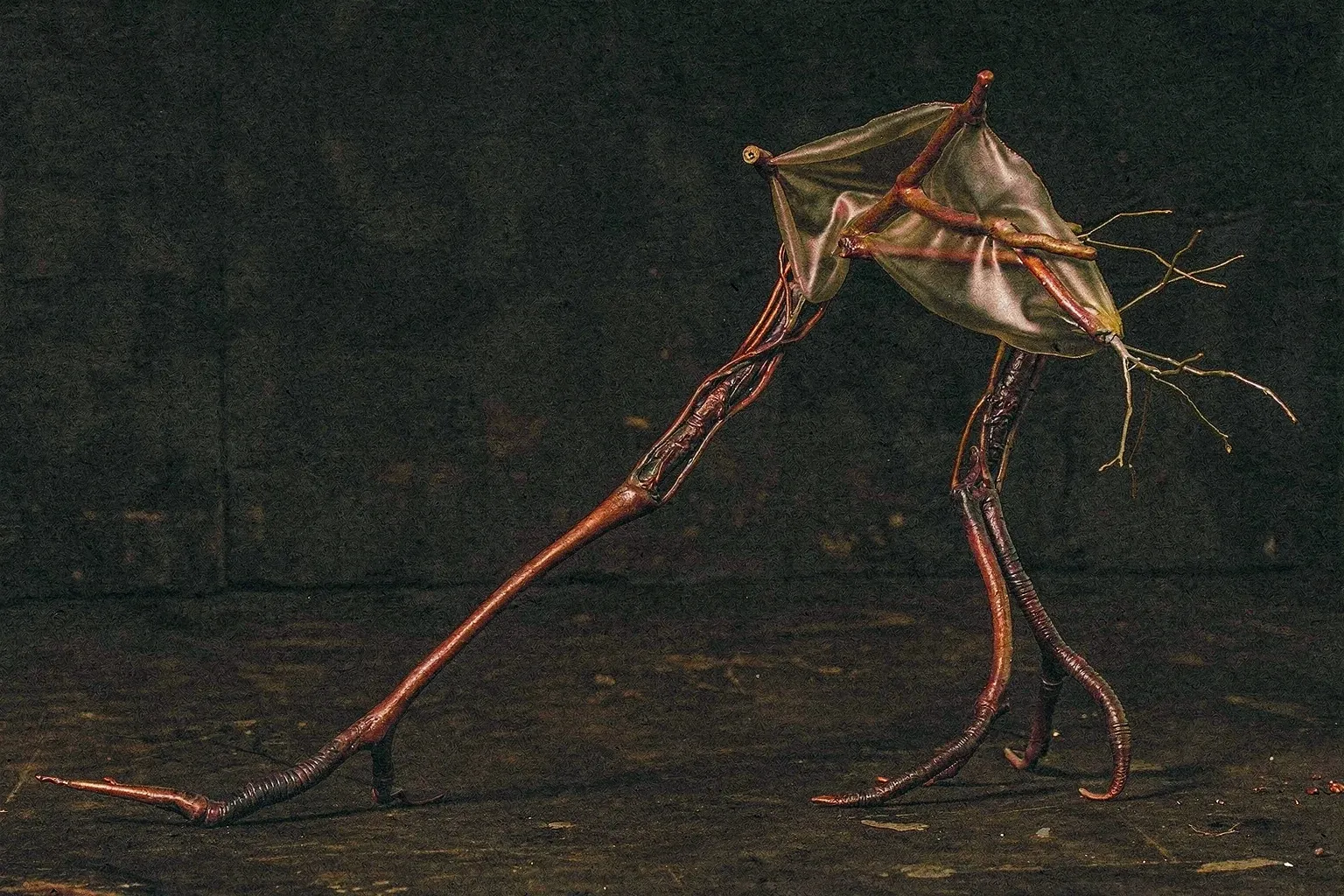
Ruptured sail, from Capillary sail. The first attempt tore a sail, but the sap ran from the core instead of the tear. The second named the upper sail and asked for sap at the torn vein, and the sap came back where it was asked for.
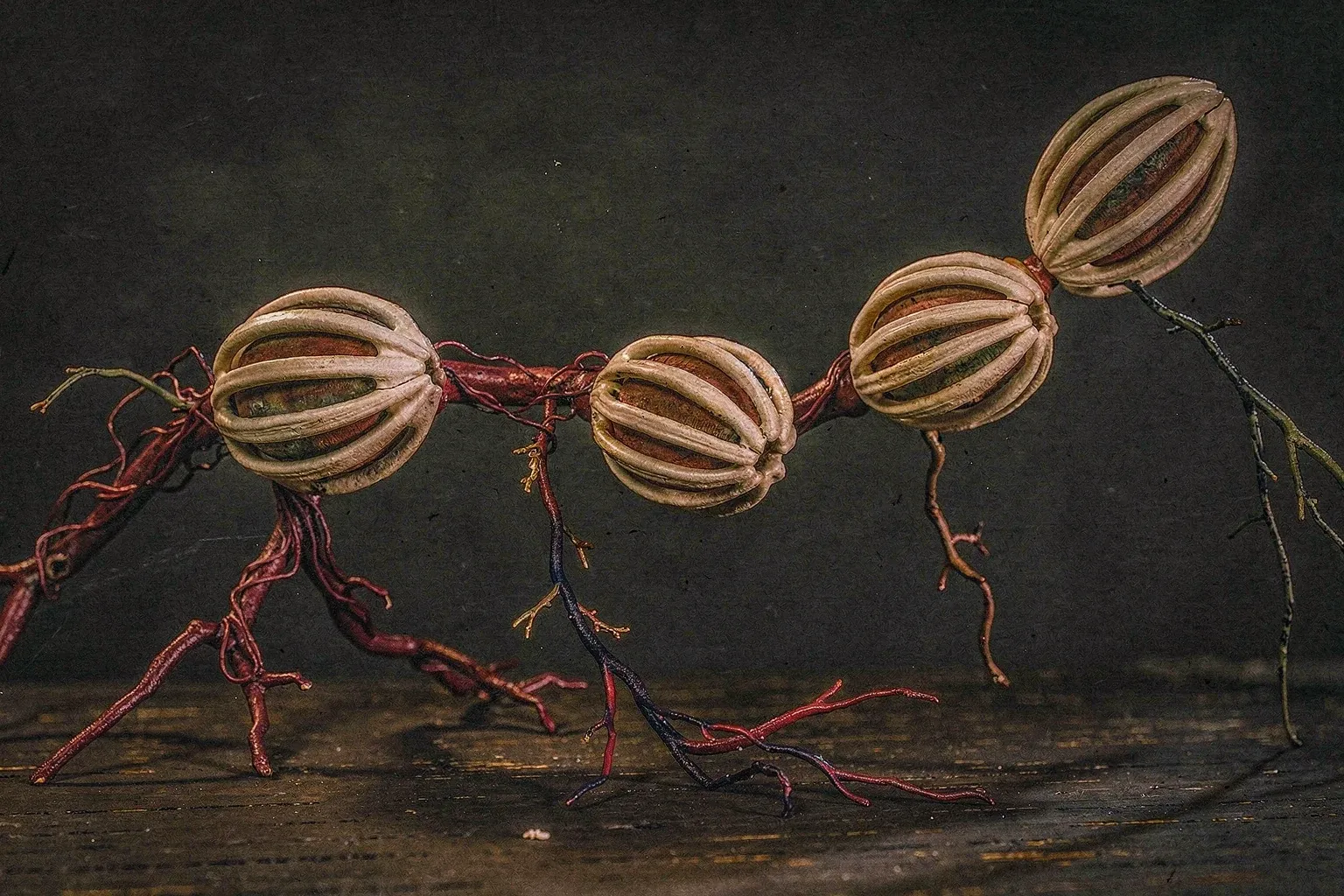
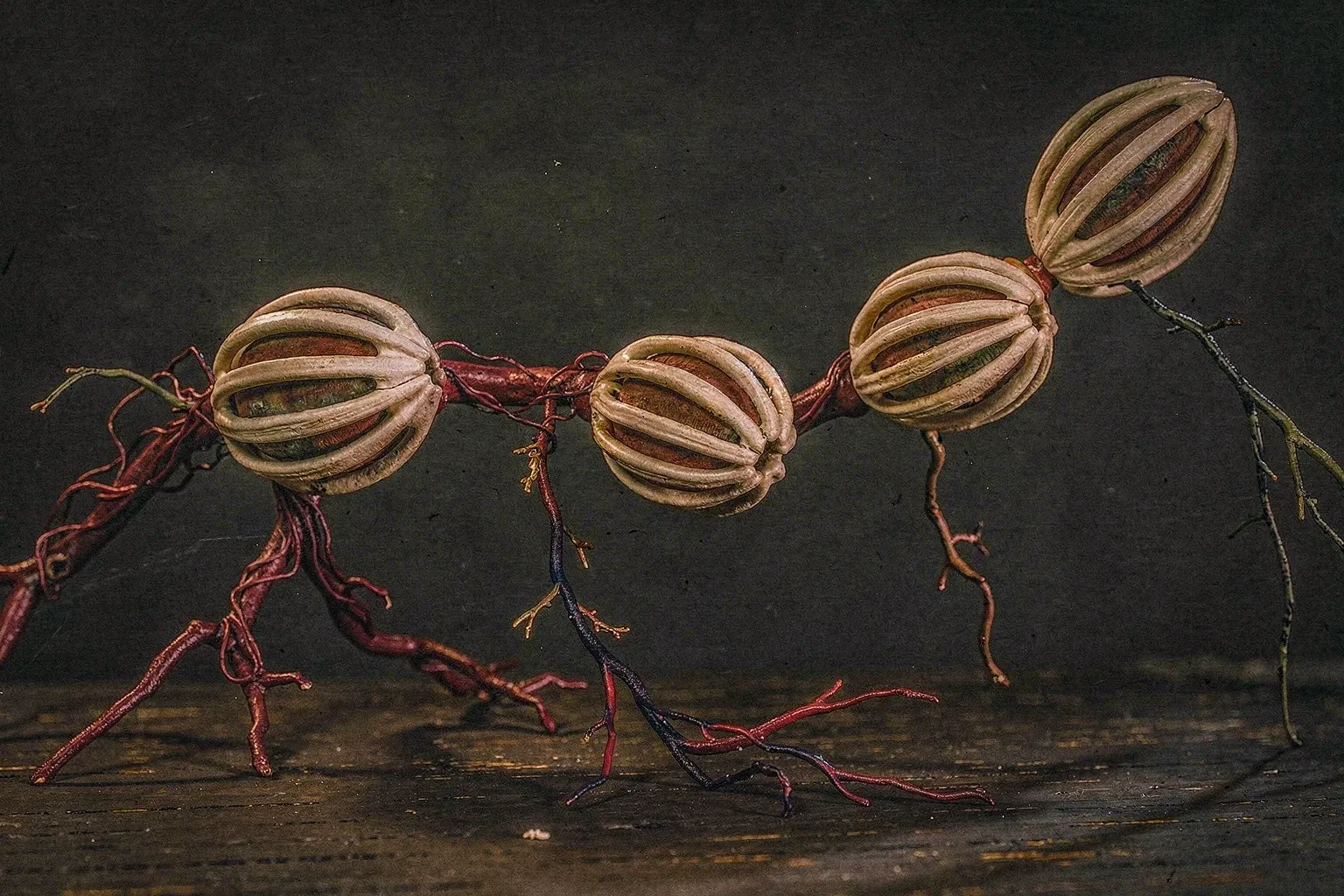
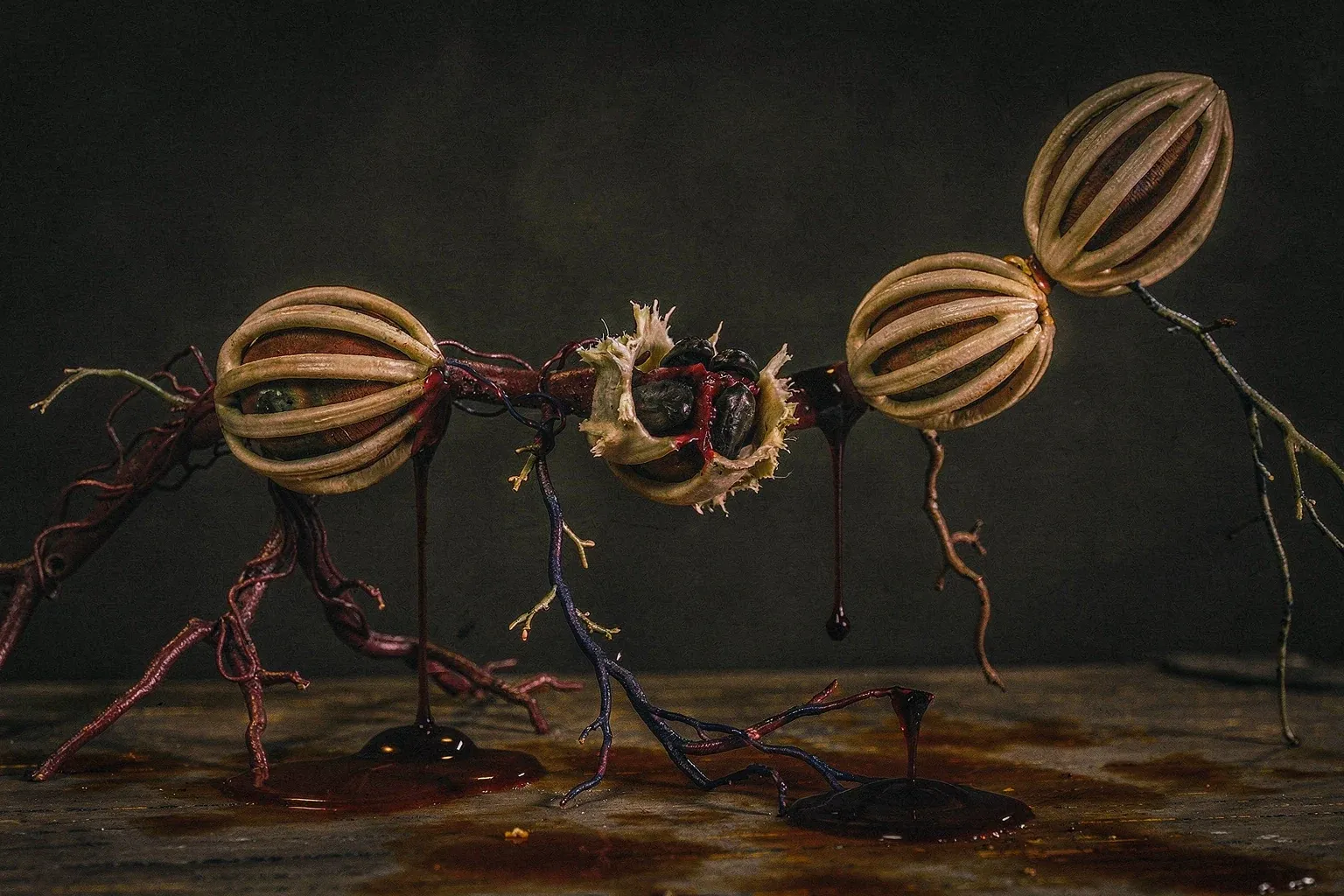
Overflow, from Anastomosis. One of the four capsules is split at a seam over dark seeds, and sap runs down the shared stem into pools on the floor. This came back right on the first attempt.
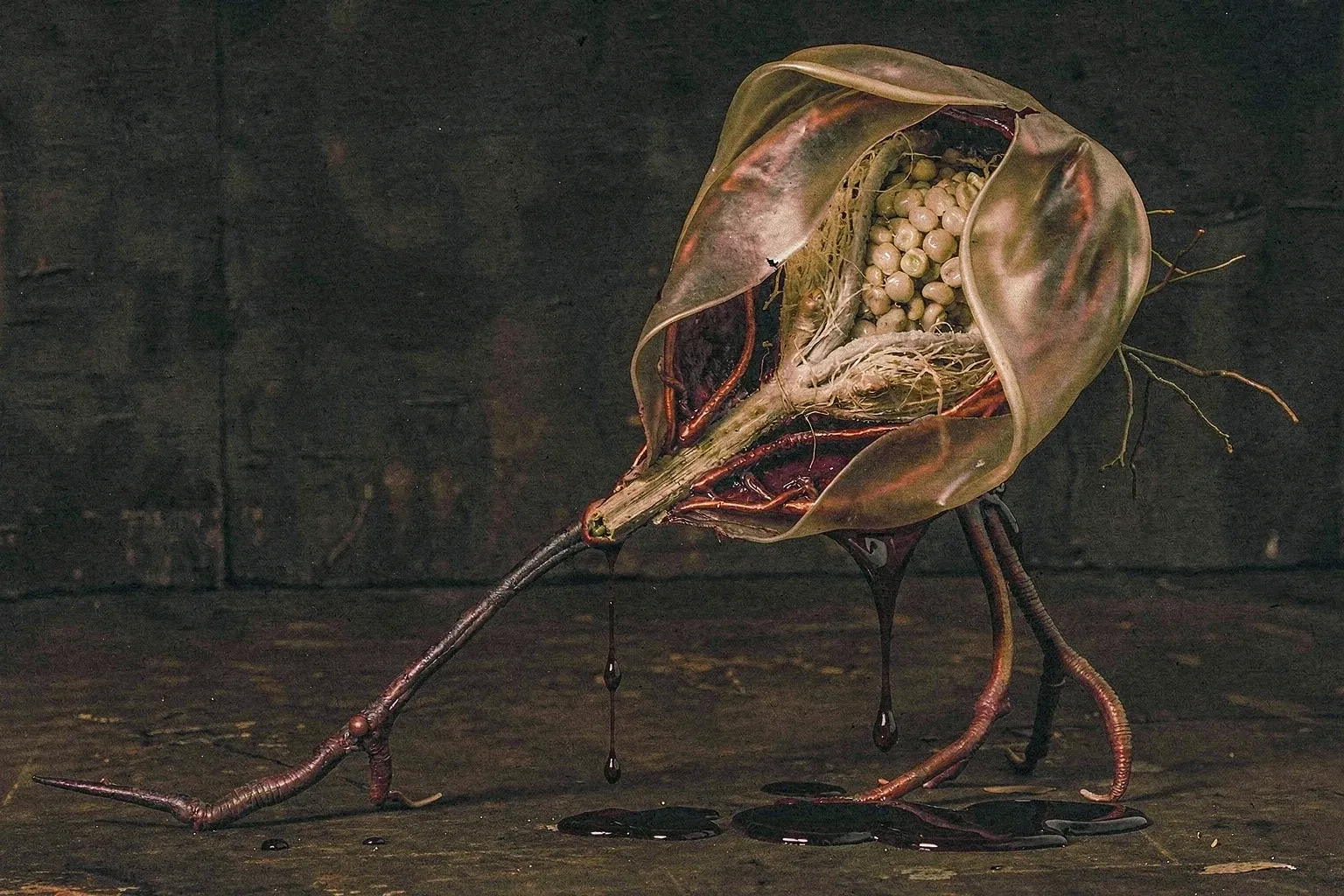
Opened husk, from Perfusion. The husk is peeled open over packed pale seeds and pith, and the cut stem drips. The husk came back about twice its old size.
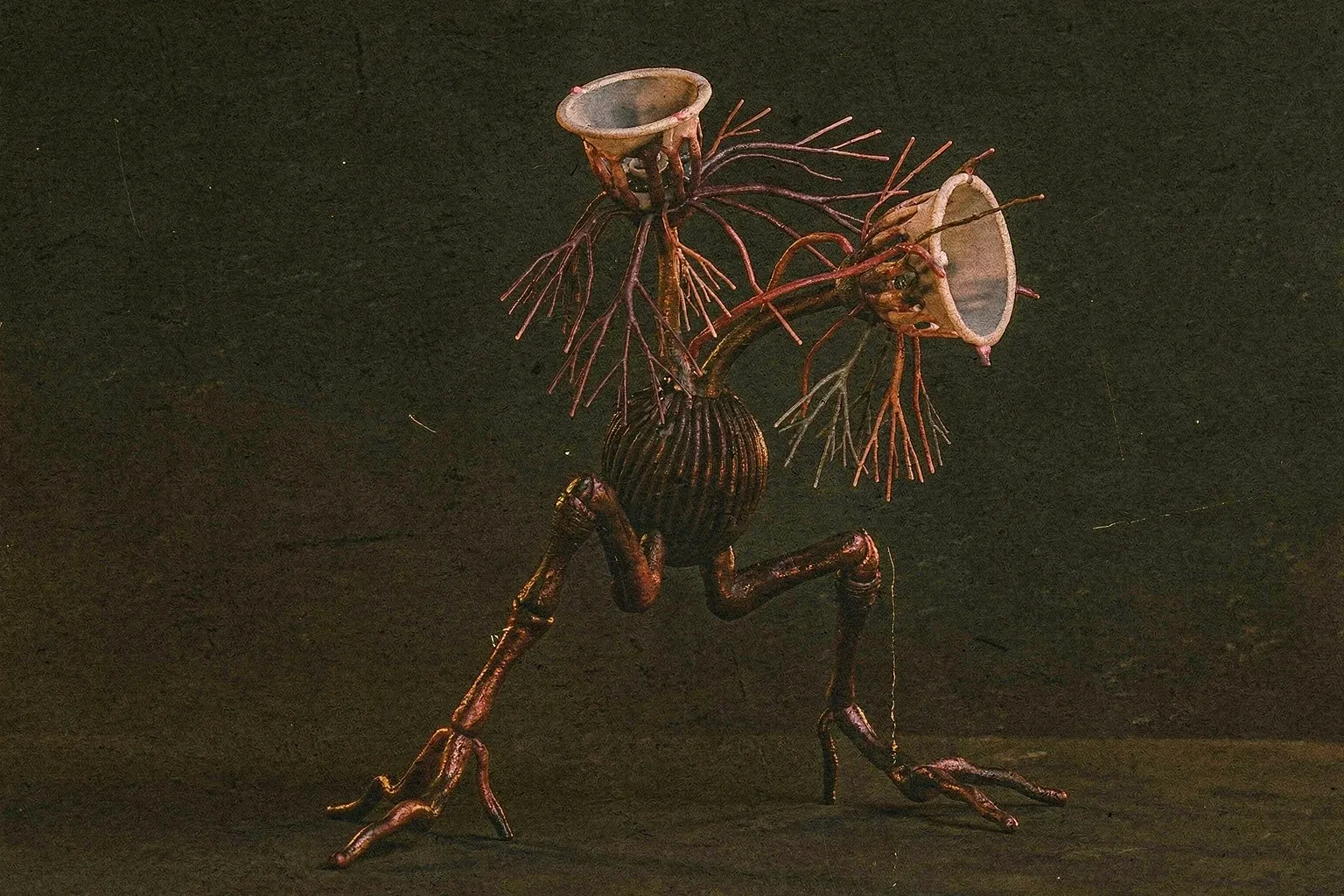
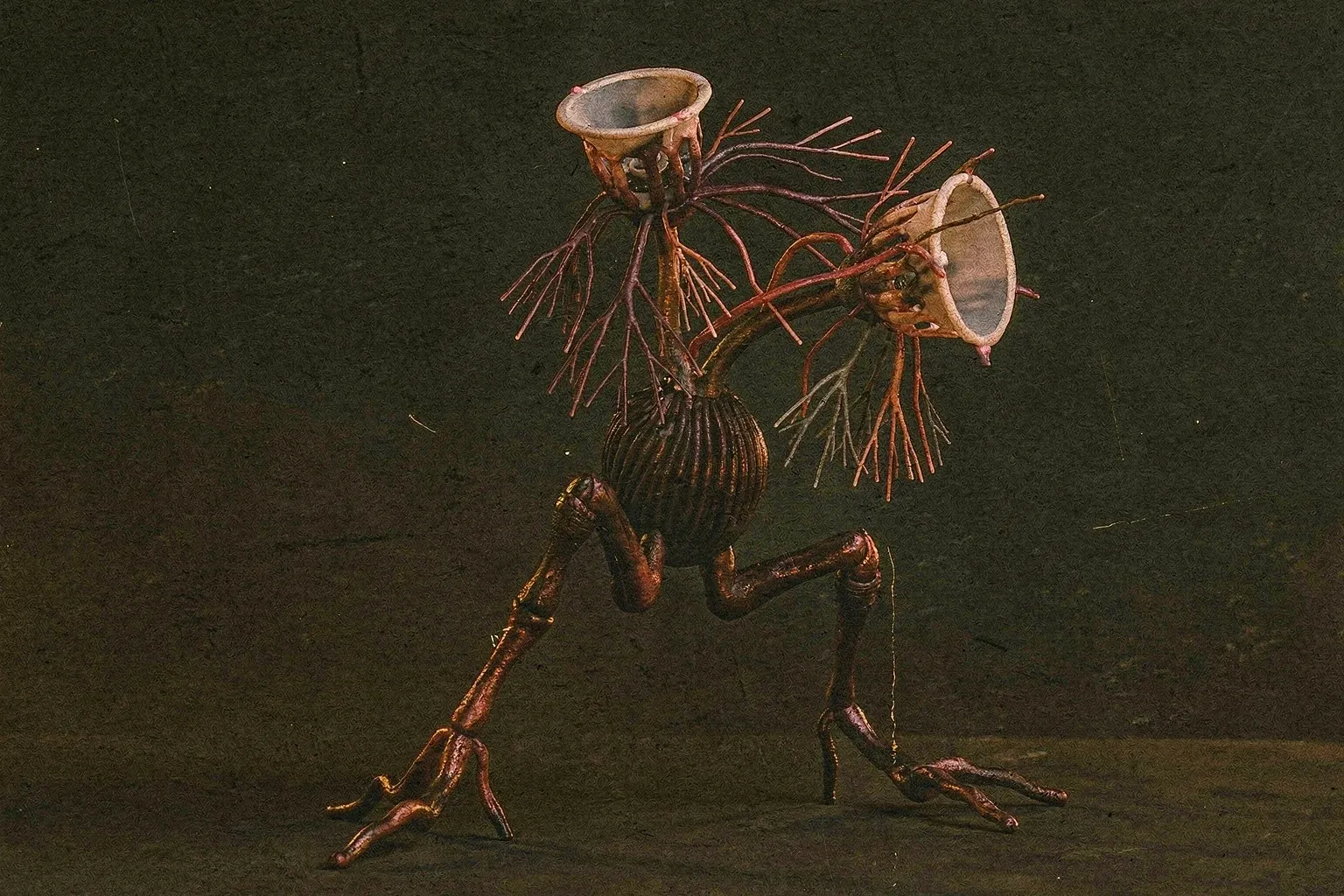
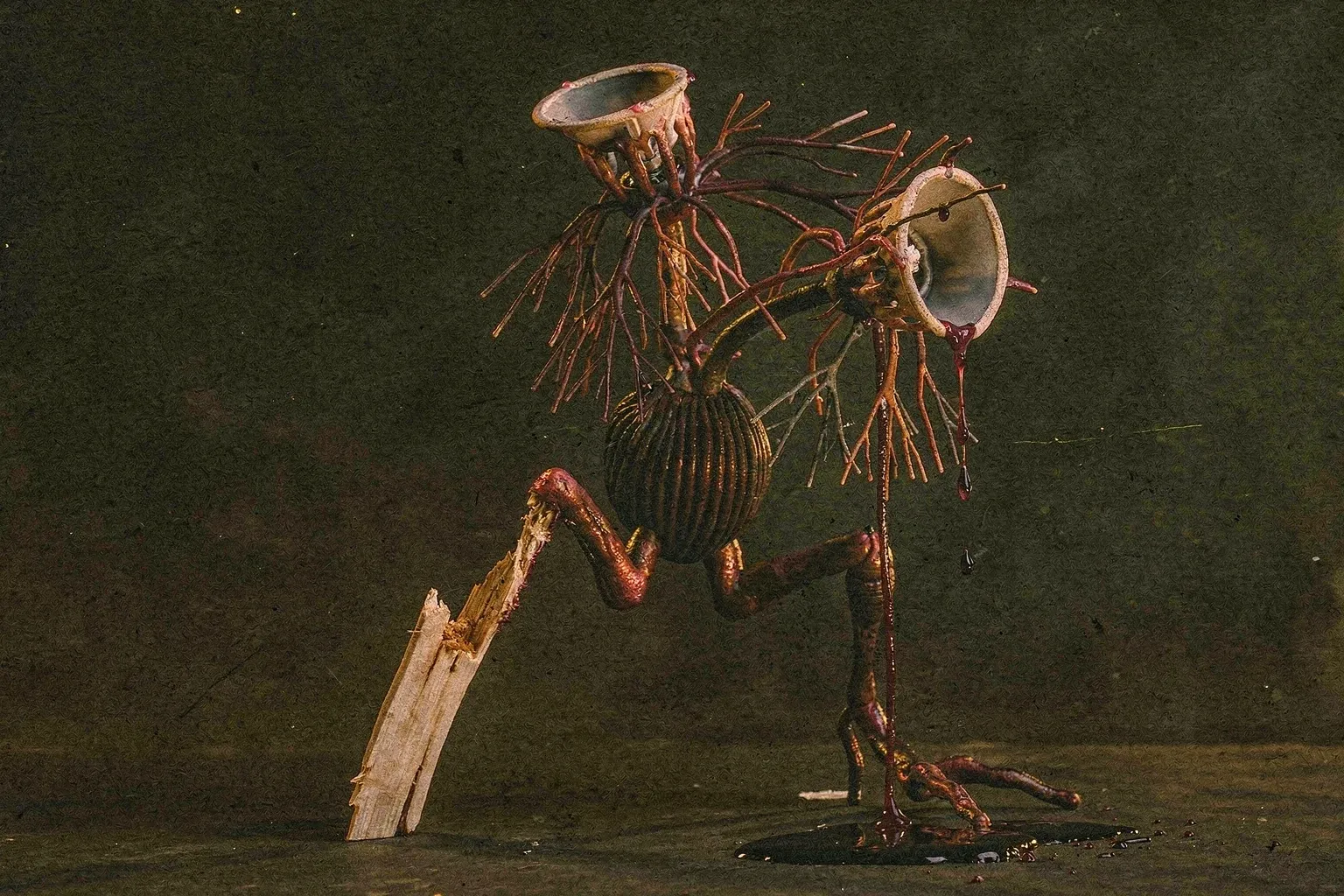
Severed root, from Circulatory hunter. This took four attempts and is not solved. One broke nothing; one produced a log far too big for the organism and no sap. The selected image has a snapped, splintered stilt, but its sap runs from a trap cup rather than the break, and the broken piece looks like pale lumber.
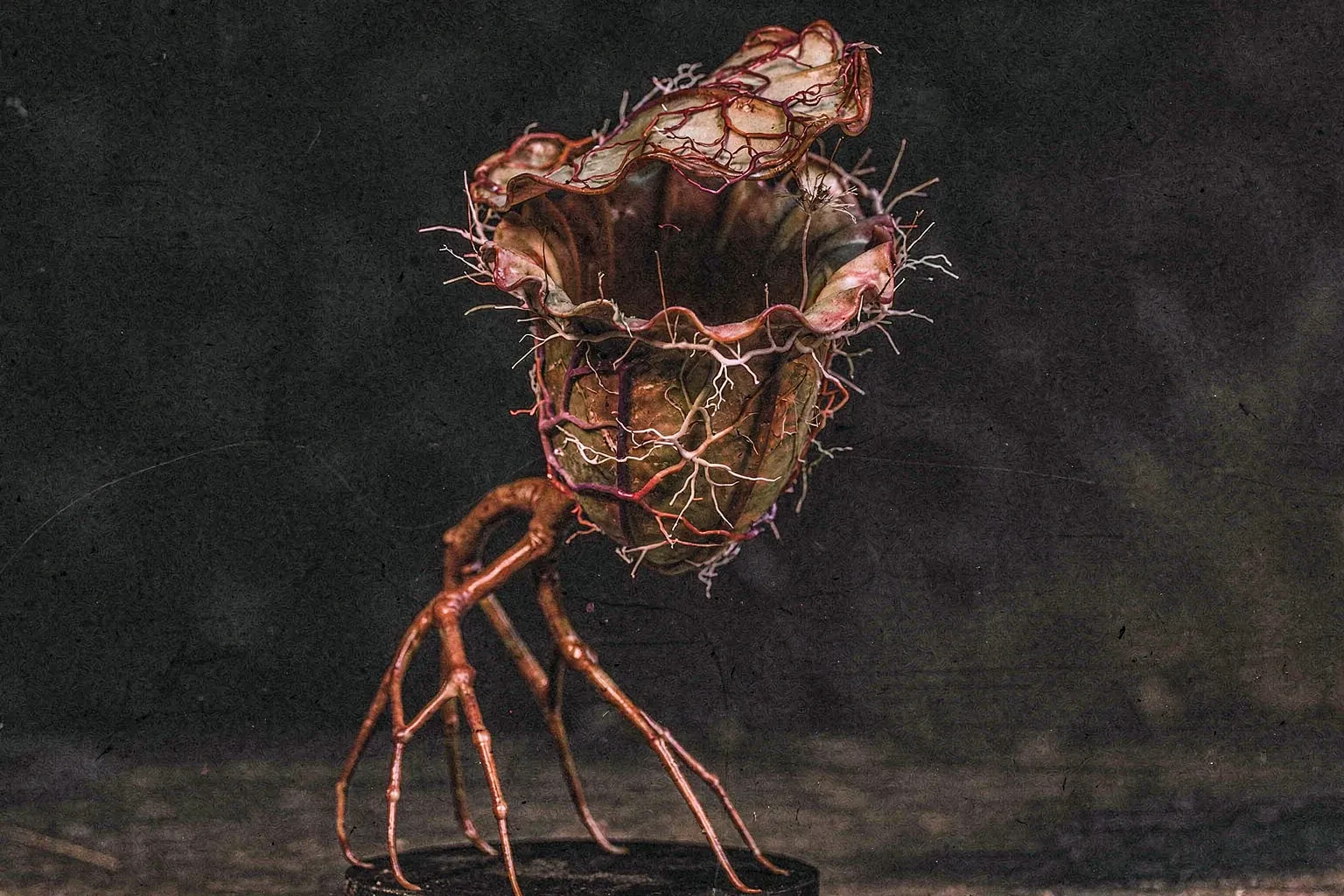
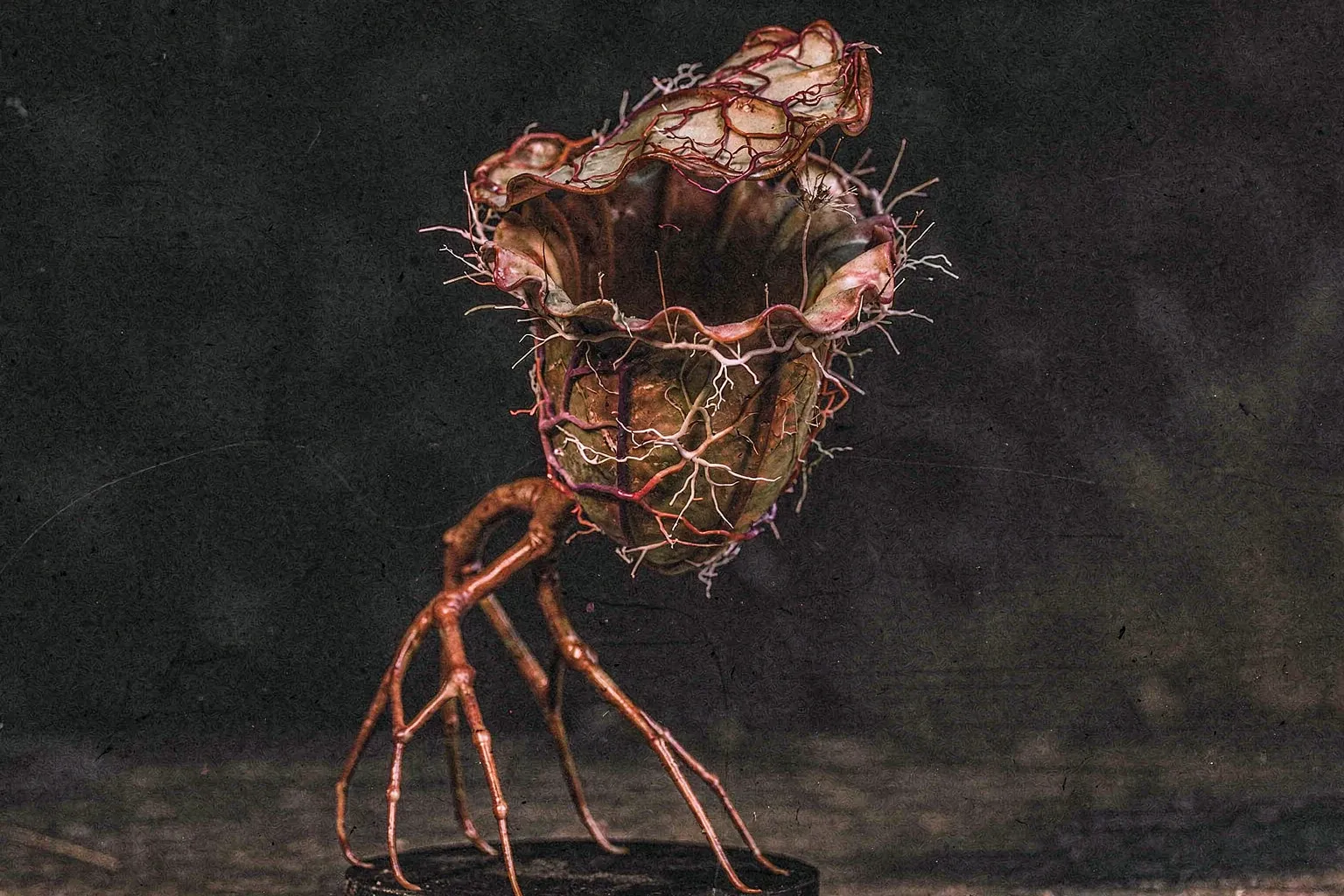
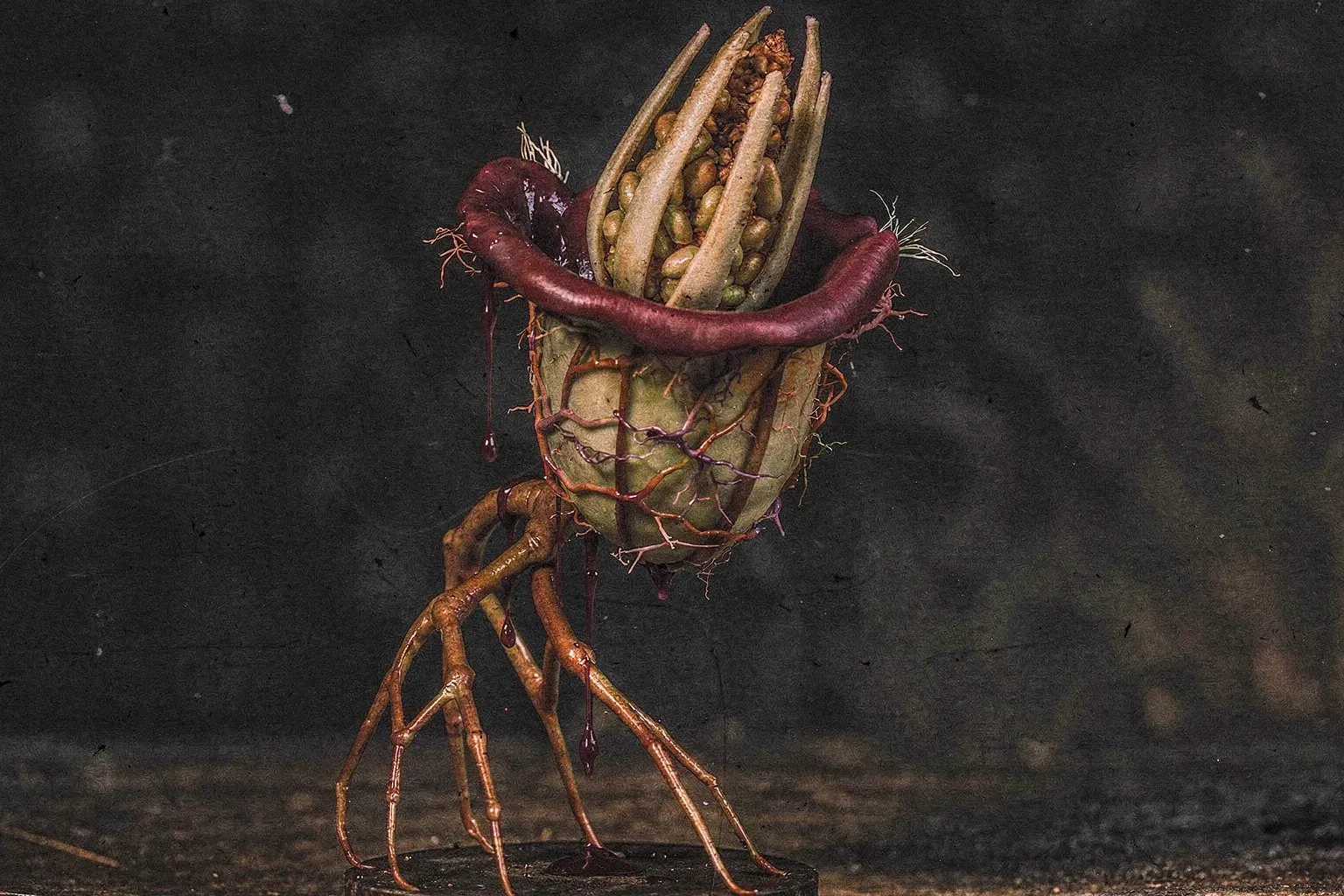
Consumption, from Vascular pitcher, with a crop of the Dormant seed capsule as prey. Sent the whole capsule image, the model dropped the pitcher and rebuilt the capsule’s own scene. With the capsule cropped, the pitcher stayed, but the capsule sat intact in its chamber. Later attempts splayed the prey without sap, or turned it into horizontal bars that read as a ribcage; that one was rejected.
After seeing the first six, John asked for one more round on the two feeding scenes. Its prompts began “Edit the first provided image” and asked the model to “keep the predator’s anatomy as it is; change only the interaction described below.” For consumption, the first edit split the prey clearly but coated the pitcher red and lost its hood, and the second split the pitcher’s own wall. The selected third attempt went back to the original pitcher and used a crop of the earlier split capsule as the prey. The chamber and its vein network are back, the capsule looks broken open over seeds and pith, and sap runs over the rim. The hood is still missing, and the rim became a thick glossy band that reads a little like a lip. It is a picture of a broken object in a vessel, not evidence of anything feeding.
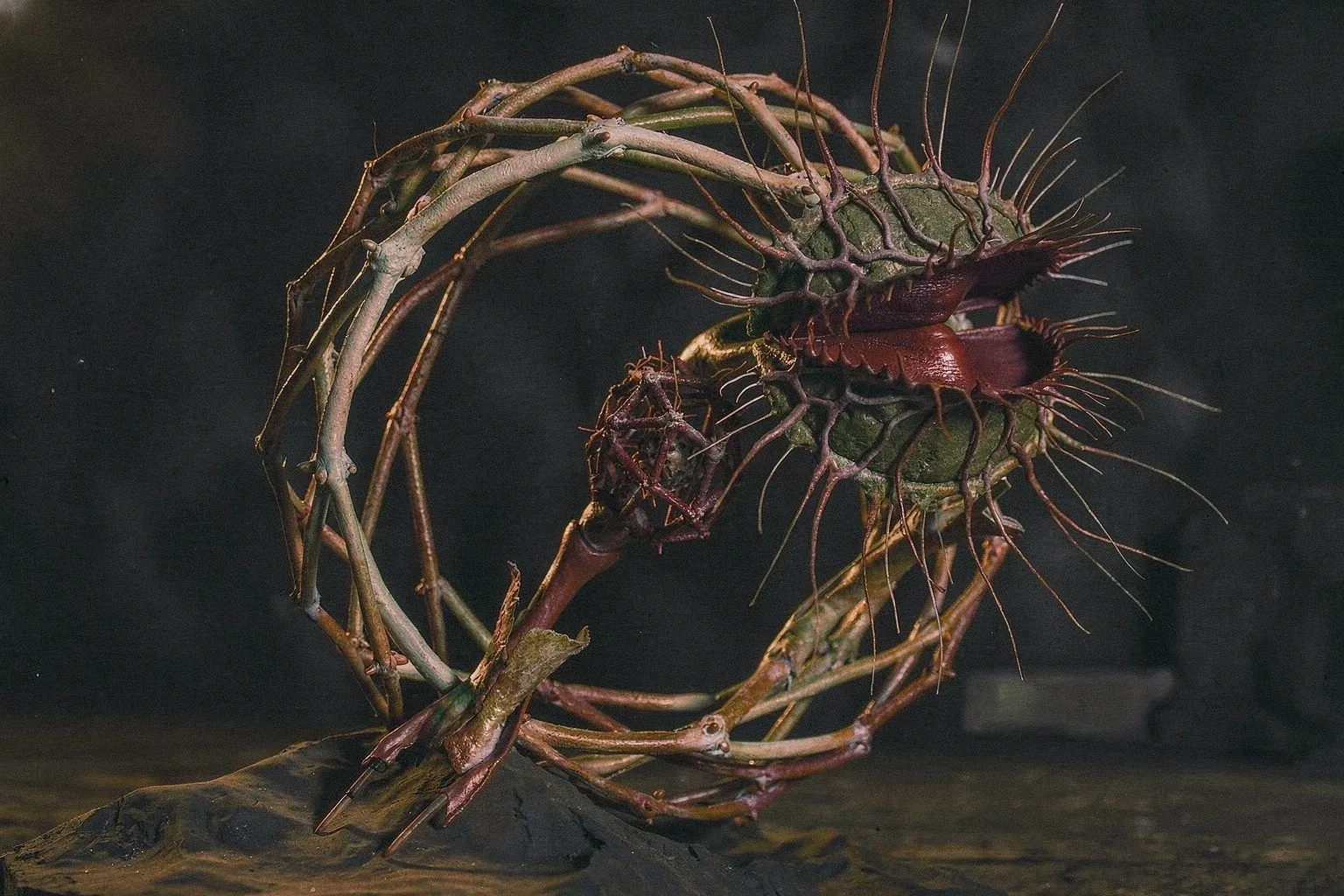
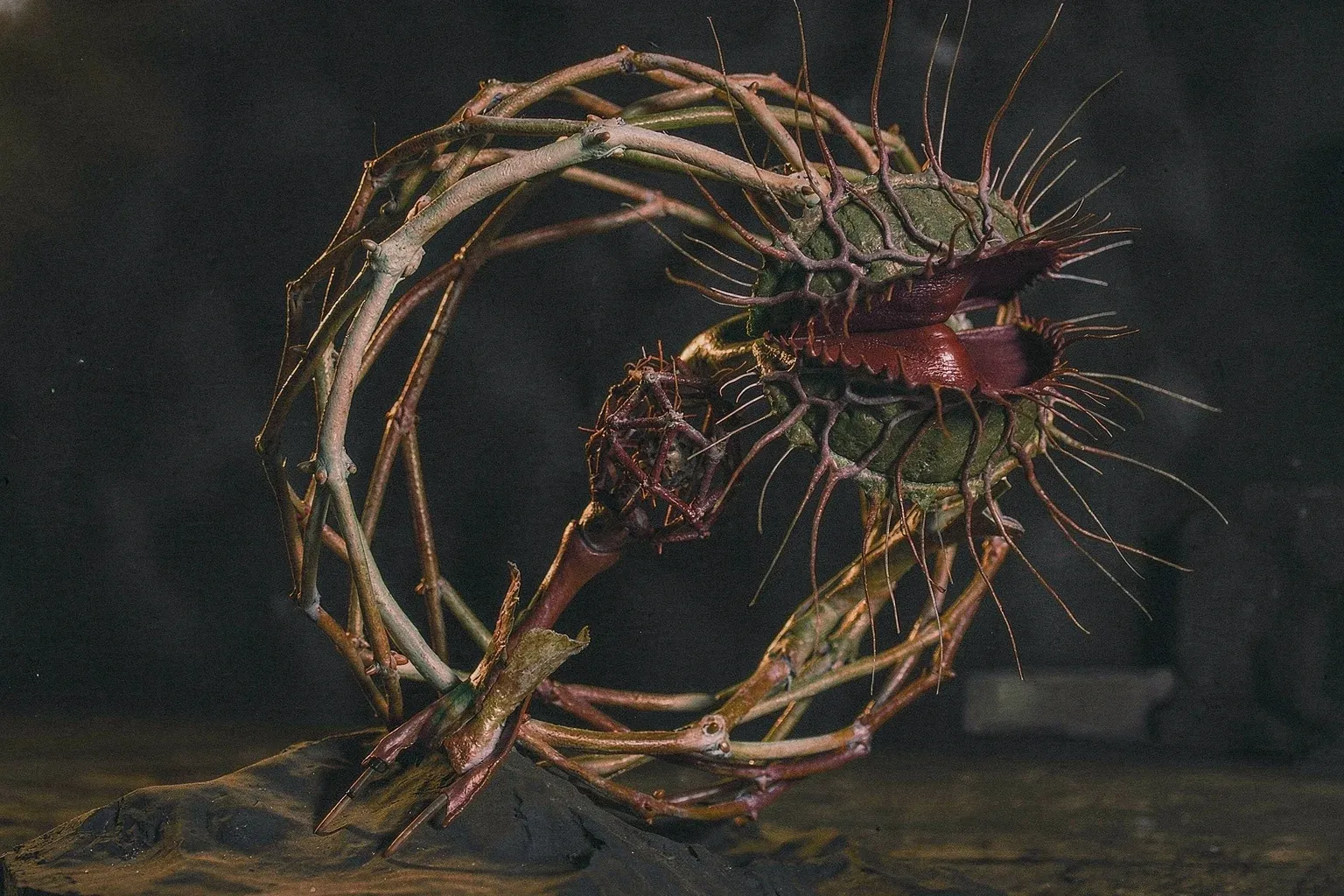
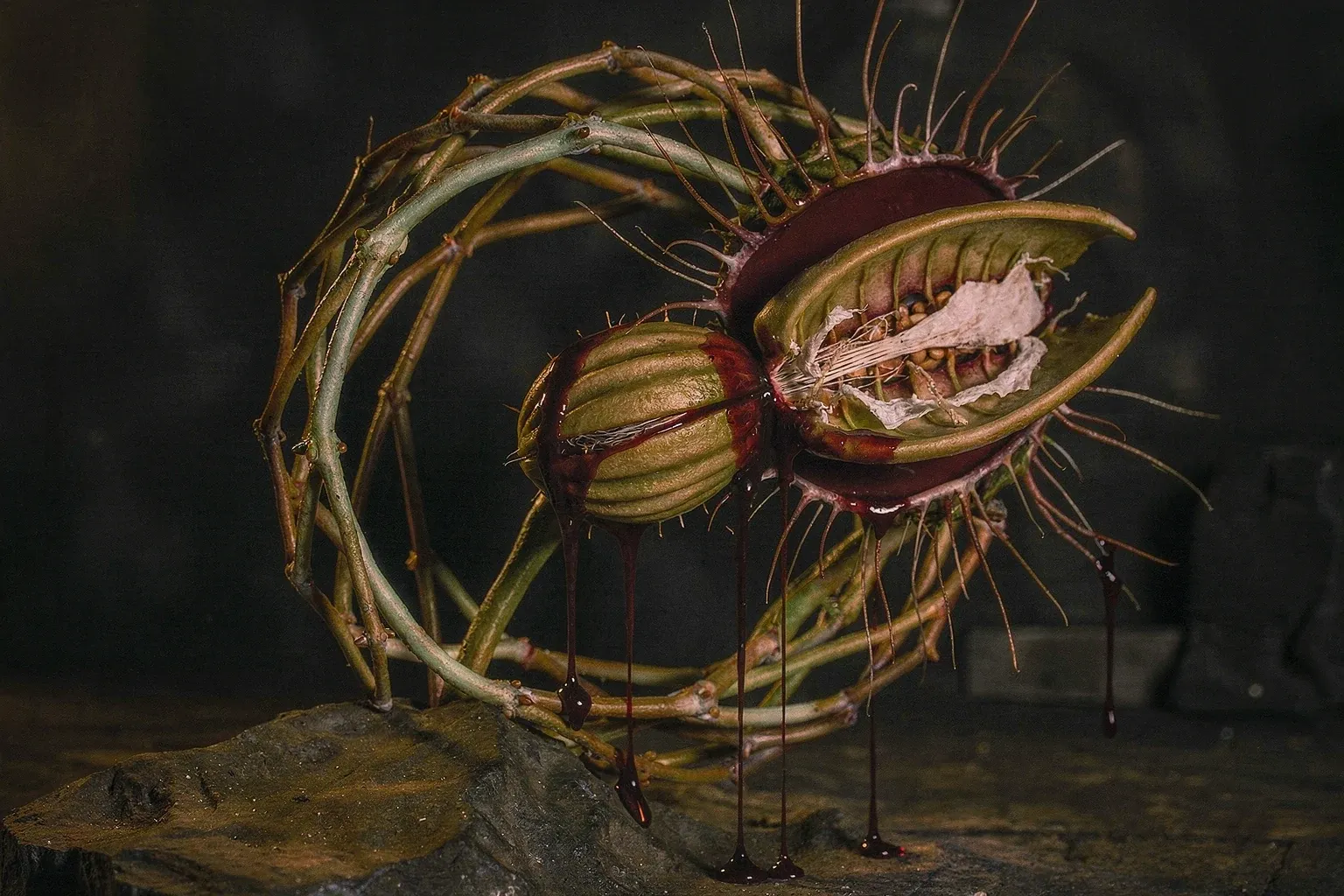
Capture, from Fed snare. With the sail organism as prey, it took the trap’s place twice. The first-round selection kept Snare’s trap holding the capsule, but the lobes were open and the capsule intact. The refinement round asked:
the two hinged lobes are now partly closed around the middle of the ribbed seed capsule, pinching it.
They did not close. In the selected result the capsule is split open inside the trap over white pith and seeds, and sap runs from where it meets the trap, but the red lobes stay wide open. It was first logged as a success; a closer look at full size showed that the narrowing was the capsule’s own waist, not the trap. A second edit asked again and came back almost unchanged. The closing trap this scene was meant to show was never produced, and the image is shown as a partial result.
Where it drifted
The sap came back glossier than the matte finish asked for in most images. Sap that clearly comes from the wound worked on the sail, the capsules and the husk, but not on Hunter. With a whole-frame prey image, the prey’s scene took over the picture; with the small capsule crop as prey, the predator stayed in all four first-round attempts that used it. That is a pattern in a few samples, not an established cause.
No teeth or jaws appeared, but the thick pitcher rim and the open red trap ringed with cilia both lean toward a mouth. Hunter’s knee-bent stilts and the pitcher’s talon-like stilt tips are inherited from the parent images.
Records
The model was FLUX.2 Pro through OpenRouter, with Black Forest Labs pinned and fallback disabled, one 1536 × 1024 image per request and no random seed. There were 21 requests: 16 in the first round and 5 in the refinement round, all returned, at $0.075 each. The whole run cost $1.575 in returned usage; the six images shown account for $0.45 of that.
Three references were crops: two of images published in the earlier notes, and one of a generated attempt from this run. Four refinement edits used a generated attempt as the image to edit. The record lists every one by hash, so a study made from an intermediate is not presented as coming straight from its published parent.
Image record
Generated art: six later states of images from From plant to motion, made with a text-to-image model. These are invented organisms, not photographs of real specimens, and not real injuries or feeding. The red fluid is plant sap.
- Model
- black-forest-labs/flux.2-pro via OpenRouter, Black Forest Labs pinned, no fallback
- Output
- 1536 × 1024 PNG, one image per request, no random seed supplied
- Requests
- 21 sent (16 in the first round and 5 in the refinement round); 21 images returned, 0 refused or failed. 6 are shown.
- Recorded cost
- $1.575 for all 21 requests, in returned API usage; the 6 images shown account for $0.450. Reference images reused from earlier notes were not generated or billed again, and crops cost nothing.
Show generated injury and consumption studies
Fictional botanical injury, blood-like sap and one invented organism breaking another open. No people, real animals or real injuries. Each row pairs the published image a study descends from with the study.
-
Capillary sail 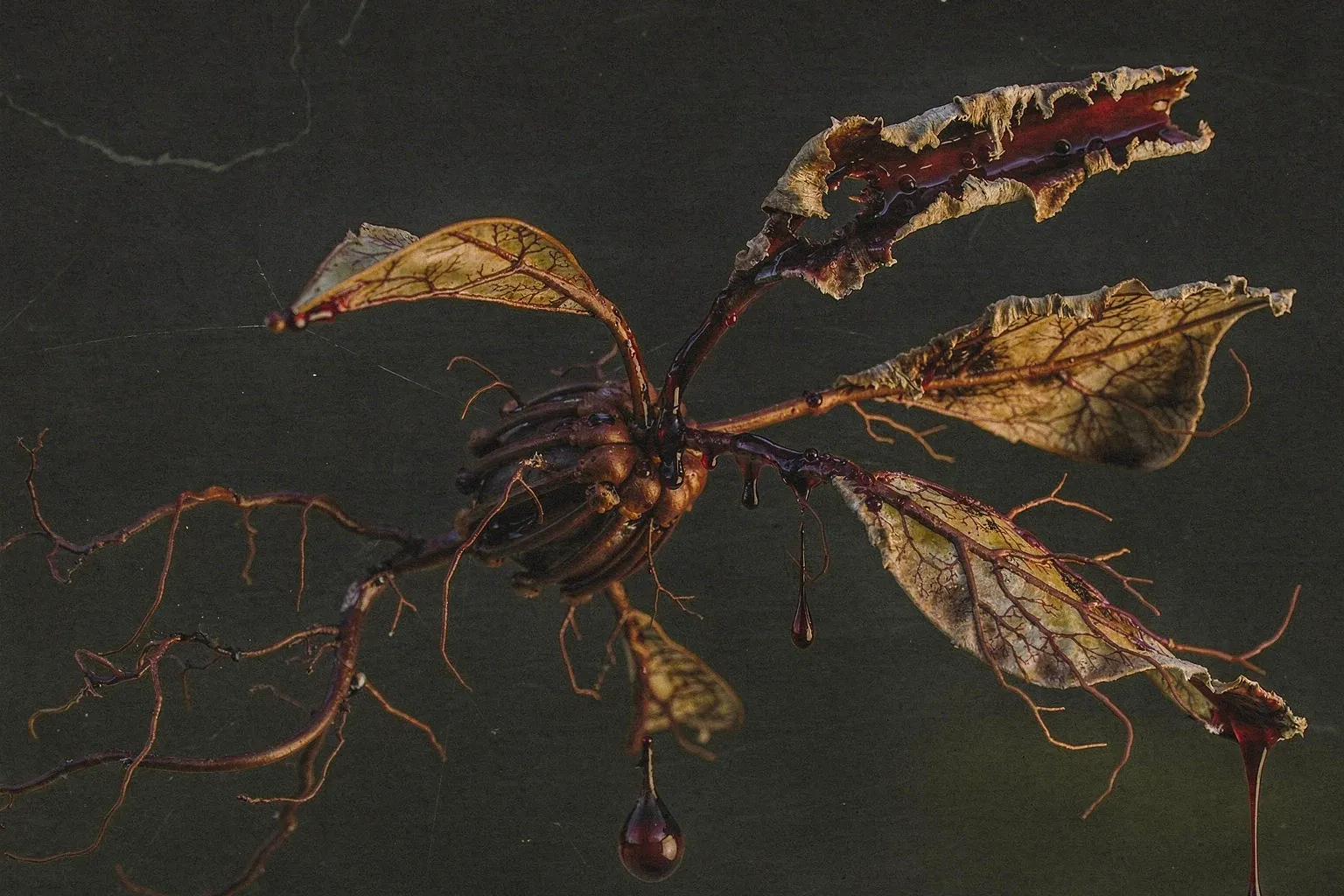
Ruptured sail Selected on the second attempt. The sap comes from the tear. Other sails drip at their tips, the drop under the core is glossier than asked, and the green-grey background is inherited. -
Anastomosis 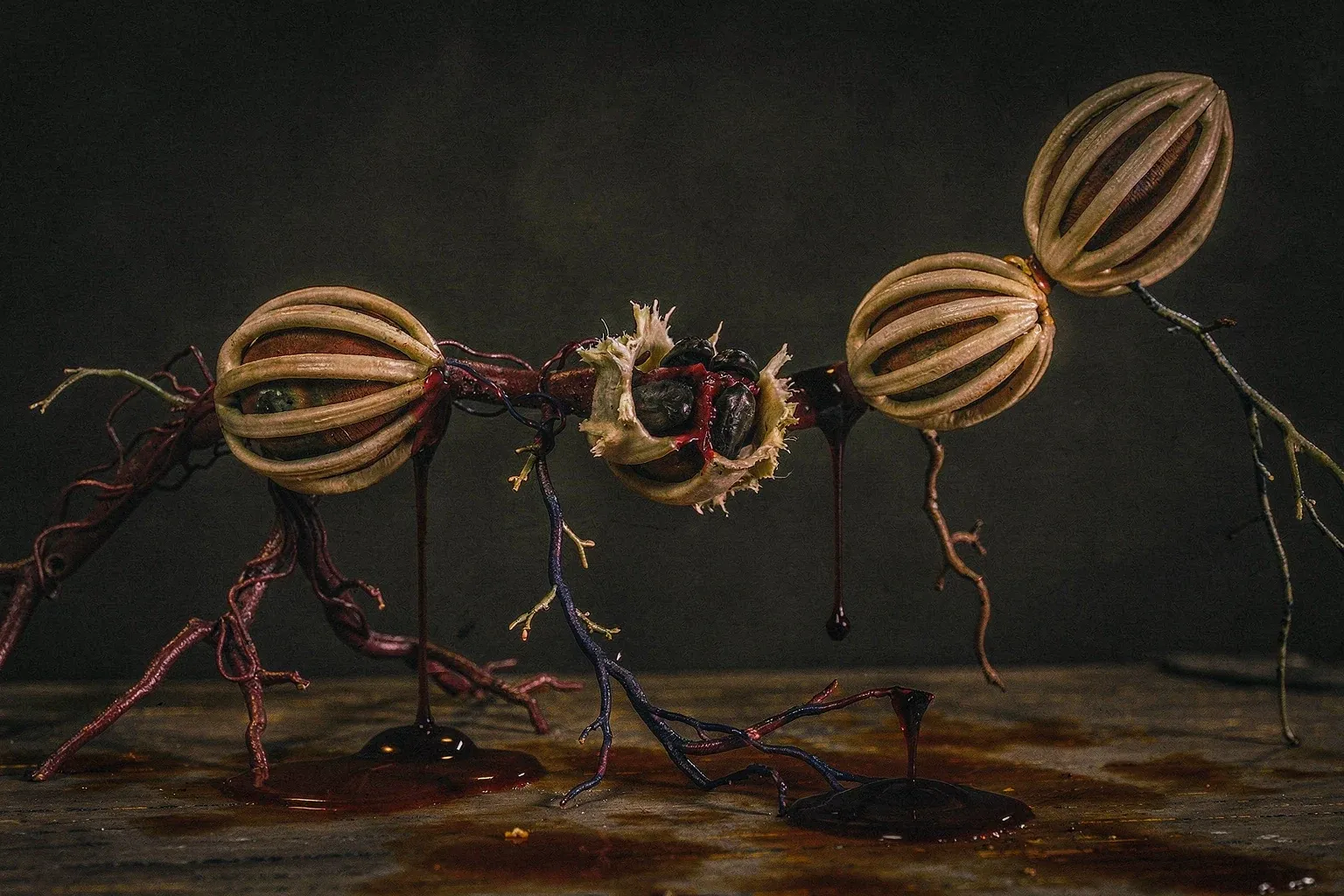
Overflow Selected on the first attempt. Glossy pools, the brightest red of the set inside the split, and an off-palette blue root inherited from the parent. -
Perfusion 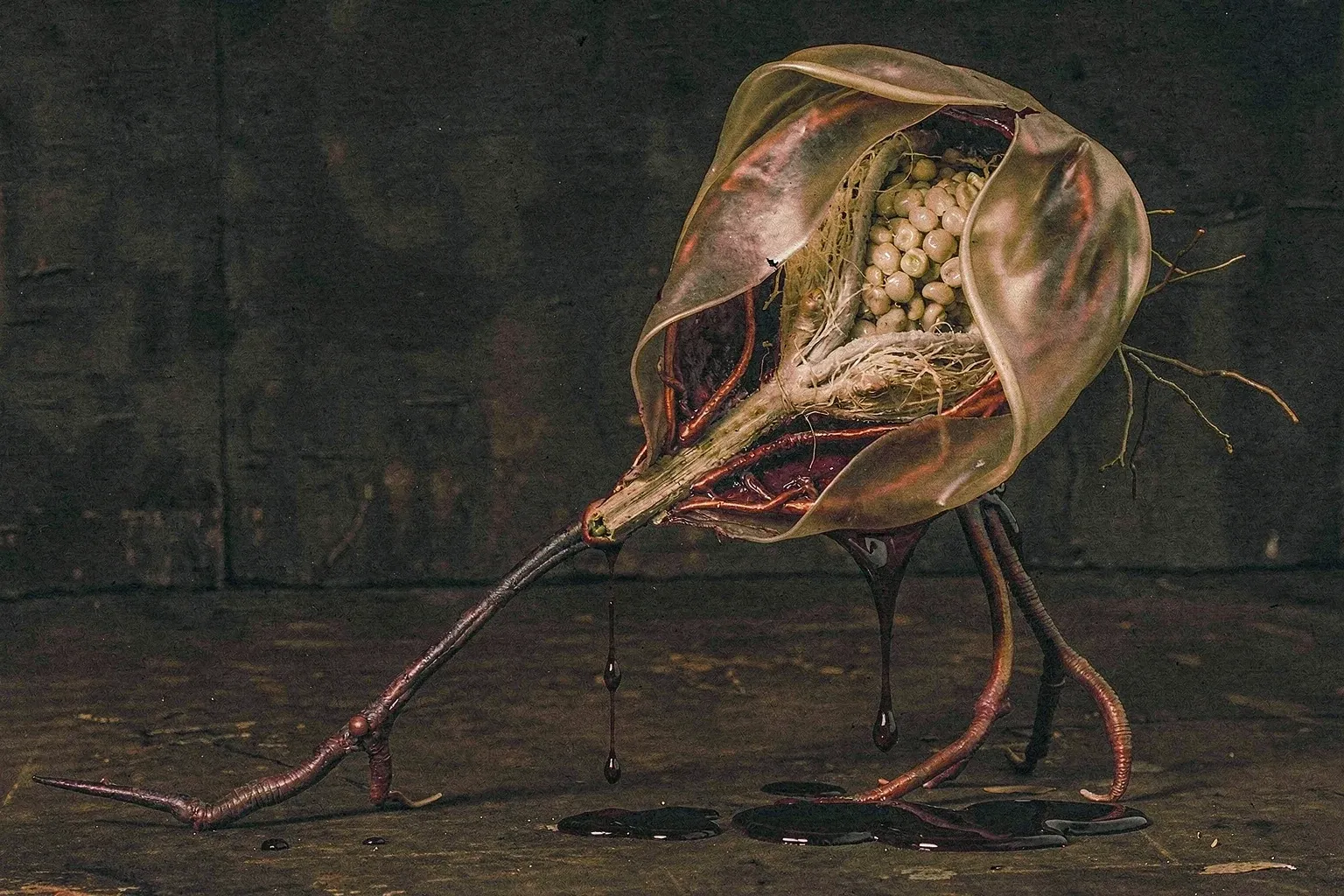
Opened husk Selected on the first attempt. The husk changed more than asked. The husk is about twice the parent's size, red folds inside lean slightly fleshy, and the pools are glossy. -
Circulatory hunter 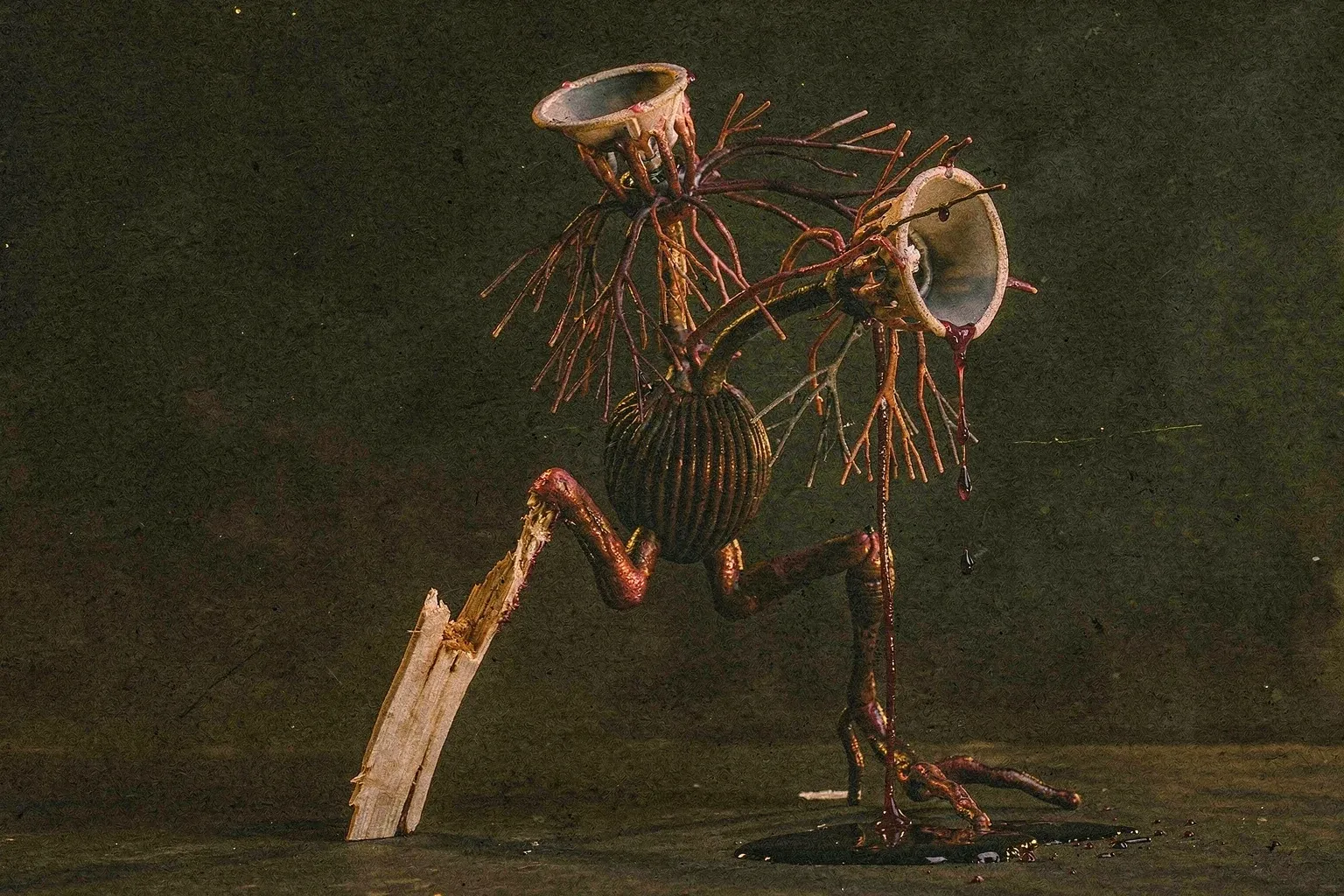
Severed root Selected on the third of four attempts. Not fully solved. The sap comes from a trap cup, not the break; the broken piece reads as pale lumber; the knee-bent stance is inherited from the parent. -
Vascular pitcher 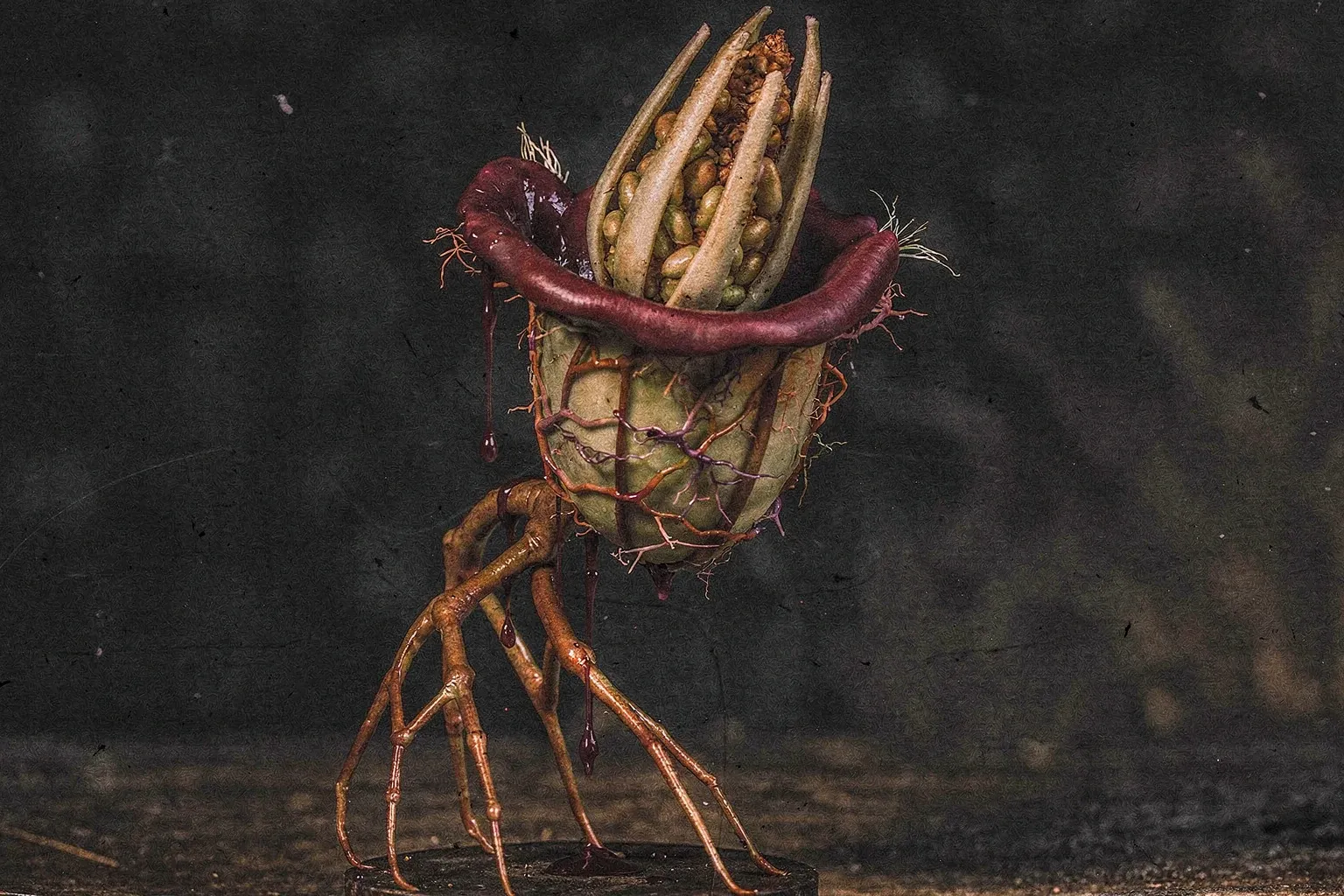
Consumption Met with defects after seven attempts over two rounds. The prey looks split and the predator stays recognisable. The hood is missing, the rim is a thick glossy band that reads a little like a lip, the stilt tips look talon-like (inherited), and the sap is glossy. It shows a broken object, not real feeding. -
Fed snare 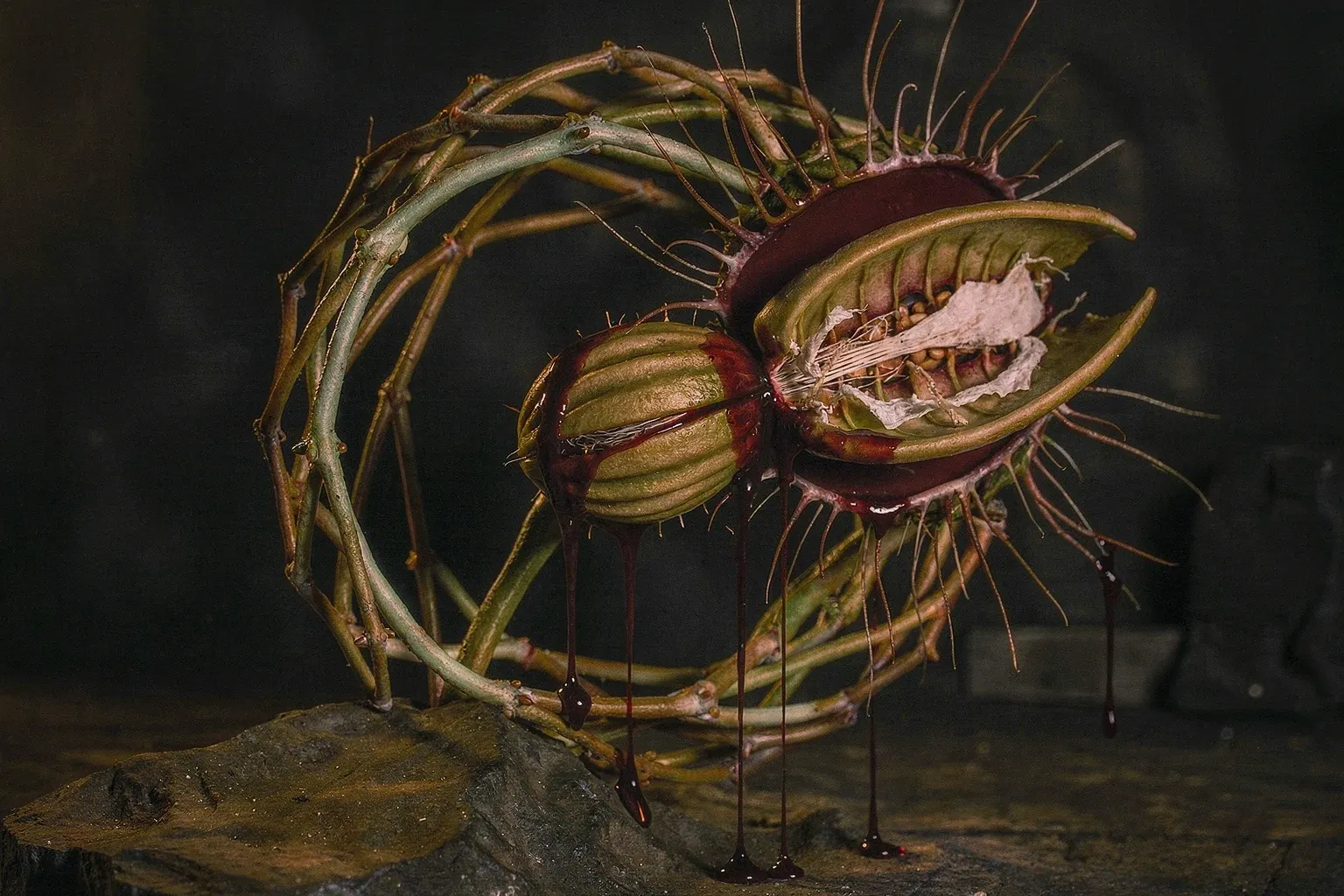
Capture Partial. The prey is split, but the trap's lobes stay wide open; the closing trap the scene asked for was never produced. The prey drifted to olive, close to the trap's colour; Snare's small ball on its stalk is lost; the drips are long and glossy; the open red trap ringed with cilia can read as a mouth or an eye.
Every request and its prompt
All 21 requests in the order they were sent, including attempts not selected for the gallery. Prompts are exactly as submitted; the result line records the observed outcome, not what was asked. References are identified by the SHA-256 of the image that was sent. The prompts describe the injuries in words.
- Capsule crop
88ad8858435c…: crop box (900, 60, 1380, 590) of the original PNG, no other edits, from Dormant (Seed suite, From seed to structure)89583c802088… - Core crop
1be8eef0a7c7…: crop box (460, 260, 1060, 860) of the original PNG, no other edits, from Capillary sail (Vascular surfaces, From plant to motion)a4df743cfa35… - Split-capsule crop
62339658f59b…: crop box (700, 0, 990, 315) of the original PNG, no other edits, from generated attempt a17, not shown48bf394ca4d4…
a01 · Ruptured sail
- Result
- A sail is torn and the organism is clearly Glider, but the sap runs in long glossy strands from the central core rather than the tear, and a second sail is also shredded. Kept as an alternate.
- Reference
- Capillary sail (Vascular surfaces, From plant to motion)
a4df743cfa35… - Image
a416b6c68af7…- Cost
- $0.075
Create a later state of the provided speculative plant-organism reference: the same individual, now wounded. Keep its silhouette, proportions, pose, shape lineage and its existing rust-red, burgundy and copper vascular network clearly recognizable. Preserve the grainy analogue print quality, matte ivory-parchment and weathered bronze materials, near-black charcoal field, dim amber sidelight, asymmetry and generous negative space. The injury is botanical and sculptural and must change the form itself: torn parchment membranes, split husk seams, severed vessel channels with visible cut ends, exposed fibrous pith. Thick dark burgundy sap wells out of the ruptured vessels themselves, beading and running along the existing channels, drying to rust-brown at the edges and staining the ground beneath; small wet highlights only on fresh sap, everything else matte. The red stays a bounded accent from the vessels, not a red-washed frame. Generated speculative sculpture art of an invented organism, not a real specimen, animal or injury. No skeleton, ribcage, vertebrae, knee joints, claws, muscle, meat, mammal or human organs, skin, faces, eyes, teeth, jaws or mouths. No people, text, labels or logos. No bright red, no splatter, no glossy CGI. Entire form inside frame with breathing room. This is Glider with its veined parchment sails. One large upper sail is torn open along its main vein, from the outer edge almost to the ribbed center: a ragged split with frayed parchment fibres and a loose curled flap. The severed copper-red vein trunk at the tear leaks dark burgundy sap that beads along the torn edge and runs in dried trails down the central stem into the trailing roots, with a few drops on the ground. The other sails stay intact with their capillary networks. Keep the drifting diagonal silhouette; no bat or insect wings.
a02 · Overflow
- Result
- One capsule is split along its seam over dark seeds; sap runs down the shared stem and pools with rust staining. The pools are glossy, and an off-palette blue root is inherited from the parent.
- Reference
- Anastomosis (Vascular surfaces, From plant to motion)
7911d8ac826d… - Image
a286d1b7566c…- Cost
- $0.075
Create a later state of the provided speculative plant-organism reference: the same individual, now wounded. Keep its silhouette, proportions, pose, shape lineage and its existing rust-red, burgundy and copper vascular network clearly recognizable. Preserve the grainy analogue print quality, matte ivory-parchment and weathered bronze materials, near-black charcoal field, dim amber sidelight, asymmetry and generous negative space. The injury is botanical and sculptural and must change the form itself: torn parchment membranes, split husk seams, severed vessel channels with visible cut ends, exposed fibrous pith. Thick dark burgundy sap wells out of the ruptured vessels themselves, beading and running along the existing channels, drying to rust-brown at the edges and staining the ground beneath; small wet highlights only on fresh sap, everything else matte. The red stays a bounded accent from the vessels, not a red-washed frame. Generated speculative sculpture art of an invented organism, not a real specimen, animal or injury. No skeleton, ribcage, vertebrae, knee joints, claws, muscle, meat, mammal or human organs, skin, faces, eyes, teeth, jaws or mouths. No people, text, labels or logos. No bright red, no splatter, no glossy CGI. Entire form inside frame with breathing room. This is Creeper, a chain of ribbed seed capsules joined by a shared vascular stem. The second capsule from the left is split open along one rib seam: its ribs pried apart, the seam edges torn and fibrous, pale seed pith and a few dark seeds visible inside. Its burgundy vessels are ruptured at the seam and sap overflows from the opening, running down the shared connecting stem and the root-legs below it and pooling dark on the ground. The other capsules stay closed and intact; ribs read as seed husk, not a ribcage. Keep the creeping posture.
a03 · Consumption
- Result
- The Pitcher is absent. The prey image's own scene came back, with a small caged capsule in off-palette pink sap.
- Predator
- Vascular pitcher (Vascular surfaces, From plant to motion)
5f71493c167a… - Prey
- Dormant (Seed suite, From seed to structure)
89583c802088… - Image
3f53378af573…- Cost
- $0.075
Create a later state of the two provided speculative plant-organism references, combined in one scene: the first reference image is the predator, the second reference image is the prey. Keep both organisms' silhouettes, shape lineage and existing vascular networks clearly recognizable. Preserve the grainy analogue print quality, matte ivory-parchment and weathered bronze materials, near-black charcoal field, dim amber sidelight, asymmetry and generous negative space. The injury is botanical and sculptural and must change the form itself: torn parchment membranes, split husk seams, severed vessel channels with visible cut ends, exposed fibrous pith. Thick dark burgundy sap wells out of the ruptured vessels themselves, beading and running along the existing channels, drying to rust-brown at the edges and staining the ground beneath; small wet highlights only on fresh sap, everything else matte. The red stays a bounded accent from the vessels, not a red-washed frame. Generated speculative sculpture art of an invented organism, not a real specimen, animal or injury. No skeleton, ribcage, vertebrae, knee joints, claws, muscle, meat, mammal or human organs, skin, faces, eyes, teeth, jaws or mouths. No people, text, labels or logos. No bright red, no splatter, no glossy CGI. Entire form inside frame with breathing room. The predator is Pitcher, the veined chamber on rooted stilts. The prey is the small closed ribbed seed capsule from the second image, without its leathery base, much smaller than the pitcher. Pitcher is consuming it: the capsule is half-sunk head-first in the open chamber, its pale ribs splitting apart and softening where they meet a pool of thick dark burgundy sap inside the chamber. Fine burgundy threads from the pitcher's inner wall have grown into the capsule's split ribs, and its fibrous pith frays into the pool. Sap brims over the rolled lip and runs in a thin line down the outside of the pitcher and one stilt. The capsule stays recognizable as the seed capsule from the reference. The pitcher is a botanical vessel, never a mouth.
a04 · Opened husk
- Result
- The husk is peeled open over packed pale seeds and stringy pith, and the cut stem drips into dark pools. The husk came back about twice the parent's size, and the pools are glossy.
- Reference
- Perfusion (Vascular surfaces, From plant to motion)
d982014e5c6e… - Image
26ccd2b768a2…- Cost
- $0.075
Create a later state of the provided speculative plant-organism reference: the same individual, now wounded. Keep its silhouette, proportions, pose, shape lineage and its existing rust-red, burgundy and copper vascular network clearly recognizable. Preserve the grainy analogue print quality, matte ivory-parchment and weathered bronze materials, near-black charcoal field, dim amber sidelight, asymmetry and generous negative space. The injury is botanical and sculptural and must change the form itself: torn parchment membranes, split husk seams, severed vessel channels with visible cut ends, exposed fibrous pith. Thick dark burgundy sap wells out of the ruptured vessels themselves, beading and running along the existing channels, drying to rust-brown at the edges and staining the ground beneath; small wet highlights only on fresh sap, everything else matte. The red stays a bounded accent from the vessels, not a red-washed frame. Generated speculative sculpture art of an invented organism, not a real specimen, animal or injury. No skeleton, ribcage, vertebrae, knee joints, claws, muscle, meat, mammal or human organs, skin, faces, eyes, teeth, jaws or mouths. No people, text, labels or logos. No bright red, no splatter, no glossy CGI. Entire form inside frame with breathing room. This is Strider, the translucent parchment husk carried high on long arched stilts. The husk is ruptured wide open: torn parchment flaps peeled back and curling, exposing an inner seed chamber packed with pale seeds and stringy fibrous pith. Two of the supplying vessels running up the arched stem are severed where they enter the husk, their cut ends visible and dripping dark burgundy sap that streaks down the stilts and collects in small dark drops on the ground. The stilts remain slender jointed botanical stems ending in root tips, not bones or bird legs. Keep the lifted root and cautious leaning stance.
a05 · Severed root
- Result
- No stilt is broken. The rings and the sap landed on a trap cup, and both stilts turned pale and knobbly, leaning toward limbs.
- Reference
- Circulatory hunter (Vascular surfaces, From plant to motion)
286735e9f887… - Image
25ece6336a50…- Cost
- $0.075
Create a later state of the provided speculative plant-organism reference: the same individual, now wounded. Keep its silhouette, proportions, pose, shape lineage and its existing rust-red, burgundy and copper vascular network clearly recognizable. Preserve the grainy analogue print quality, matte ivory-parchment and weathered bronze materials, near-black charcoal field, dim amber sidelight, asymmetry and generous negative space. The injury is botanical and sculptural and must change the form itself: torn parchment membranes, split husk seams, severed vessel channels with visible cut ends, exposed fibrous pith. Thick dark burgundy sap wells out of the ruptured vessels themselves, beading and running along the existing channels, drying to rust-brown at the edges and staining the ground beneath; small wet highlights only on fresh sap, everything else matte. The red stays a bounded accent from the vessels, not a red-washed frame. Generated speculative sculpture art of an invented organism, not a real specimen, animal or injury. No skeleton, ribcage, vertebrae, knee joints, claws, muscle, meat, mammal or human organs, skin, faces, eyes, teeth, jaws or mouths. No people, text, labels or logos. No bright red, no splatter, no glossy CGI. Entire form inside frame with breathing room. This is Hunter, with its two trap cups, filament fans and two root stilts under a ribbed core. One root stilt is snapped clean through at mid-length; the lower piece lies separately on the ground. The break shows a botanical cross-section of a woody stem: concentric pale rings around a bundle of hollow vessel tubes, splintered fibres at the edge, dark burgundy sap welling from the cut vessel ends and pooling beneath. The organism lists heavily toward the broken side, one trap cup tipped and spilling a thin line of sap. Woody stem and cable, not bone; root tips spread like rootlets, not feet.
a06 · Consumption
- Result
- A whole Pitcher holds the ribbed capsule half-sunk in its chamber with sap over the rim, but the capsule is intact, the hood is lost and the sap is syrupy. Selected in the first round, replaced by a20.
- Predator
- Vascular pitcher (Vascular surfaces, From plant to motion)
5f71493c167a… - Prey
- Capsule crop, cropped from Dormant (Seed suite, From seed to structure)
88ad8858435c… - Image
46056678b28c…- Cost
- $0.075
Create a later state of the two provided speculative plant-organism references, combined in one scene: the first reference image is the predator, the second reference image is the prey. Keep both organisms' silhouettes, shape lineage and existing vascular networks clearly recognizable. Preserve the grainy analogue print quality, matte ivory-parchment and weathered bronze materials, near-black charcoal field, dim amber sidelight, asymmetry and generous negative space. The injury is botanical and sculptural and must change the form itself: torn parchment membranes, split husk seams, severed vessel channels with visible cut ends, exposed fibrous pith. Thick dark burgundy sap wells out of the ruptured vessels themselves, beading and running along the existing channels, drying to rust-brown at the edges and staining the ground beneath; small wet highlights only on fresh sap, everything else matte. The red stays a bounded accent from the vessels, not a red-washed frame. Generated speculative sculpture art of an invented organism, not a real specimen, animal or injury. No skeleton, ribcage, vertebrae, knee joints, claws, muscle, meat, mammal or human organs, skin, faces, eyes, teeth, jaws or mouths. No people, text, labels or logos. No bright red, no splatter, no glossy CGI. Entire form inside frame with breathing room. Use the first image for the scene: its full Pitcher organism, the veined chamber on rooted stilts, is the main subject, whole and centered, with its background, ground and lighting. The second image only shows what the prey looks like: a small closed ribbed seed capsule, here about a quarter the height of the pitcher chamber. Pitcher is consuming it: the capsule is half-sunk head-first in the pitcher's open chamber, its pale ribs splitting apart and softening where they meet a pool of thick dark burgundy sap inside the chamber, not pink or magenta. Fine burgundy threads from the pitcher's inner wall have grown into the capsule's split ribs, and its fibrous pith frays into the pool. Sap brims over the rolled lip and runs in a thin line down the outside of the chamber and one stilt. The pitcher is a botanical vessel, never a mouth.
a07 · Capture
- Result
- Snare's trap is gone: a large Glider sits inside the looping stem, dripping sap. Nothing is captured.
- Predator
- Fed snare (Vascular surfaces, From plant to motion)
f736ce67e462… - Prey
- Capillary sail (Vascular surfaces, From plant to motion)
a4df743cfa35… - Image
74f51840b118…- Cost
- $0.075
Create a later state of the two provided speculative plant-organism references, combined in one scene: the first reference image is the predator, the second reference image is the prey. Keep both organisms' silhouettes, shape lineage and existing vascular networks clearly recognizable. Preserve the grainy analogue print quality, matte ivory-parchment and weathered bronze materials, near-black charcoal field, dim amber sidelight, asymmetry and generous negative space. The injury is botanical and sculptural and must change the form itself: torn parchment membranes, split husk seams, severed vessel channels with visible cut ends, exposed fibrous pith. Thick dark burgundy sap wells out of the ruptured vessels themselves, beading and running along the existing channels, drying to rust-brown at the edges and staining the ground beneath; small wet highlights only on fresh sap, everything else matte. The red stays a bounded accent from the vessels, not a red-washed frame. Generated speculative sculpture art of an invented organism, not a real specimen, animal or injury. No skeleton, ribcage, vertebrae, knee joints, claws, muscle, meat, mammal or human organs, skin, faces, eyes, teeth, jaws or mouths. No people, text, labels or logos. No bright red, no splatter, no glossy CGI. Entire form inside frame with breathing room. Use the first image for the scene: Snare, the hinged trap lobes with long dry cilia on a curved stalk inside its looping stem, is the main subject with its background, ground and lighting. The second image only shows what the prey looks like: Glider, a ribbed core with veined parchment sails, here small, about a third the size of the trap lobes. Snare has caught it: the two trap lobes are closing like a folding leaf over Glider's ribbed core, clamping it; two of Glider's parchment sails are crushed and torn between the lobe edges, one ripped sail hanging out with its severed veins. Dark burgundy sap from Glider's torn veins runs down the dry bone-colored cilia, darkening them, and drips from the lower lobe. A closing leaf mechanism, never an animal mouth; no lips, tongue or teeth.
a08 · Severed root
- Result
- The break became an oversized log with a correct woody cross-section, out of scale with the organism, and with no sap.
- Reference
- Circulatory hunter (Vascular surfaces, From plant to motion)
286735e9f887… - Image
c458f99f3eef…- Cost
- $0.075
Create a later state of the provided speculative plant-organism reference: the same individual, now wounded. Keep its silhouette, proportions, pose, shape lineage and its existing rust-red, burgundy and copper vascular network clearly recognizable. Preserve the grainy analogue print quality, matte ivory-parchment and weathered bronze materials, near-black charcoal field, dim amber sidelight, asymmetry and generous negative space. The injury is botanical and sculptural and must change the form itself: torn parchment membranes, split husk seams, severed vessel channels with visible cut ends, exposed fibrous pith. Thick dark burgundy sap wells out of the ruptured vessels themselves, beading and running along the existing channels, drying to rust-brown at the edges and staining the ground beneath; small wet highlights only on fresh sap, everything else matte. The red stays a bounded accent from the vessels, not a red-washed frame. Generated speculative sculpture art of an invented organism, not a real specimen, animal or injury. No skeleton, ribcage, vertebrae, knee joints, claws, muscle, meat, mammal or human organs, skin, faces, eyes, teeth, jaws or mouths. No people, text, labels or logos. No bright red, no splatter, no glossy CGI. Entire form inside frame with breathing room. This is Hunter, with its two trap cups, filament fans, ribbed core and two root stilts. Keep the stilts' dark weathered bronze and rust colour and woody, twig-like texture exactly as in the reference, not pale, pink or smooth. The left stilt is broken off: it ends in a jagged splintered stump a short way below the core, and its detached lower half, with its root tips, lies flat on the ground in front. The stump's broken end faces the viewer and shows a woody cross-section: concentric pale growth rings around a cluster of hollow vessel tubes, from which dark burgundy sap wells and drips onto the ground below. Standing on its one remaining stilt, the organism tilts heavily toward the broken side. Both trap cups stay unchanged.
a09 · Consumption
- Result
- The hood and filaments are back and the capsule's ribs are splayed apart, but there is no sap and the prey is hard to read as a capsule.
- Predator
- Vascular pitcher (Vascular surfaces, From plant to motion)
5f71493c167a… - Prey
- Capsule crop, cropped from Dormant (Seed suite, From seed to structure)
88ad8858435c… - Image
1ebdecc84620…- Cost
- $0.075
Create a later state of the two provided speculative plant-organism references, combined in one scene: the first reference image is the predator, the second reference image is the prey. Keep both organisms' silhouettes, shape lineage and existing vascular networks clearly recognizable. Preserve the grainy analogue print quality, matte ivory-parchment and weathered bronze materials, near-black charcoal field, dim amber sidelight, asymmetry and generous negative space. The injury is botanical and sculptural and must change the form itself: torn parchment membranes, split husk seams, severed vessel channels with visible cut ends, exposed fibrous pith. Thick dark burgundy sap wells out of the ruptured vessels themselves, beading and running along the existing channels, drying to rust-brown at the edges and staining the ground beneath; small wet highlights only on fresh sap, everything else matte. The red stays a bounded accent from the vessels, not a red-washed frame. Generated speculative sculpture art of an invented organism, not a real specimen, animal or injury. No skeleton, ribcage, vertebrae, knee joints, claws, muscle, meat, mammal or human organs, skin, faces, eyes, teeth, jaws or mouths. No people, text, labels or logos. No bright red, no splatter, no glossy CGI. Entire form inside frame with breathing room. Use the first image for the scene: its full Pitcher organism is the main subject, whole and centered, with its ruffled veined hood, rolled rim, fine pale filaments, background, ground and lighting kept as in the reference. The second image only shows what the prey looks like: a closed ribbed seed capsule, here small, about a quarter the height of the pitcher chamber. Pitcher is digesting it: the capsule lies tilted, mostly sunk in the open chamber, only its upper third showing above the rim. Its ribs are visibly splayed apart, softened and collapsing, stained dark burgundy from the bottom up where sap has soaked into them, and its pale fibrous pith frays out between the ribs. Fine burgundy threads run from the pitcher's inner rim into the gaps between the capsule's ribs. A thin film of dark burgundy sap brims at the lip and runs in two narrow lines down the outside of the chamber; matte, not syrupy, pink or magenta. The pitcher is a botanical vessel, never a mouth.
a10 · Capture
- Result
- With a crop of Glider's core as the prey, Glider again took the trap's place, with almost no sap.
- Predator
- Fed snare (Vascular surfaces, From plant to motion)
f736ce67e462… - Prey
- Core crop, cropped from Capillary sail (Vascular surfaces, From plant to motion)
1be8eef0a7c7… - Image
3752057ded74…- Cost
- $0.075
Create a later state of the two provided speculative plant-organism references, combined in one scene: the first reference image is the predator, the second reference image is the prey. Keep both organisms' silhouettes, shape lineage and existing vascular networks clearly recognizable. Preserve the grainy analogue print quality, matte ivory-parchment and weathered bronze materials, near-black charcoal field, dim amber sidelight, asymmetry and generous negative space. The injury is botanical and sculptural and must change the form itself: torn parchment membranes, split husk seams, severed vessel channels with visible cut ends, exposed fibrous pith. Thick dark burgundy sap wells out of the ruptured vessels themselves, beading and running along the existing channels, drying to rust-brown at the edges and staining the ground beneath; small wet highlights only on fresh sap, everything else matte. The red stays a bounded accent from the vessels, not a red-washed frame. Generated speculative sculpture art of an invented organism, not a real specimen, animal or injury. No skeleton, ribcage, vertebrae, knee joints, claws, muscle, meat, mammal or human organs, skin, faces, eyes, teeth, jaws or mouths. No people, text, labels or logos. No bright red, no splatter, no glossy CGI. Entire form inside frame with breathing room. Use the first image for the scene: Snare is the main subject, kept as in the reference, with its looping pale stems, its rounded moss-green trap pod at upper right with two dark-red hinged inner lobes and long fine cilia, its background, rock and lighting. The second image only shows what the prey looks like: Glider's ribbed rust-coloured core with veined parchment sail stalks, here small enough to fit inside the trap pod. Snare has caught it: the two hinged lobes of the trap pod are clamped shut on Glider, the ribbed core crushed between the lobe edges and half hidden inside; two veined parchment sails stick out from between the closed lobes, torn and creased, their cut veins leaking. Dark burgundy sap runs out of the closed trap seam and down the long cilia, darkening them, and drips onto the rock below. A closing leaf mechanism, never an animal mouth; no lips, tongue or teeth.
a11 · Severed root
- Result
- One stilt is snapped into a splintered stump and the organism is off its stance. The sap runs from a trap cup, not from the break, and the broken piece reads as pale lumber.
- Reference
- Circulatory hunter (Vascular surfaces, From plant to motion)
286735e9f887… - Image
4b3ae16189b4…- Cost
- $0.075
Create a later state of the provided speculative plant-organism reference: the same individual, now wounded. Keep its silhouette, proportions, pose, shape lineage and its existing rust-red, burgundy and copper vascular network clearly recognizable. Preserve the grainy analogue print quality, matte ivory-parchment and weathered bronze materials, near-black charcoal field, dim amber sidelight, asymmetry and generous negative space. The injury is botanical and sculptural and must change the form itself: torn parchment membranes, split husk seams, severed vessel channels with visible cut ends, exposed fibrous pith. Thick dark burgundy sap wells out of the ruptured vessels themselves, beading and running along the existing channels, drying to rust-brown at the edges and staining the ground beneath; small wet highlights only on fresh sap, everything else matte. The red stays a bounded accent from the vessels, not a red-washed frame. Generated speculative sculpture art of an invented organism, not a real specimen, animal or injury. No skeleton, ribcage, vertebrae, knee joints, claws, muscle, meat, mammal or human organs, skin, faces, eyes, teeth, jaws or mouths. No people, text, labels or logos. No bright red, no splatter, no glossy CGI. Entire form inside frame with breathing room. This is Hunter, with its two trap cups, filament fans, ribbed core and two root stilts. Keep the stilts' dark weathered bronze and rust colour and woody, twig-like texture exactly as in the reference, not pale, pink or smooth. The left stilt is snapped through at mid-length and stays as thin as the remaining right stilt: its upper part ends in a short splintered stump hanging below the core, and the detached lower segment, the same slender twig thickness with its root tips, lies on the ground beneath it. The stump's broken end shows a small cross-section: pale growth rings around a few hollow vessel tubes. Dark burgundy sap wells out of those vessel tubes, runs down the stump in a thick bead and drips into a small dark pool on the ground; the broken end of the fallen segment leaks a little sap too. Standing on its one remaining stilt, the organism tilts toward the broken side. No logs or tree trunks: the broken parts are thin stems. Both trap cups stay unchanged.
a12 · Consumption
- Result
- Sap brims and runs to the ground and the hood is present, but the prey became stacked horizontal bars that read as a ribcage. Rejected for that drift.
- Predator
- Vascular pitcher (Vascular surfaces, From plant to motion)
5f71493c167a… - Prey
- Capsule crop, cropped from Dormant (Seed suite, From seed to structure)
88ad8858435c… - Image
cb0ecbfd26be…- Cost
- $0.075
Create a later state of the two provided speculative plant-organism references, combined in one scene: the first reference image is the predator, the second reference image is the prey. Keep both organisms' silhouettes, shape lineage and existing vascular networks clearly recognizable. Preserve the grainy analogue print quality, matte ivory-parchment and weathered bronze materials, near-black charcoal field, dim amber sidelight, asymmetry and generous negative space. The injury is botanical and sculptural and must change the form itself: torn parchment membranes, split husk seams, severed vessel channels with visible cut ends, exposed fibrous pith. Thick dark burgundy sap wells out of the ruptured vessels themselves, beading and running along the existing channels, drying to rust-brown at the edges and staining the ground beneath; small wet highlights only on fresh sap, everything else matte. The red stays a bounded accent from the vessels, not a red-washed frame. Generated speculative sculpture art of an invented organism, not a real specimen, animal or injury. No skeleton, ribcage, vertebrae, knee joints, claws, muscle, meat, mammal or human organs, skin, faces, eyes, teeth, jaws or mouths. No people, text, labels or logos. No bright red, no splatter, no glossy CGI. Entire form inside frame with breathing room. Use the first image for the scene: its full Pitcher organism is the main subject, whole and centered, with its ruffled veined hood, rolled rim, fine pale filaments, background, ground and lighting kept as in the reference. The second image only shows what the prey looks like: a closed ribbed seed capsule, here small, about a quarter the height of the pitcher chamber. Pitcher is digesting it: the capsule sits tilted in the open chamber with its rounded tip and upper ribs still recognizable above the rim; lower down its ribs are splayed apart, softened and collapsing, and its pale fibrous pith frays out between them. A pool of thick dark burgundy sap fills the chamber around the sinking capsule and visibly soaks up into its lower ribs, staining them. Fine burgundy threads run from the pitcher's inner rim into the gaps between the capsule's ribs. Sap brims at one point of the rim and runs in a narrow line down the outside of the chamber and one stilt, drying rust-brown at its edges; matte, not syrupy, pink or magenta. The pitcher is a botanical vessel, never a mouth.
a13 · Capture
- Result
- With the prey described only in text, the trap is hidden behind plain leaves, the prey does not read, and the sap comes from the stem.
- Reference
- Fed snare (Vascular surfaces, From plant to motion)
f736ce67e462… - Image
d4738e1be368…- Cost
- $0.075
Create a later state of the provided speculative plant-organism reference: the same individual, now feeding on a smaller invented organism. Keep its silhouette, proportions, shape lineage and its existing rust-red, burgundy and copper vascular network clearly recognizable. Preserve the grainy analogue print quality, matte ivory-parchment and weathered bronze materials, near-black charcoal field, dim amber sidelight, asymmetry and generous negative space. The injury is botanical and sculptural and must change the form itself: torn parchment membranes, split husk seams, severed vessel channels with visible cut ends, exposed fibrous pith. Thick dark burgundy sap wells out of the ruptured vessels themselves, beading and running along the existing channels, drying to rust-brown at the edges and staining the ground beneath; small wet highlights only on fresh sap, everything else matte. The red stays a bounded accent from the vessels, not a red-washed frame. Generated speculative sculpture art of an invented organism, not a real specimen, animal or injury. No skeleton, ribcage, vertebrae, knee joints, claws, muscle, meat, mammal or human organs, skin, faces, eyes, teeth, jaws or mouths. No people, text, labels or logos. No bright red, no splatter, no glossy CGI. Entire form inside frame with breathing room. This is Snare, kept as in the reference: its looping pale stems, its rounded moss-green trap pod at upper right with two dark-red hinged inner lobes and long fine cilia, the rock and lighting. The prey is a small Glider from the same invented lineage: a ribbed rust-coloured seed core about the size of a walnut with three veined pale parchment sails on thin stalks. The two hinged lobes of the trap pod are clamped shut on the Glider: its ribbed core is crushed between the lobe edges and half hidden inside; two of its veined parchment sails stick out from between the closed lobes, torn and creased, their cut veins leaking. Dark burgundy sap runs out of the closed trap seam and down the long cilia, darkening them, and drips onto the rock below. A closing leaf mechanism, never an animal mouth; no lips, tongue or teeth.
a14 · Ruptured sail
- Result
- The named upper sail is split along its vein, and sap sits in the split and runs down that sail's stalk. Other sails drip at their tips, and the drop under the core is glossy.
- Reference
- Capillary sail (Vascular surfaces, From plant to motion)
a4df743cfa35… - Image
50a00270404e…- Cost
- $0.075
Create a later state of the provided speculative plant-organism reference: the same individual, now wounded. Keep its silhouette, proportions, pose, shape lineage and its existing rust-red, burgundy and copper vascular network clearly recognizable. Preserve the grainy analogue print quality, matte ivory-parchment and weathered bronze materials, near-black charcoal field, dim amber sidelight, asymmetry and generous negative space. The injury is botanical and sculptural and must change the form itself: torn parchment membranes, split husk seams, severed vessel channels with visible cut ends, exposed fibrous pith. Thick dark burgundy sap wells out of the ruptured vessels themselves, beading and running along the existing channels, drying to rust-brown at the edges and staining the ground beneath; small wet highlights only on fresh sap, everything else matte. The red stays a bounded accent from the vessels, not a red-washed frame. Generated speculative sculpture art of an invented organism, not a real specimen, animal or injury. No skeleton, ribcage, vertebrae, knee joints, claws, muscle, meat, mammal or human organs, skin, faces, eyes, teeth, jaws or mouths. No people, text, labels or logos. No bright red, no splatter, no glossy CGI. Entire form inside frame with breathing room. This is Glider with its veined parchment sails. Only the large upper-right sail is wounded: it is torn open along its main copper-red vein, from the outer tip almost to the ribbed center, a ragged split with frayed parchment fibres and the two halves curling apart. The severed vein trunk and its side veins are open along both torn edges, and dark burgundy sap beads out of them right at the tear, runs down the sail's stalk toward the core in a thin trail, and drips from the lowest point of the torn edge. The ribbed core and the other sails stay intact and dry with their capillary networks. Keep the drifting diagonal silhouette; no bat or insect wings.
a15 · Severed root
- Result
- A small papery break low on the stilt with nothing detached, and the sap again comes from the trap cup.
- Reference
- Circulatory hunter (Vascular surfaces, From plant to motion)
286735e9f887… - Image
f86304f26a35…- Cost
- $0.075
Create a later state of the provided speculative plant-organism reference: the same individual, now wounded. Keep its silhouette, proportions, pose, shape lineage and its existing rust-red, burgundy and copper vascular network clearly recognizable. Preserve the grainy analogue print quality, matte ivory-parchment and weathered bronze materials, near-black charcoal field, dim amber sidelight, asymmetry and generous negative space. The injury is botanical and sculptural and must change the form itself: torn parchment membranes, split husk seams, severed vessel channels with visible cut ends, exposed fibrous pith. Thick dark burgundy sap wells out of the ruptured vessels themselves, beading and running along the existing channels, drying to rust-brown at the edges and staining the ground beneath; small wet highlights only on fresh sap, everything else matte. The red stays a bounded accent from the vessels, not a red-washed frame. Generated speculative sculpture art of an invented organism, not a real specimen, animal or injury. No skeleton, ribcage, vertebrae, knee joints, claws, muscle, meat, mammal or human organs, skin, faces, eyes, teeth, jaws or mouths. No people, text, labels or logos. No bright red, no splatter, no glossy CGI. Entire form inside frame with breathing room. This is Hunter, with its two trap cups, filament fans, ribbed core and two root stilts. Keep both stilts' dark weathered bronze and rust colour and twig-like texture as in the reference, not pale wood, pink or smooth. The left stilt is snapped through at mid-length: a short splintered stump hangs below the core, and the detached lower segment, the same thin rust-bronze stem with its root tips, lies flat on the ground beneath. Both broken ends show a small woody cross-section, pale growth rings around a few hollow vessel tubes, and dark burgundy sap wells out of those tubes: a thick bead hangs from the stump and drips into a small dark pool on the ground, and the fallen segment's end leaks a short trail. All the sap comes from the break; the trap cups stay dry and empty. Standing on its one remaining stilt, the organism tilts toward the broken side. No logs, planks or tree trunks.
a16 · Capture
- Result
- Snare's trap holds the capsule across its open lobes, but the lobes do not close, the capsule is intact and the sap pools at the stalk base. Selected in the first round, replaced by a18.
- Predator
- Fed snare (Vascular surfaces, From plant to motion)
f736ce67e462… - Prey
- Capsule crop, cropped from Dormant (Seed suite, From seed to structure)
88ad8858435c… - Image
b62389839fe7…- Cost
- $0.075
Create a later state of the two provided speculative plant-organism references, combined in one scene: the first reference image is the predator, the second reference image is the prey. Keep both organisms' silhouettes, shape lineage and existing vascular networks clearly recognizable. Preserve the grainy analogue print quality, matte ivory-parchment and weathered bronze materials, near-black charcoal field, dim amber sidelight, asymmetry and generous negative space. The injury is botanical and sculptural and must change the form itself: torn parchment membranes, split husk seams, severed vessel channels with visible cut ends, exposed fibrous pith. Thick dark burgundy sap wells out of the ruptured vessels themselves, beading and running along the existing channels, drying to rust-brown at the edges and staining the ground beneath; small wet highlights only on fresh sap, everything else matte. The red stays a bounded accent from the vessels, not a red-washed frame. Generated speculative sculpture art of an invented organism, not a real specimen, animal or injury. No skeleton, ribcage, vertebrae, knee joints, claws, muscle, meat, mammal or human organs, skin, faces, eyes, teeth, jaws or mouths. No people, text, labels or logos. No bright red, no splatter, no glossy CGI. Entire form inside frame with breathing room. Use the first image for the scene: Snare is the main subject, kept as in the reference, with its looping pale stems, its rounded moss-green trap pod at upper right with two dark-red hinged inner lobes and long fine cilia, its background, rock and lighting. The second image only shows what the prey looks like: a closed ribbed seed capsule, here small, about the length of one trap lobe. Snare has caught it: the two hinged lobes of the trap pod are clamped shut over the capsule, which is crushed between the lobe edges, its pale lengthwise ribs split and bent, its rounded tip sticking out at one side, fibrous pith squeezed out of the seams. Dark burgundy sap from the capsule's crushed vessels runs out of the closed trap seam and down the long cilia, darkening them, and drips onto the rock below. The trap pod with its catch is in clear view, not hidden behind anything. A closing leaf mechanism, never an animal mouth; no lips, tongue or teeth.
a17 · Consumption
- Result
- The prey is an unmistakable split capsule spilling seeds and pith, but the Pitcher lost its hood and filaments and is coated in glossy red.
- Image to edit
- generated attempt a09, not shown
1ebdecc84620… - Prey
- Capsule crop, cropped from Dormant (Seed suite, From seed to structure)
88ad8858435c… - Image
48bf394ca4d4…- Cost
- $0.075
Edit the first provided image, a scene from an invented plant-organism series: keep its composition, camera, lighting, background, grain and palette, and keep the predator's anatomy as it is; change only the interaction described below. Preserve the grainy analogue print quality, matte ivory-parchment and weathered bronze materials, near-black charcoal field, dim amber sidelight, asymmetry and generous negative space. The injury is botanical and sculptural and must change the form itself: torn parchment membranes, split husk seams, severed vessel channels with visible cut ends, exposed fibrous pith. Thick dark burgundy sap wells out of the ruptured vessels themselves, beading and running along the existing channels, drying to rust-brown at the edges and staining the ground beneath; small wet highlights only on fresh sap, everything else matte. The red stays a bounded accent from the vessels, not a red-washed frame. Generated speculative sculpture art of an invented organism, not a real specimen, animal or injury. No skeleton, ribcage, vertebrae, knee joints, claws, muscle, meat, mammal or human organs, skin, faces, eyes, teeth, jaws or mouths. No people, text, labels or logos. No bright red, no splatter, no glossy CGI. Entire form inside frame with breathing room. The predator is Pitcher: its ruffled veined hood, rolled rim, chamber with burgundy vessels and fine pale filaments, and its rooted stilts stay as in the first image and undamaged. The prey inside the chamber is the ribbed seed capsule shown in the second image, partly digested: its husk is split open lengthwise and buckled outward, its rounded tip and several long vertical ribs still recognizable above the rim, its lower part softened and dissolving into the sap. Pale seeds and stringy fibrous pith spill out of the split husk. A pool of thick dark burgundy sap fills the chamber up to the rim around the prey; where the husk touches the chamber wall, fine burgundy vessel threads from the pitcher grow into the split husk, joined by beads of resin. Sap overflows the rim at one point and runs in a narrow line down the outside of the chamber. Only the prey is damaged; the pitcher is intact. The capsule's ribs run vertically from base to tip, never horizontal bars. The pitcher is a botanical vessel, never a jaw or mouth.
a18 · Capture
- Result
- The capsule is split open inside the trap over white pith and seeds, and sap runs from where it meets the trap. The trap's lobes stay wide open, the prey drifted to olive, and Snare's small ball on its stalk is gone.
- Image to edit
- generated attempt a16, not shown
b62389839fe7… - Image
051707dcbb15…- Cost
- $0.075
Edit the first provided image, a scene from an invented plant-organism series: keep its composition, camera, lighting, background, grain and palette, and keep the predator's anatomy as it is; change only the interaction described below. Preserve the grainy analogue print quality, matte ivory-parchment and weathered bronze materials, near-black charcoal field, dim amber sidelight, asymmetry and generous negative space. The injury is botanical and sculptural and must change the form itself: torn parchment membranes, split husk seams, severed vessel channels with visible cut ends, exposed fibrous pith. Thick dark burgundy sap wells out of the ruptured vessels themselves, beading and running along the existing channels, drying to rust-brown at the edges and staining the ground beneath; small wet highlights only on fresh sap, everything else matte. The red stays a bounded accent from the vessels, not a red-washed frame. Generated speculative sculpture art of an invented organism, not a real specimen, animal or injury. No skeleton, ribcage, vertebrae, knee joints, claws, muscle, meat, mammal or human organs, skin, faces, eyes, teeth, jaws or mouths. No people, text, labels or logos. No bright red, no splatter, no glossy CGI. Entire form inside frame with breathing room. The predator is Snare: its looping pale stems, moss-green trap pod with long fine cilia and its two dark-red hinged lobes stay as in the image and clearly visible. Change the interaction: the two hinged lobes are now partly closed around the middle of the ribbed seed capsule, pinching it. Where the lobe edges press in, the capsule's shell is cracked and buckled inward, split open along two ribs, with pale pith and seeds squeezed out of the cracks and its thin root filaments torn loose. Dark burgundy sap runs out of the ruptured channels at those contact points, down the lobe edges and the long cilia, and drips toward the rock. Make the capsule a little smaller than now so the trap pod clearly dominates. The large sap mass at the base of the stalk is gone: the stalk base and rock show only a few drips fallen from above. Only the prey is ruptured; the trap is intact. A closing leaf mechanism, never a jaw or mouth; no teeth, lips or tongue.
a19 · Consumption
- Result
- The Pitcher's own wall split down the front, so the damage reads as the predator's, and the whole predator went dark burgundy.
- Image to edit
- generated attempt a09, not shown
1ebdecc84620… - Image
33a6312553aa…- Cost
- $0.075
Edit the first provided image, a scene from an invented plant-organism series: keep its composition, camera, lighting, background, grain and palette, and keep the predator's anatomy as it is; change only the interaction described below. Preserve the grainy analogue print quality, matte ivory-parchment and weathered bronze materials, near-black charcoal field, dim amber sidelight, asymmetry and generous negative space. The injury is botanical and sculptural and must change the form itself: torn parchment membranes, split husk seams, severed vessel channels with visible cut ends, exposed fibrous pith. Thick dark burgundy sap wells out of the ruptured vessels themselves, beading and running along the existing channels, drying to rust-brown at the edges and staining the ground beneath; small wet highlights only on fresh sap, everything else matte. The red stays a bounded accent from the vessels, not a red-washed frame. Generated speculative sculpture art of an invented organism, not a real specimen, animal or injury. No skeleton, ribcage, vertebrae, knee joints, claws, muscle, meat, mammal or human organs, skin, faces, eyes, teeth, jaws or mouths. No people, text, labels or logos. No bright red, no splatter, no glossy CGI. Entire form inside frame with breathing room. The predator is Pitcher. Keep it exactly as in the image: the large ruffled veined hood arching over the chamber, the rolled rim, the fine white filaments, the ivory-green chamber wall with its network of burgundy veins, and the rooted stilts; its outer wall stays ivory-green, not coated or stained red. The prey inside the chamber is the pale ribbed seed capsule already there; make it legible as a capsule being digested: its husk split open lengthwise and buckled outward, its rounded tip and several long vertical ivory ribs visible above the rim, pale seeds and stringy fibrous pith spilling out of the split. Dark burgundy sap fills the chamber around the prey, soaking and darkening the lower ribs; where the husk touches the inner wall, fine burgundy vessel threads from the pitcher grow into the split husk. Sap overflows the rim at one point only and runs in one narrow line down the outside of the chamber. Only the prey is damaged; the pitcher is intact. The capsule's ribs run vertically from base to tip, never horizontal bars. The pitcher is a botanical vessel, never a jaw or mouth.
a20 · Consumption
- Result
- The Pitcher's chamber, vein network, filaments and stilts are back, and the capsule looks split, its ribs buckled apart over seeds and pith, with sap over the rim. The hood is missing, and the rim became a thick glossy band that reads a little like a lip.
- Predator
- Vascular pitcher (Vascular surfaces, From plant to motion)
5f71493c167a… - Prey
- Split-capsule crop, cropped from generated attempt a17, not shown
62339658f59b… - Image
3b92044c2aa2…- Cost
- $0.075
Create a later state of the two provided speculative plant-organism references, combined in one scene: the first reference image is the predator, the second reference image is the prey. Keep both organisms' silhouettes, shape lineage and existing vascular networks clearly recognizable. Preserve the grainy analogue print quality, matte ivory-parchment and weathered bronze materials, near-black charcoal field, dim amber sidelight, asymmetry and generous negative space. The injury is botanical and sculptural and must change the form itself: torn parchment membranes, split husk seams, severed vessel channels with visible cut ends, exposed fibrous pith. Thick dark burgundy sap wells out of the ruptured vessels themselves, beading and running along the existing channels, drying to rust-brown at the edges and staining the ground beneath; small wet highlights only on fresh sap, everything else matte. The red stays a bounded accent from the vessels, not a red-washed frame. Generated speculative sculpture art of an invented organism, not a real specimen, animal or injury. No skeleton, ribcage, vertebrae, knee joints, claws, muscle, meat, mammal or human organs, skin, faces, eyes, teeth, jaws or mouths. No people, text, labels or logos. No bright red, no splatter, no glossy CGI. Entire form inside frame with breathing room. Use the first image for the scene: its full Pitcher organism is the main subject, whole and centered, kept as in the reference: the large ruffled veined hood, the rolled rim, the fine pale filaments, the ivory-green chamber wall with its burgundy vein network, the rooted stilts, background, ground and lighting. The second image shows the prey already being digested: a split ribbed seed capsule, its long ivory ribs buckled apart and pale seeds and fibrous pith spilling out. Place that split capsule tilted in the pitcher's open chamber, small, its upper half and rib tips showing above the rim. Dark burgundy sap pools inside the chamber around the capsule and soaks into its lower ribs; fine burgundy threads from the pitcher's inner rim grow into the gaps between the capsule's ribs. A single thin line of sap runs over the rim and down the outside of the chamber. Only the prey is damaged; the pitcher's wall is intact and stays ivory-green, not coated red. The pitcher is a botanical vessel, never a jaw or mouth.
a21 · Capture
- Result
- Asked again for closing lobes and an ivory shell, it came back almost identical to a18, with the lobes still open. The remaining approved capture request was not used.
- Image to edit
- generated attempt a18 (Capture, shown above)
051707dcbb15… - Image
73285437739f…- Cost
- $0.075
Edit the first provided image, a scene from an invented plant-organism series: keep its composition, camera, lighting, background, grain and palette, and keep the predator's anatomy as it is; change only the interaction described below. Preserve the grainy analogue print quality, matte ivory-parchment and weathered bronze materials, near-black charcoal field, dim amber sidelight, asymmetry and generous negative space. The injury is botanical and sculptural and must change the form itself: torn parchment membranes, split husk seams, severed vessel channels with visible cut ends, exposed fibrous pith. Thick dark burgundy sap wells out of the ruptured vessels themselves, beading and running along the existing channels, drying to rust-brown at the edges and staining the ground beneath; small wet highlights only on fresh sap, everything else matte. The red stays a bounded accent from the vessels, not a red-washed frame. Generated speculative sculpture art of an invented organism, not a real specimen, animal or injury. No skeleton, ribcage, vertebrae, knee joints, claws, muscle, meat, mammal or human organs, skin, faces, eyes, teeth, jaws or mouths. No people, text, labels or logos. No bright red, no splatter, no glossy CGI. Entire form inside frame with breathing room. The predator is Snare: keep its looping pale stems, its moss-green trap pod and its long fine cilia as in the image. Change only this: the trap's two dark-red hinged lobes, which are now wide open, swing inward and close most of the way onto the prey, their cilia-fringed rims pressing down on the split capsule from above and below so that only a narrow gap remains and most of the red inner surface is hidden. Where the closing rims press into the capsule, its shell is crushed and creased, with pale fibrous pith and seeds squeezed out through the gap, and dark burgundy sap runs out of the gap and down the cilia to the rock. The prey's shell is pale ivory-parchment like a dried seed husk, clearly different in colour from the green trap; its ribbed rounded end still sticks out of the trap on the left. Only the prey is ruptured; the trap's lobes are whole. A closing leaf mechanism, never a jaw, mouth or eye; no teeth, lips or tongue.
Generated via OpenRouter with Black Forest Labs FLUX.2 [pro]. Use is governed by those providers' terms at generation time; terms have not been separately reviewed. The provider accepting these requests is not a policy review of the images.